20 Liter Rotary Evaporator: Practical Guide for Labs and Pilot Production
A 20 liter rotary evaporator is often the turning point where a lab moves from small experiments to serious pilot-scale or small-batch production. This article explains, in everyday language, what it does, who needs it, and how to select the right configuration without paying for features that will never be used.
1. What Is a 20 Liter Rotary Evaporator?
A rotary evaporator (often called “rotovap”) is a device used to gently remove solvents from liquid mixtures by evaporation under vacuum. A 20 liter rotary evaporator simply means the main rotating flask has a capacity of about 20 liters, making it suitable for medium-scale evaporation tasks.
Typical uses include:
Concentrating plant extracts and natural products
Solvent recovery in pharmaceutical process development
Recycling expensive organic solvents in chemical synthesis
Removing alcohol or water in food, flavor, and fragrance production
According to a 2022 study in the journal Chemical Engineering and Processing, efficient solvent recovery can reduce overall production costs in fine chemical plants by 10–25%, largely by reusing high-purity solvents instead of constantly buying new ones.
2. How Does a 20L Rotary Evaporator Work?
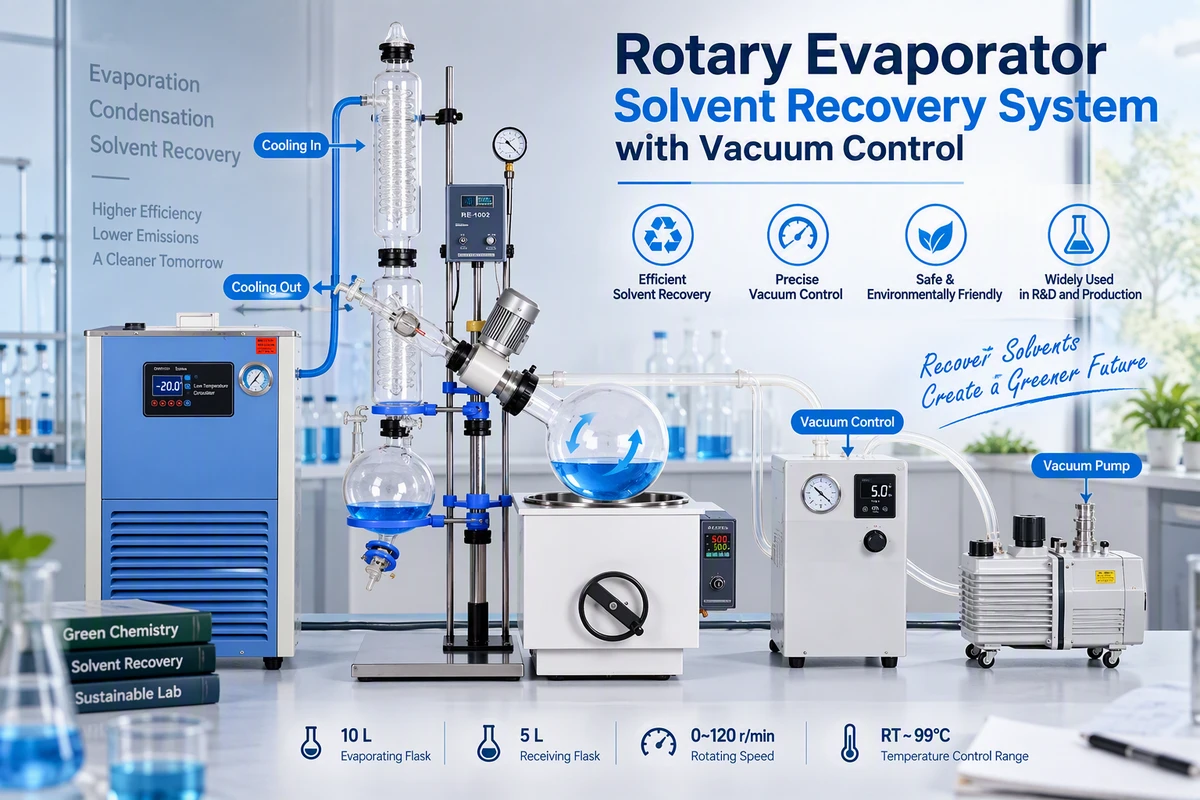
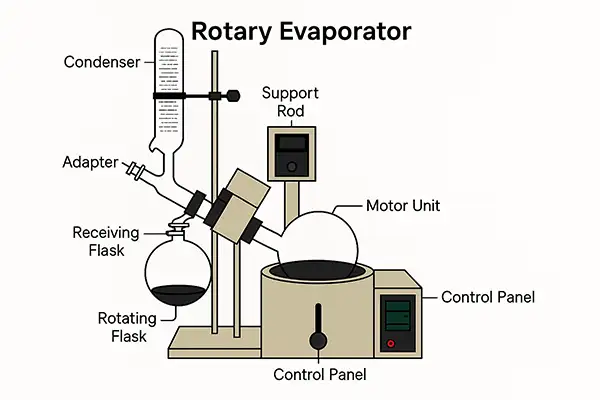
The working principle is straightforward: lower the boiling point of the solvent by using vacuum, heat the mixture gently, and rotate the flask to increase the surface area of the liquid. The solvent evaporates, condenses in a cooled condenser, and is collected for reuse.
Main Components
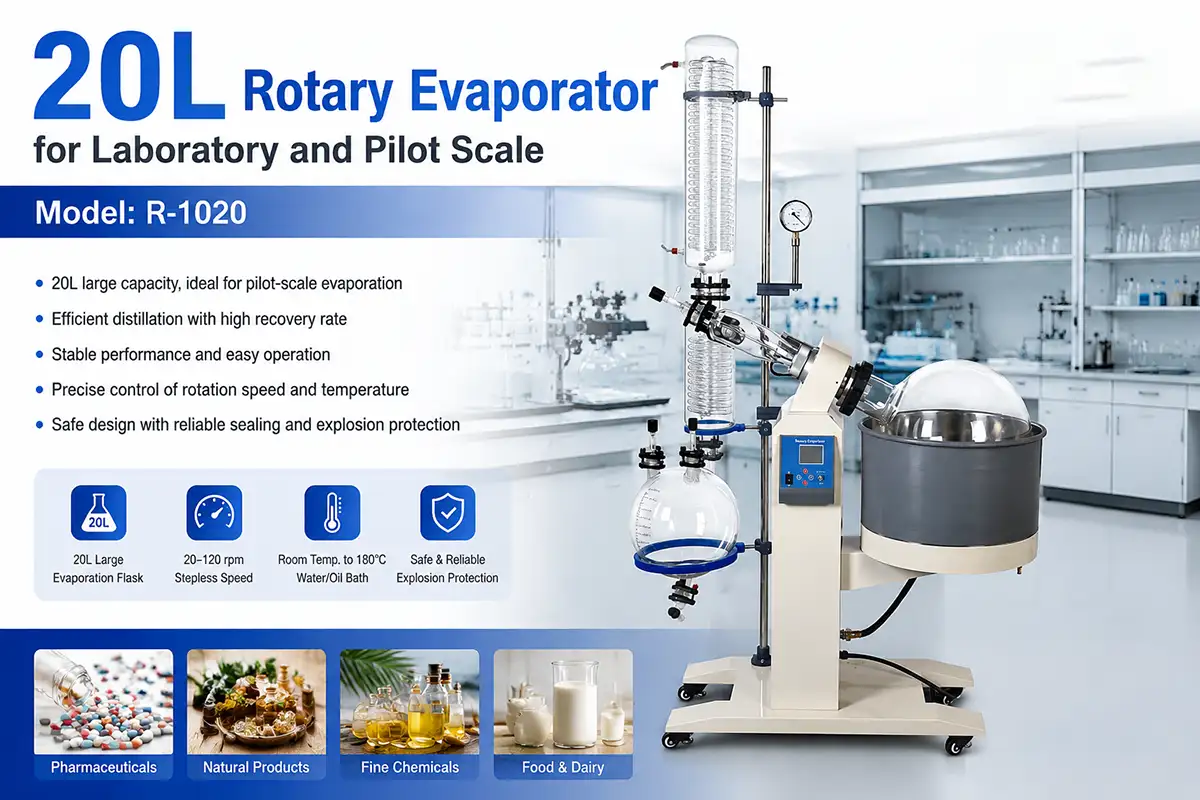
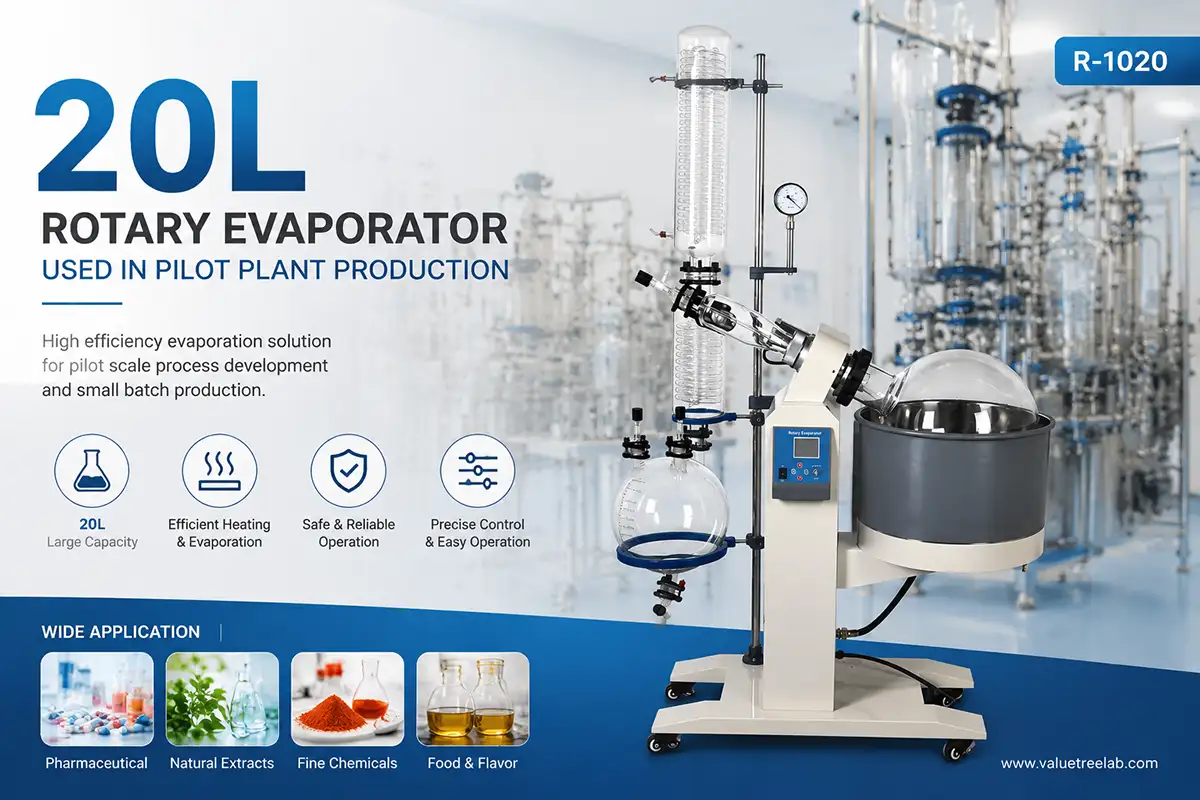
A typical 20L system, such as theR-1020 20L laboratory rotary evaporator, includes:
Rotating flask (20L) – holds the mixture to be concentrated.
Receiving flask (about 10L) – collects the condensed solvent.
Vacuum-tight seal – often PTFE and fluoro rubber, to maintain stable vacuum.
Condenser – usually a vertical double-coil or main + auxiliary condenser for higher efficiency.
Water or oil bath – heats the rotating flask, typically up to 99–250 °C depending on liquid.
Lift mechanism – electric plus hand lift for safe, precise position control.
Vacuum and chiller (external) – provide pressure and temperature control of the system.
Answer: Open boiling needs much higher temperatures, wastes solvent into the air, and may damage sensitive materials. A rotary evaporator operates under vacuum, at lower temperatures, and recovers solvent in a closed system, improving safety, product quality, and cost.
3. Why Choose a 20L Rotary Evaporator Instead of a 5L or 50L?
Many labs start with 2L or 5L models such as theRE-501 5L rotary evaporator, then move up to 10L, 20L, or even 50L. So where does a 20L unit fit?
Typical Use Cases for 20L Size
Pilot trials that are too large for 5L but don’t justify 50L investment
Medium-volume CBD and botanical extract processing
Process development for pharmaceutical or specialty chemical manufacturing
Small commercial production where batches of 5–15 L are frequent
Answer: First, estimate the largest batch volume and preferred turnaround time. For example, if processing 10 L of solvent per batch and the target is to finish within 2–3 hours, a 20L unit is usually sufficient. If needing to handle 30–40 L batches in a single run, a 50L rotary evaporatoror even larger becomes more economical.
4. Core Technical Parameters of a 20L Rotary Evaporator
Below is a simplified view of the R-1020 20L rotary evaporator specification, based on the R-series data set:
| Parameter | R-1020 (20L Rotary Evaporator) |
|---|---|
| Rotating flask volume | 20 L |
| Receiving flask volume | 10 L |
| Main engine speed | 20–120 RPM (brush-less 250 W motor) |
| Condenser | Vertical main condenser + side cold condenser, high-efficiency reflux |
| Bath material & size | Stainless steel, approx. Φ450 × 260 mm |
| Lifting function | Electric + hand lift, about 0–190 mm travel |
| Working power supply | Three phase 220–240 V / 380 V, 60 Hz |
| Total power | Approx. 4 kW |
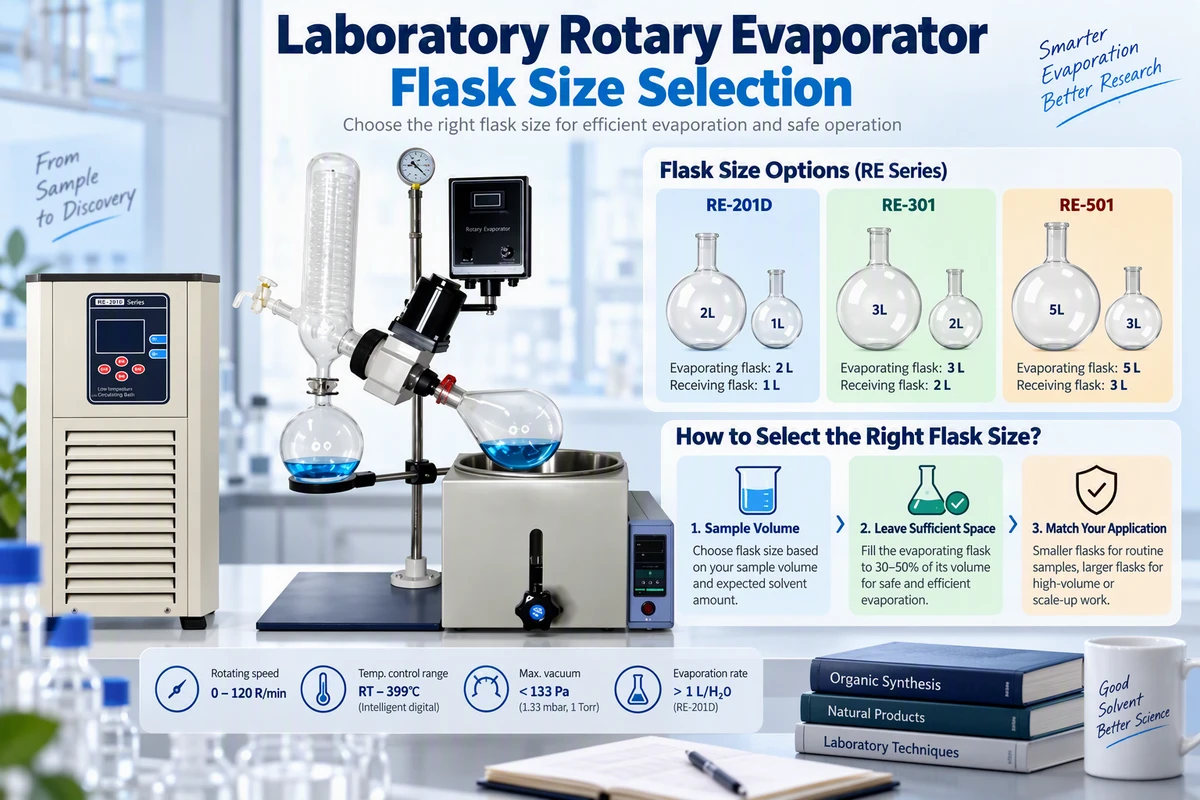
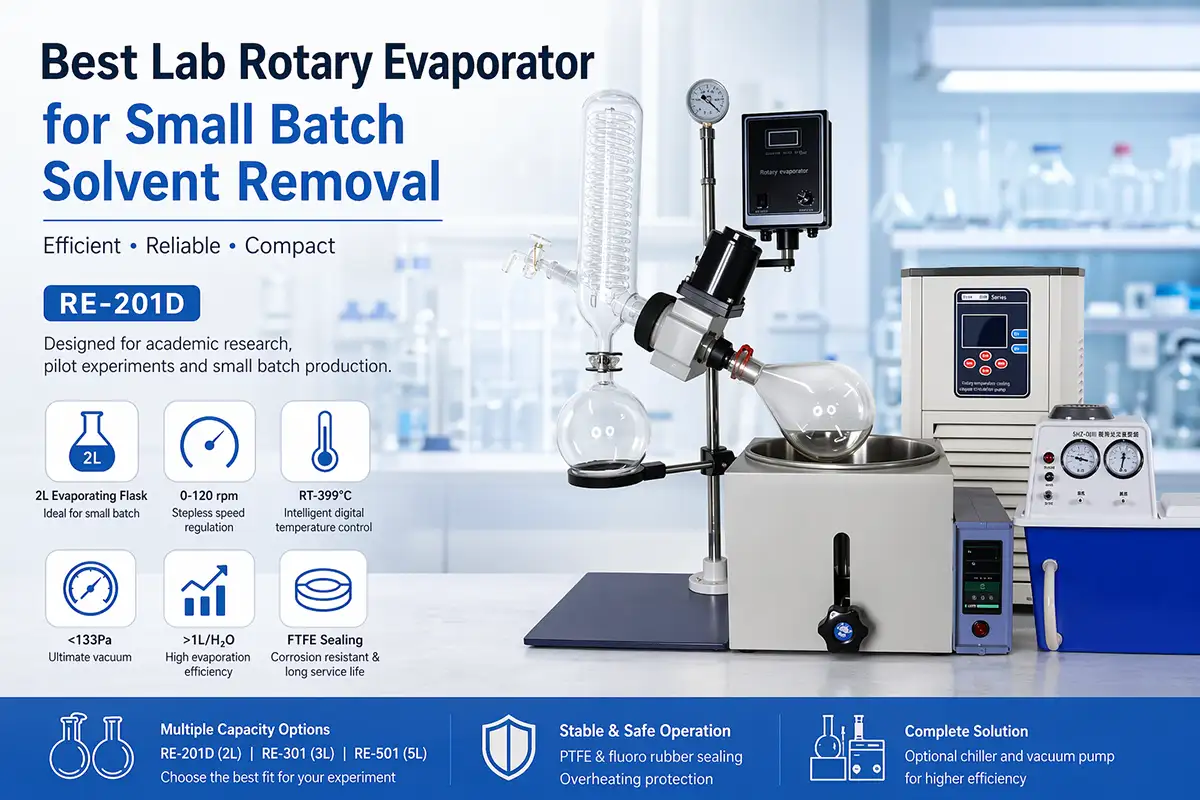
For comparison, smaller models like theRE-201D 2L rotary evaporatoruse a 40 W motor, have a 2L evaporating flask, and lift height around 150 mm, with the water bath power of about 1200 W. This illustrates the jump in both capacity and power when moving to 20L scale.
Industry data published by the European Federation of Chemical Engineering shows that moving from small glassware to pilot-scale equipment (10–50 L) can increase process data reliability by up to 60%, because heat and mass transfer conditions are closer to real production.
5. What Problems Can a 20L Rotary Evaporator Solve?
From a user’s point of view, a 20 liter rotary evaporator is not just a larger flask; it is a tool to solve specific problems in an efficient way.
5.1 Reduce Solvent Costs
Organic solvents like acetonitrile, THF, or high-purity ethanol are expensive. A 20L rotovap allows:
Recovery and reuse of solvents at scale
Less hazardous waste and lower disposal fees
Lower environmental footprint and easier compliance
5.2 Protect Heat-Sensitive Products
Under vacuum, water, alcohol, and many organic solvents boil at far lower temperatures. This is crucial for:
Plant extracts rich in terpenes or polyphenols
Biologically active pharmaceutical intermediates
Food flavors and fragrances that degrade at high temperature
Answer: Yes. A stable deep vacuum (for example <133 Pa as specified on several KD models) allows the same solvent to evaporate at much lower temperatures, which helps keep color, aroma, and activity closer to the original material.
5.3 Shorten Processing Time
Pilot lines often suffer from “evaporation bottlenecks” when small 2L or 5L units cannot keep up with upstream production. With a 20L rotary evaporator and a suitable vacuum pump and chiller:
Large batches can be processed in fewer cycles
Process development studies can be finished faster
The same equipment can serve as a backup to production units
6. How to Choose the Right 20L Rotary Evaporator
When different 20L models look similar on paper, it can be confusing to pick one. In practice, selection can be narrowed down to a few practical questions.
6.1 Solvent Type and Boiling Point
Decide whether the main solvents are water, low-boiling organics (like hexane or ether), or high-boiling ones (like DMSO). This affects:
Bath type (water vs. oil) and maximum temperature
Required condenser cooling capacity and chiller temperature
Recommended vacuum pump type and corrosion resistance
6.2 Target Throughput
Ask internally: how many liters of solvent should be removed per hour or per day? Technical sheets for large units such as the RE-2002 (20L) show evaporation rates >5 L/h (for water) under good vacuum and temperature conditions. Real-world throughput will depend on:
Solvent mixture composition
Operating temperature and vacuum level
Available chiller and pump performance
6.3 Power Supply and Space
A 20L rotary evaporator like the R-1020 typically runs on three phase 220–240V or 380V, with a footprint similar to 1250 × 600 × 2100 mm. Check:
Whether three-phase power is available
Ceiling height and space for installing the condenser
Space for the chiller, vacuum pump, and working aisles around the unit
7. Safety and Maintenance Essentials
At 20L scale, safety and maintenance are more critical than with small benchtop units.
Safety Tips
Always operate under recommended vacuum to avoid implosion and boiling bump
Use appropriate glassware supports and check for cracks before running
Ensure proper grounding of electrical equipment and avoid overloading outlets
Follow solvent-specific safety guidelines (flammability, toxicity, ventilation)
Routine Maintenance
Inspect PTFE and fluoro rubber seals regularly, replace if hardened or cracked
Clean condenser and bath to prevent scale and corrosion
Check vacuum level to detect leaks early
Lubricate mechanical parts if recommended by the rotary evaporator manual
A survey in Journal of Loss Prevention in the Process Industries reported that more than 40% of lab-scale solvent incidents were related to poor maintenance or incorrect pressure/temperature settings, not equipment design faults.
8. When Is the Right Time to Upgrade to a 20L Rotary Evaporator?
Many labs delay the upgrade, thinking the current 5L or 10L system is “just enough”. In practice, a move to a 20 liter rotary evaporator makes sense when:
Rotary evaporators are operating near full capacity every day
Process development is constrained by evaporation speed
Solvent consumption and waste costs are rising significantly
Scale-up trials require conditions closer to plant-level operations
9. Summary: What a 20L Rotary Evaporator Can Do
To summarize, a 20 liter rotary evaporator can:
Handle medium-scale evaporation for labs and pilot plants
Recover valuable solvents and cut running costs
Provide gentle processing for sensitive compounds
Bridge the gap between small-batch research and production-scale equipment
With clear understanding of solvent type, throughput, power conditions, and space, it becomes much easier to determine whether a 20L system like the R-1020 is the right step, or whether a smaller unit (2L, 5L, 10L) or a larger large scale rotary evaporator is better suited.