Best Lab Rotary Evaporator for Small Batch Solvent Removal
The best lab rotary evaporator for small batch solvent removal is not simply the smallest or cheapest unit. It is the model that matches flask volume, evaporation rate, vacuum stability, condenser performance, and daily workload without making the setup harder than the process requires.
Small Batch Solvent Removal Needs Control Before Capacity
Small batch solvent removal usually happens in research labs, teaching labs, formulation rooms, analytical preparation areas, and extraction development workflows. These environments often process limited sample volumes, but they still need consistent evaporation, gentle temperature control, reliable vacuum sealing, and clean solvent collection. A compact rotary evaporator, also called a rotovap, is designed exactly for that balance.
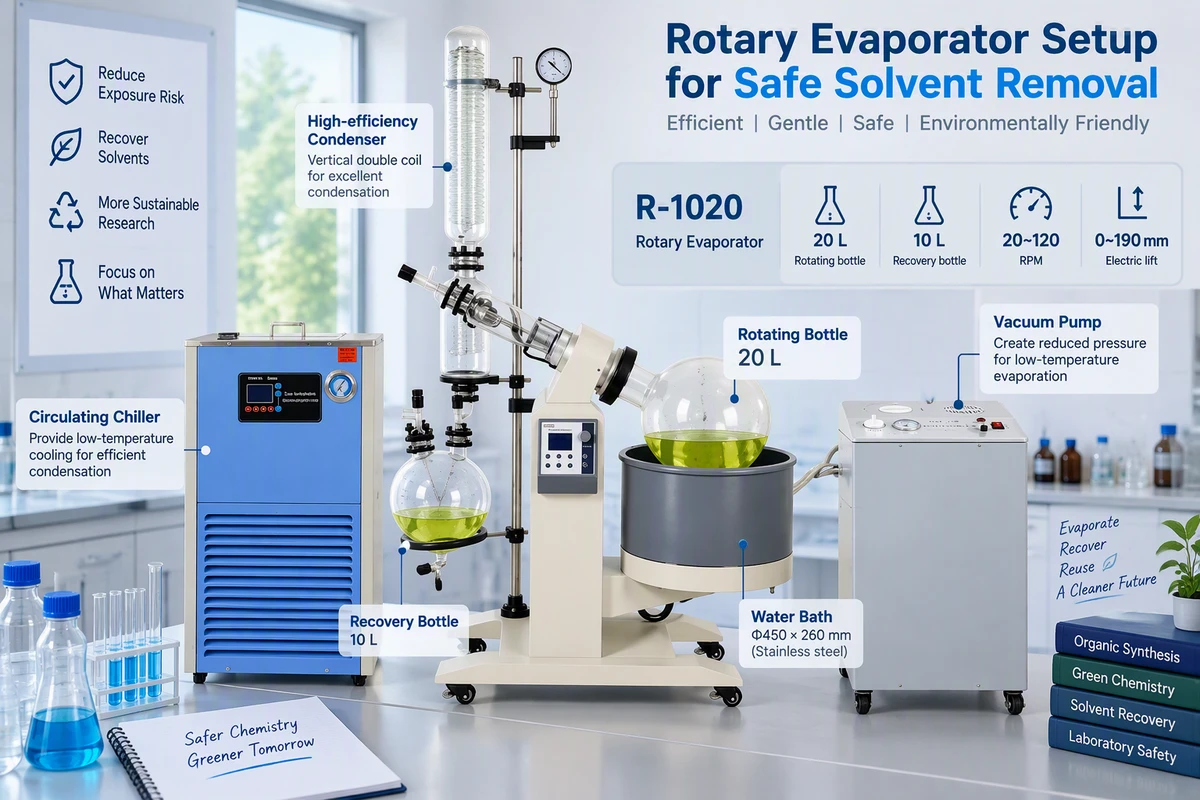
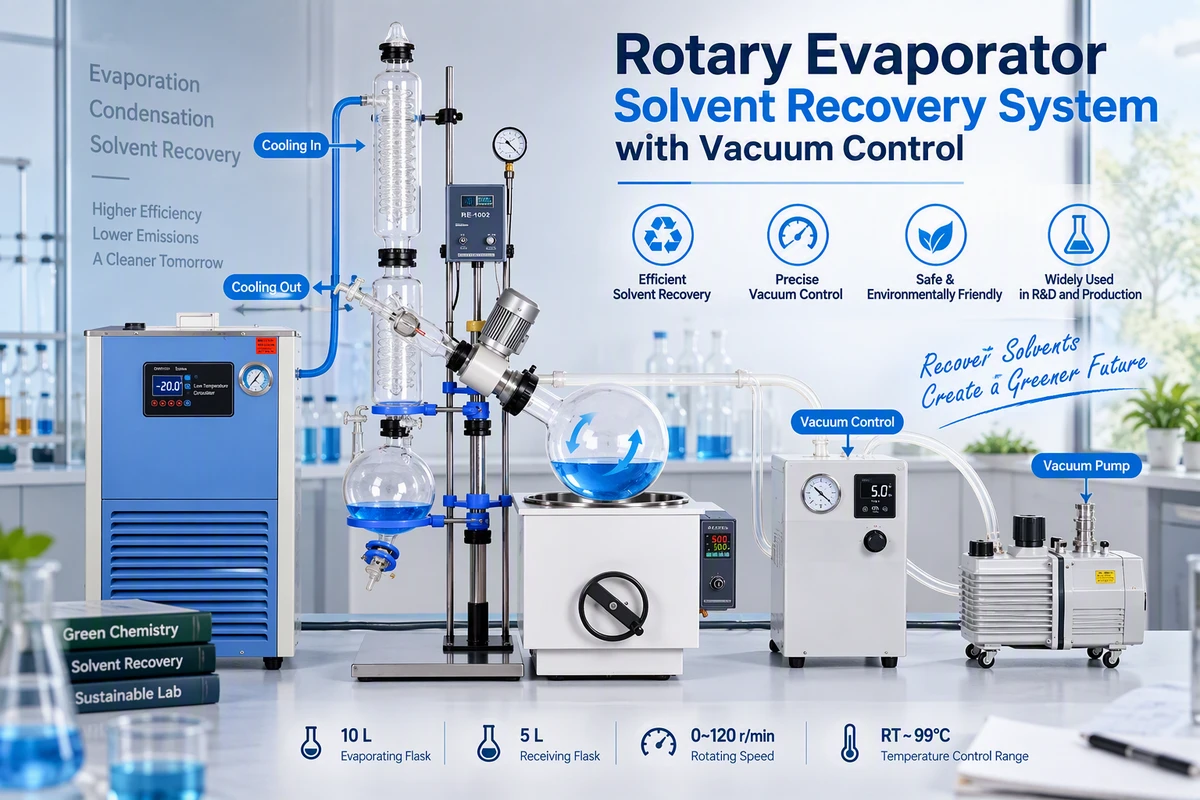
A rotary evaporator removes solvent under reduced pressure while the evaporating flask rotates in a controlled water or oil bath. The rotation spreads liquid into a thin film, the vacuum lowers the solvent boiling point, and the condenser captures vapor back into the receiving flask. For a deeper explanation of the mechanism, KD's guide to rotary evaporator chemistry is a useful related resource.
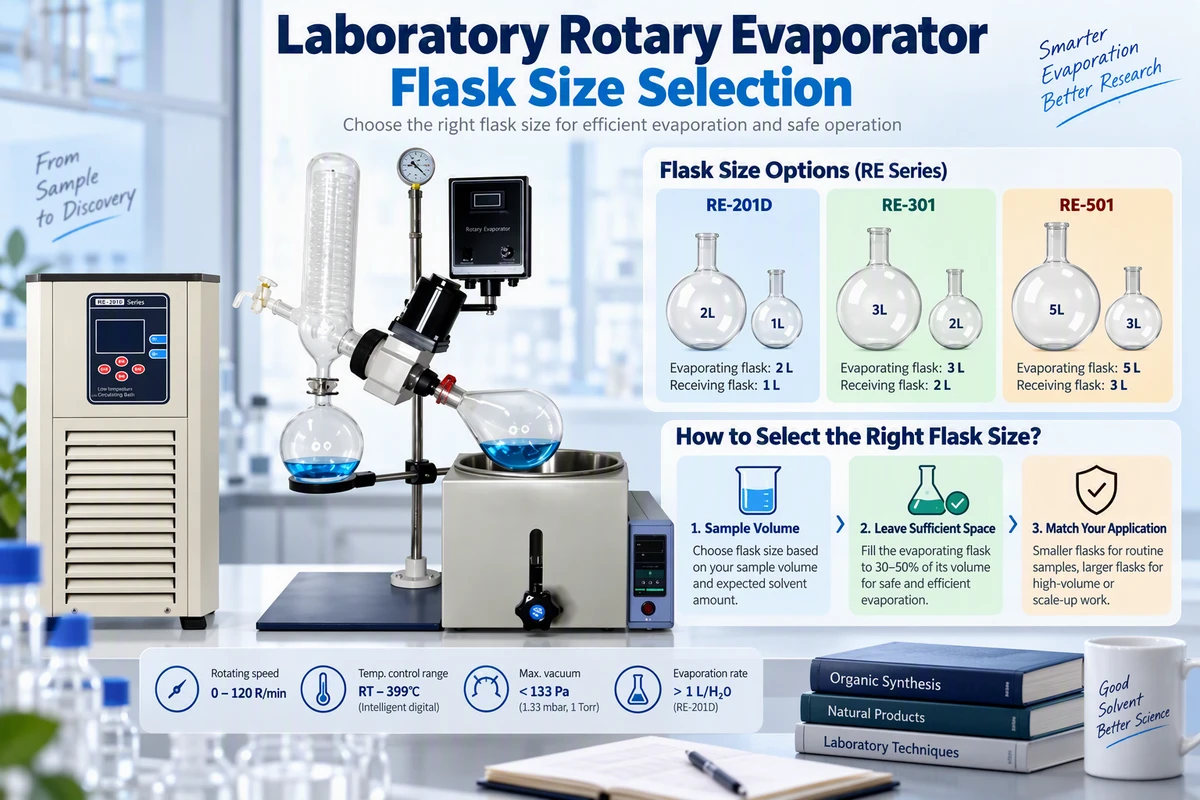
For small batches, the best fit is often a 2L, 3L, or 5L laboratory rotary evaporator. These sizes keep solvent removal efficient without requiring the footprint, glassware weight, bath power, or accessory demand of larger 10L to 50L systems.
Quick Recommendation: RE-201D, RE-301, or RE-501?
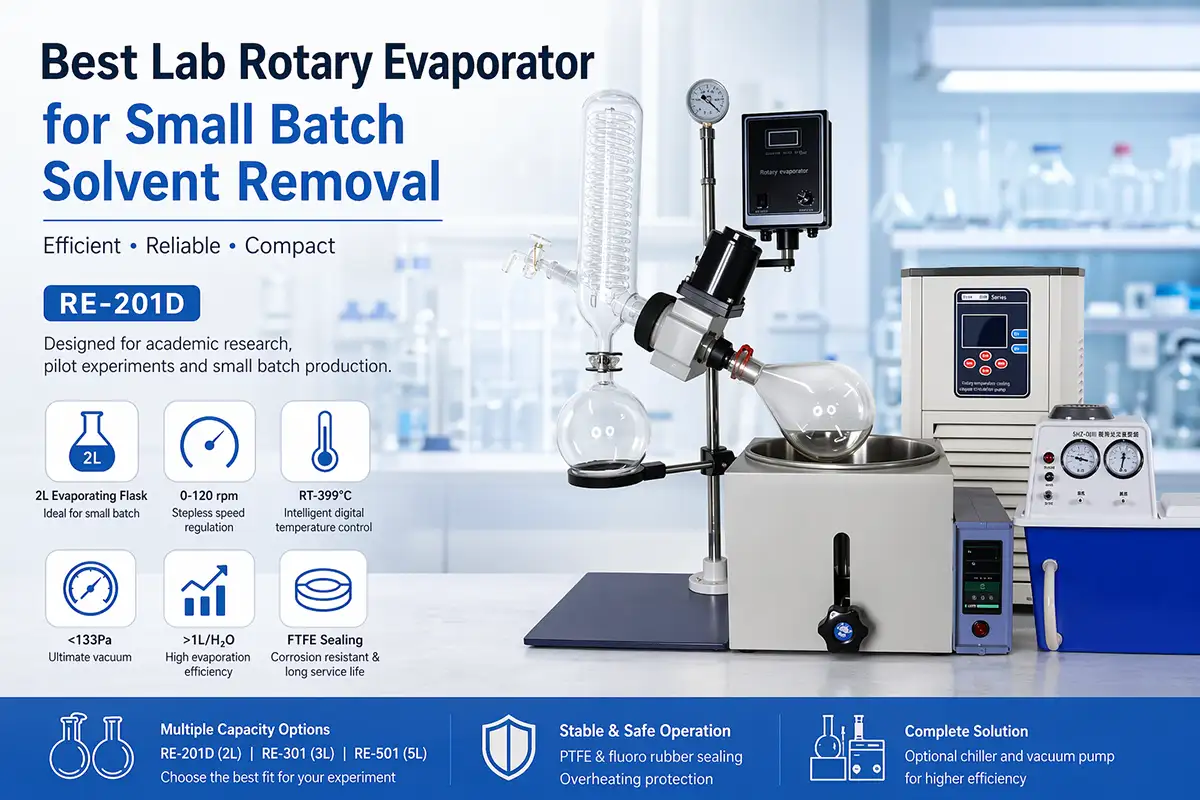
For most small batch solvent removal tasks, the RE-201D is the best entry model when the process is mainly 2L flask work, routine concentration, teaching, or occasional solvent recovery. The RE-301 becomes more comfortable when the working volume increases and a 3L evaporating flask with a 2L receiving flask is more practical. The RE-501 is the stronger small lab choice when 5L flask capacity, a larger receiving flask, and more batch flexibility are required.
RE-201D
Good for small samples, teaching labs, chemical synthesis support, and routine concentration where a 2L evaporating flask is enough.
RE-301
A practical middle choice with 3L evaporating capacity and a 2L receiving flask for slightly higher solvent load.
RE-501
A 5L laboratory rotary evaporator option for users who want more room per cycle without moving into pilot-scale equipment.
From an equipment selection perspective, yes, when sample volume is modest and batch frequency is not heavy. A 2L RE-201D can be a very efficient starting point because it offers controlled heating, 0-120 rpm rotation, and practical evaporation performance without occupying much bench space.
Technical Comparison of Recommended Small Lab Models
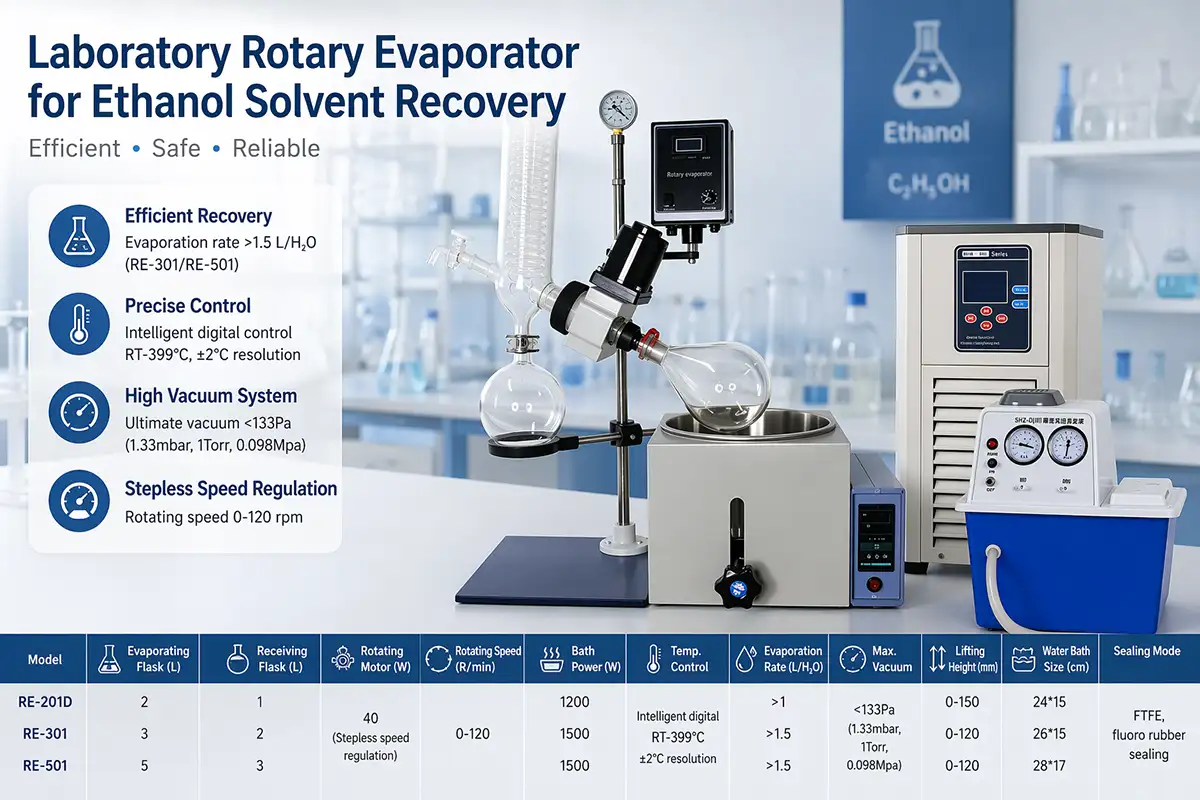
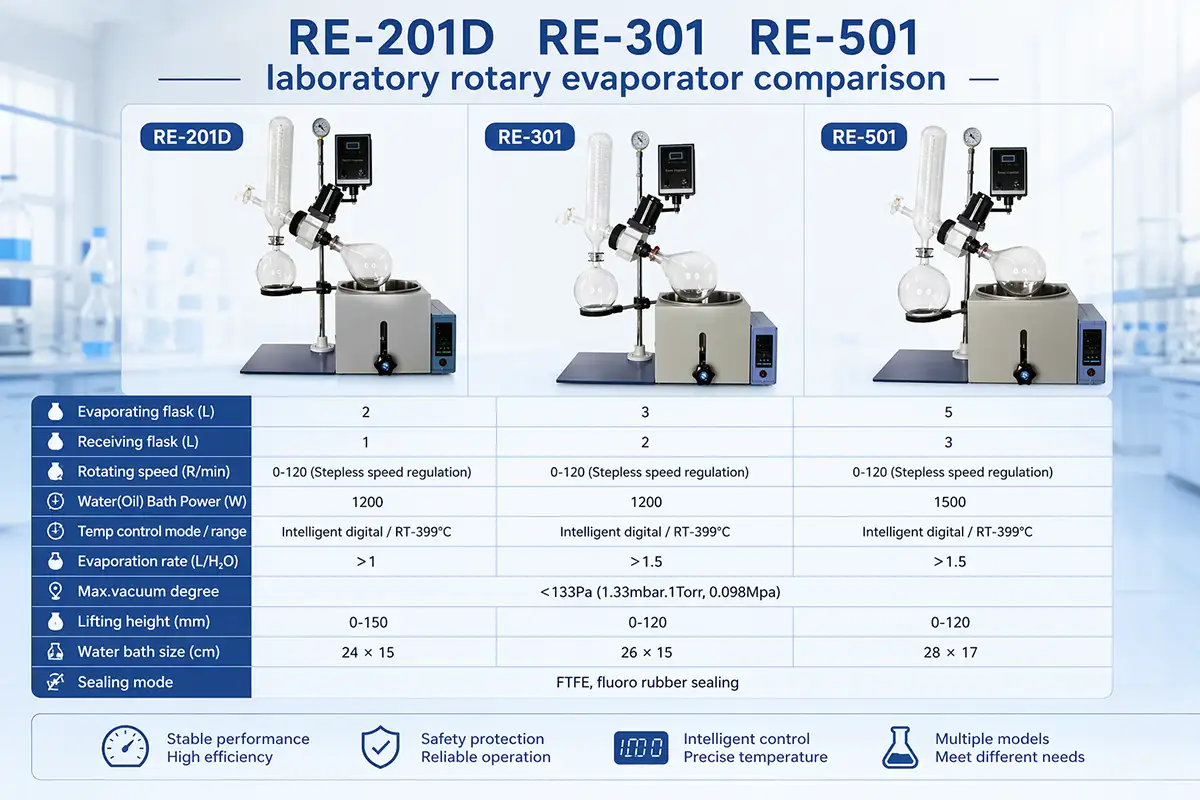
The supplied KD technical parameter sheets show a clear progression from 2L to 5L small laboratory units. The RE-201D, RE-301, and RE-501 share important operating features, including stepless 40W rotation, 0-120 rpm speed control, intelligent digital bath control, PTFE and fluoro rubber sealing, and high vacuum capability below 133Pa under suitable system conditions.
| Model | Evaporating Flask | Receiving Flask | Speed | Bath Power | Evaporation Rate | Best Use |
|---|---|---|---|---|---|---|
| RE-201D | 2L | 1L | 0-120 rpm | 1200W | >1L/h water reference | Compact daily lab solvent removal |
| RE-301 | 3L | 2L | 0-120 rpm | 1500W class | >1.5L/h water reference | Balanced small batch concentration |
| RE-501 | 5L | 3L | 0-120 rpm | 1500W class | >1.5L/h water reference | 5L lab batches and more working headroom |
| R1005 | 5L | 3L | 10-140 rpm | 2kW whole power | Application dependent | 5L electric lift rotary evaporation |
For a small lab, the most important specification is not only flask size. Vacuum degree, bath control, condenser surface, sealing material, and lift height all affect usability. A compact system that reaches the needed vacuum and condenses vapor effectively will often outperform a larger unit that is poorly matched with its pump or cooling source.
How to Choose the Best Lab Rotary Evaporator
A useful selection process starts with batch volume, then moves to solvent type, heat sensitivity, recovery target, and accessory matching. For volatile solvents, stable vacuum and cooling capacity can matter more than bath power alone. For higher boiling solvents, oil bath capability and temperature control range become more important.
Match flask size to real working volume. A rotary flask should not be filled to its maximum rated volume during evaporation. A 2L flask is suitable for smaller working loads, while 3L and 5L models provide more comfortable headroom.
Evaluate condenser performance. Efficient condensation improves solvent recovery and helps protect the vacuum pump from vapor exposure.
Check vacuum compatibility. The small RE series is specified with a maximum vacuum degree below 133Pa under appropriate conditions, which supports low-temperature solvent removal.
Think about batch frequency. Occasional use may favor RE-201D. Repeated daily use with larger sample volumes may justify RE-301, RE-501, or a 5L electric lift configuration.
Plan the complete system. A rotary evaporator performs best with a suitable vacuum pump, cooling circulation, tubing, clamps, and glassware selected together.
A 5L unit becomes the better choice when solvent removal starts to slow the workflow, when larger receiving capacity reduces interruptions, or when the same process is repeated many times per day. In that situation, RE-501 or the R1005 class gives more working room while still staying in the laboratory-scale category.
Practical operation also matters. Before starting, the bath should be warmed to a suitable set point, the condenser should be cooled, the flask should rotate smoothly, and vacuum should be applied gradually to avoid bumping. For operating details, the related KD guide on how to use a rotovap gives a clear step-by-step reference.
Best Applications for Small Batch Rotary Evaporation
Compact lab rotary evaporators are especially useful when the process requires gentle evaporation rather than aggressive boiling. The combination of vacuum, rotation, heating, and condensation makes solvent removal faster and more repeatable than open-vessel evaporation.
Chemical synthesis workup: removing reaction solvents after synthesis, purification, or solvent exchange.
Sample concentration: concentrating extracts, fractions, and analytical samples before further testing.
Ethanol recovery: reclaiming ethanol from small extraction batches when condenser cooling and vacuum are correctly matched.
Teaching and demonstration: showing rotary evaporation principles in university and training laboratories.
Formulation development: removing solvents while reducing thermal stress on sensitive compounds.
Ethanol workflows are common because ethanol is widely used in botanical extraction, product development, and laboratory purification. For this solvent-specific application, the KD ethanol rotary evaporator guide adds more process context.
Small Lab Rotary Evaporator Price Guidance
Price should be read together with configuration. A low base price can be attractive, but final value depends on glassware size, lift type, sealing quality, condenser design, voltage, accessories, and whether the offer includes a vacuum pump or chiller. Based on the supplied product price sheet, when a model has multiple listed prices, the middle lower value is selected.
| Product Reference | Price Used | How the Price Was Selected | Buyer Note |
|---|---|---|---|
| RE-201D | $600 | Multiple listed prices appeared from $480 to $655; the middle lower reference is $600. | Best value for compact 2L small batch solvent removal. |
| RE-301 | $800 | One RE-301 listing was provided in the price sheet. | Balanced 3L lab size when more receiving capacity is useful. |
| RE-501 | $780 | Listed RE-501 prices included $760, $780, and $956; the middle value is $780. | Strong 5L small batch option with more process headroom. |
| 5L lab set | $1,699 | 5L rotary evaporator set references clustered around the upper small-lab range. | Useful reference for electric-lift or fuller 5L system configurations. |
Not usually. From a buyer-focused technical view, value comes from matching the rotary evaporator to the real solvent load. A slightly higher model price can be justified when it improves condenser efficiency, batch capacity, lift convenience, vacuum stability, or daily throughput.
Final Verdict: Best Lab Rotary Evaporator for Small Batch Work
The best all-around choice for small batch solvent removal depends on how the laboratory defines "small." For occasional or lower-volume work, RE-201D is the most economical compact recommendation. It offers 2L evaporating capacity, 1L receiving capacity, stepless rotation, digital temperature control, and strong vacuum compatibility in a bench-friendly format.
For laboratories that need a little more breathing room, RE-301 is a balanced upgrade. It keeps the system manageable while increasing evaporating and receiving volume. For users who expect frequent solvent recovery, larger extracts, or fewer batch interruptions, RE-501 is the better long-term small batch choice because the 5L flask and 3L receiving flask provide more practical capacity.
The R1005 class is worth considering when a 5L rotary evaporator with electric lift and a vertical double coil condenser is preferred. It expands convenience and control while staying far below the footprint and complexity of 10L, 20L, or 50L systems.
Buying Checklist Before Requesting a Quote
A better quotation starts with clear process information. Before comparing models, define the solvent, approximate batch volume, target recovery rate, heating limit, available voltage, and whether the system should include a vacuum pump and chiller.
Solvent name and approximate boiling point under normal pressure.
Typical liquid load per batch and expected batches per day.
Required flask size: 2L, 3L, 5L, or electric-lift 5L class.
Preferred bath medium: water or oil, depending on temperature requirement.
Cooling source for condenser: tap water, recirculating chiller, or low-temperature circulator.
Vacuum pump compatibility and vapor protection requirements.
Local voltage, frequency, plug standard, and any compliance preference.
Conclusion
For a laboratory focused on small batch solvent removal, the most practical buying path is to start with process volume and then choose the smallest rotary evaporator that can handle that workload comfortably. RE-201D is the compact value choice, RE-301 is the balanced middle option, and RE-501 is the strongest recommendation when 5L capacity will save time across repeated runs.
With the right vacuum pump, condenser cooling, bath control, and glassware size, a KD lab rotary evaporator can turn solvent removal from a slow bottleneck into a controlled, repeatable, and efficient workflow.
Explore KD Rotary Evaporators