Rotovap for Sale: How to Choose the Right Rotary Evaporator for Reliable Solvent Recovery
Finding the right rotovap for sale is not only about price. In real laboratory and pilot-scale work, the best rotary evaporator is the one that matches solvent volume, evaporation speed, vacuum conditions, bath temperature range, and daily operating intensity. A well-matched system improves recovery efficiency, protects heat-sensitive samples, and reduces wasted downtime.
Why a Rotary Evaporator Is Still a Smart Investment
A rotary evaporator remains one of the most efficient tools for solvent removal, concentration, recovery, and purification. It is widely used in chemistry laboratories, pharmaceutical research, botanical extraction, fine chemical processing, and university teaching labs. Compared with open heating methods, rotary evaporation offers lower boiling points under vacuum, more uniform thin-film evaporation, and far better control over temperature-sensitive materials.
For buyers comparing a rotovap for sale, the real decision usually comes down to whether the unit can support routine throughput without sacrificing process control. Small laboratories may focus on compact benchtop models, while pilot-scale users often need higher evaporation rates, larger receiving flasks, and stronger lifting structures.
Benchtop rotary evaporator setup for routine solvent evaporation.
If deeper background is useful, readers exploring process fundamentals may also want to review rotary evaporator chemistry explained for supporting theory behind evaporation under reduced pressure.
Key Features to Compare When Evaluating a Rotovap for Sale
Product listings often look similar at first glance, but performance differences become obvious after installation. The following points deserve close comparison before purchasing.
Evaporating Flask Capacity
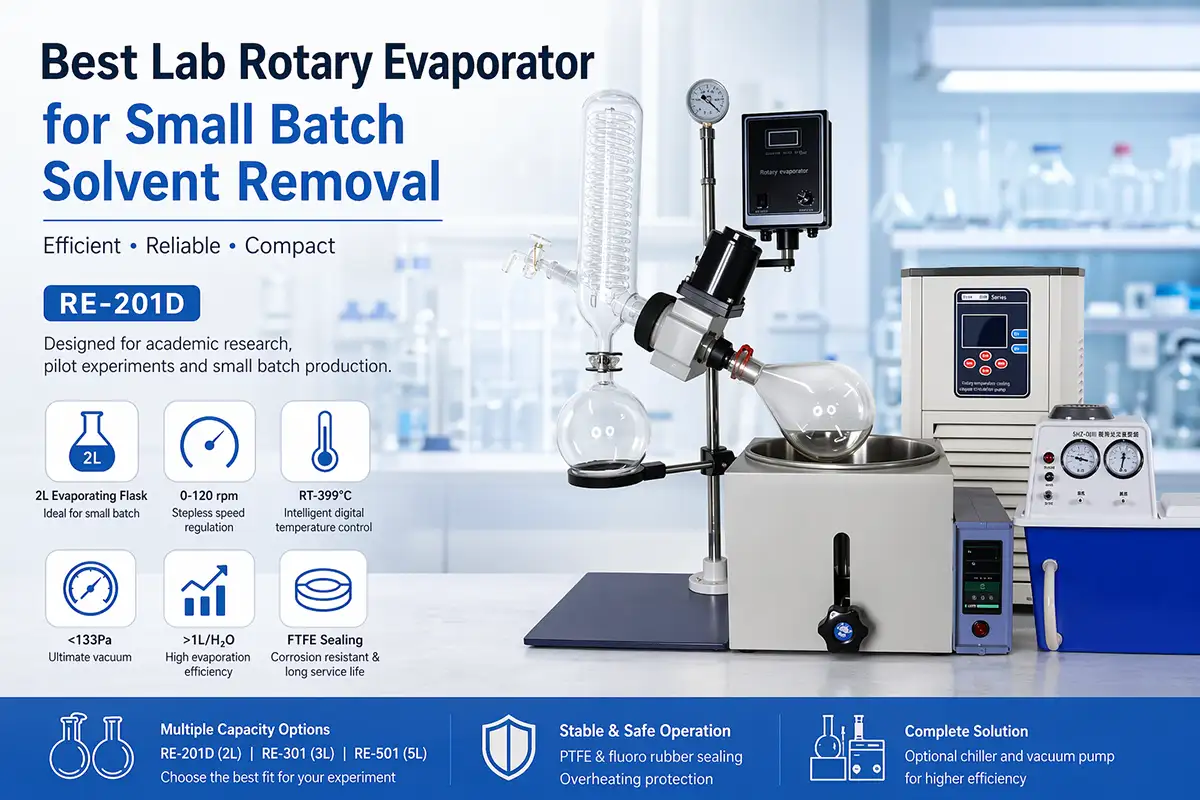
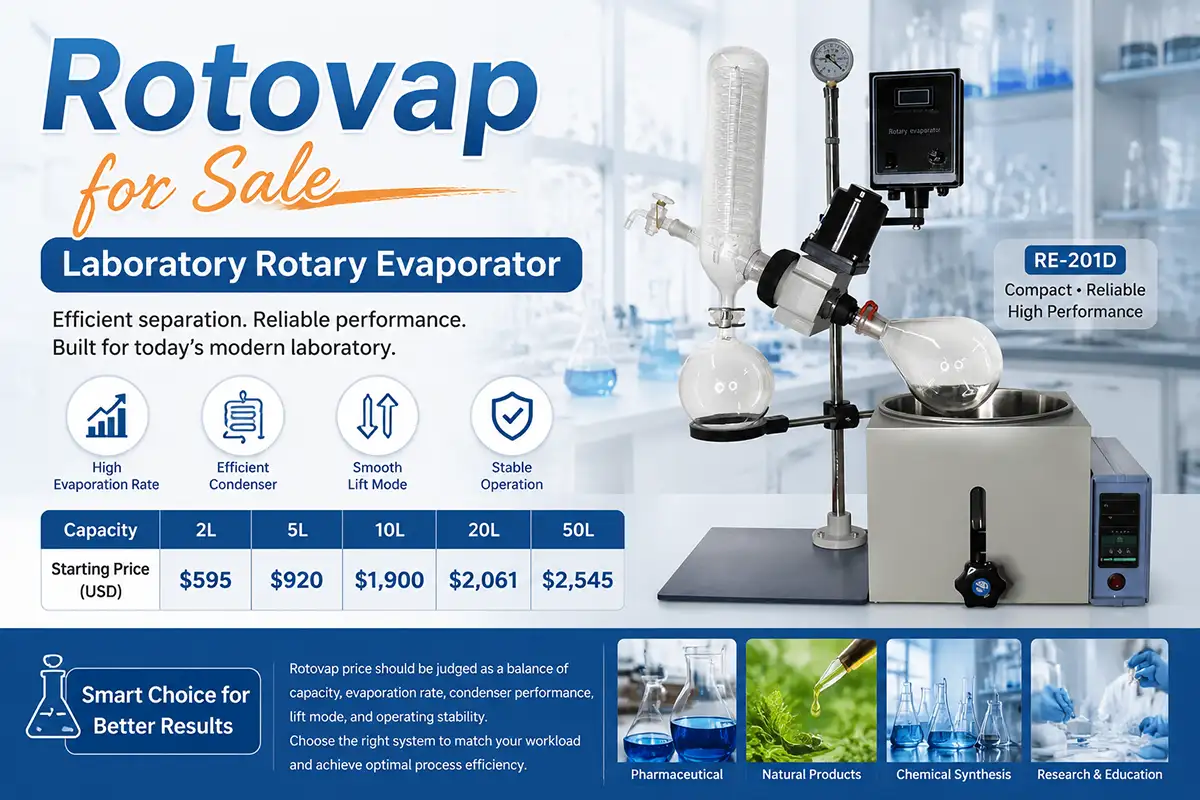
Capacity directly affects batch size and processing rhythm. Standard options commonly include 2L, 3L, 5L, 10L, 20L, and 50L. Smaller systems suit daily analytical or research tasks, while larger units support pilot production and solvent recycling.
Evaporation Rate
Evaporation rate indicates how quickly water-equivalent solvent can be removed. Entry models in this range achieve over 1L/h, while larger systems can exceed 9L/h. For high-throughput applications, this specification is often more important than headline flask size alone.
Vacuum Performance
Maximum vacuum degree affects the boiling point reduction and process gentleness. Units rated below 133Pa provide strong support for low-temperature evaporation and are helpful when handling thermally sensitive compounds.
Rotation Speed and Motor Power
Steady rotation forms a thin liquid film across the flask wall, improving heat transfer and minimizing bumping. Depending on model family, speeds range from 0-120 rpm, 0-90 rpm, or 10-140 rpm, supported by motors from 40W up to brushless 250W configurations.
Bath Power and Temperature Range
Bath performance determines how fast heat is transferred to the sample. Smaller units use 1200W to 1500W baths, while 10L to 50L systems reach 3000W to 9000W. Temperature control ranges span from room temperature up to 99°C, 250°C, or even 399°C depending on bath type and model design.
Condenser and Sealing Structure
Efficient condensers improve solvent recovery and reduce vapor loss. PTFE and fluoro rubber sealing are common, while vertical double condensers or high-efficiency reflux condensers offer stronger condensation performance for larger systems.
Is Bigger Always Better?
Does a larger rotary evaporator always create better value for a buyer searching for a rotovap for sale?
Not necessarily. From an equipment selection perspective, oversized systems can increase energy consumption, footprint, installation demands, and cleaning time. If normal batches stay below a few liters, a 2L to 5L model may deliver better cost efficiency and easier day-to-day handling. Larger 10L to 50L systems are most valuable when throughput, solvent recovery volume, and scaling requirements justify them.
Rotovap Model Range Overview
Based on the supplied technical parameters, the following model groups cover compact research work through large-scale evaporation. The table below is arranged for easy comparison. On mobile devices, it can be scrolled horizontally for better readability.
| Model | Evaporating Flask | Receiving Flask | Rotation Speed | Motor Power | Bath Power | Temp Range | Evaporation Rate | Lifting |
|---|---|---|---|---|---|---|---|---|
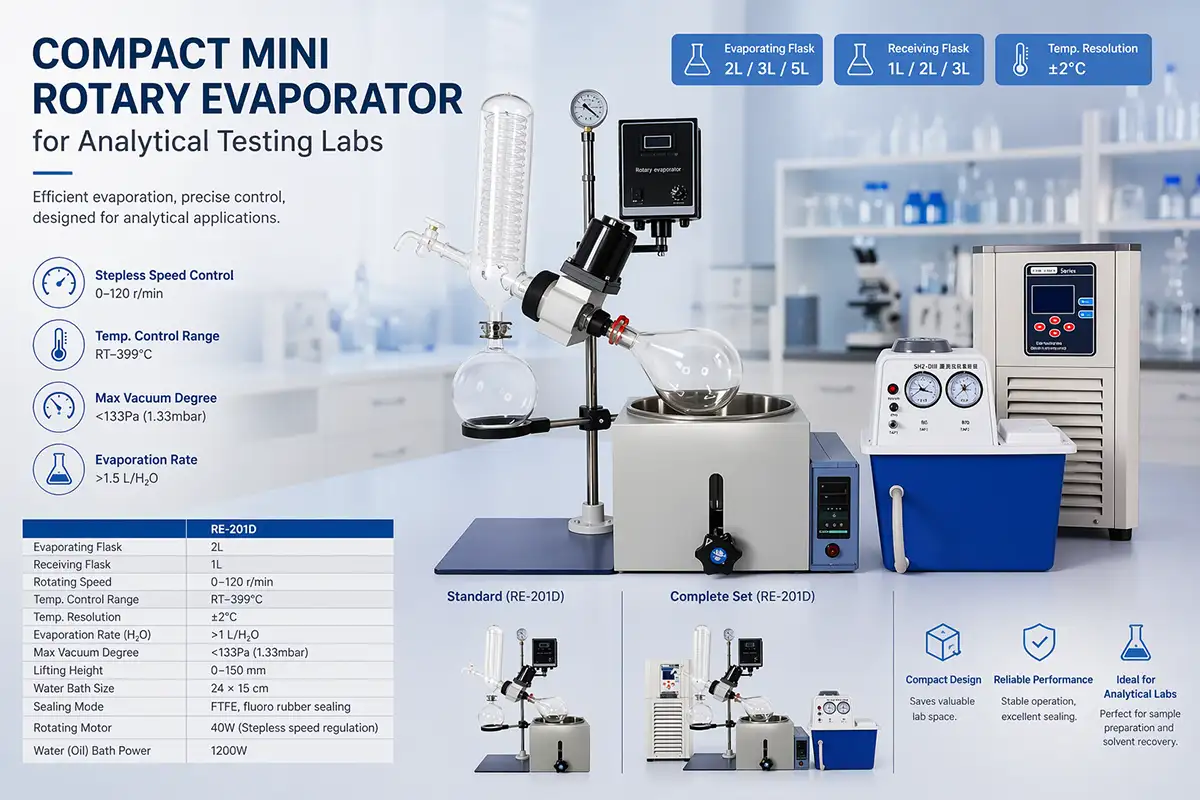
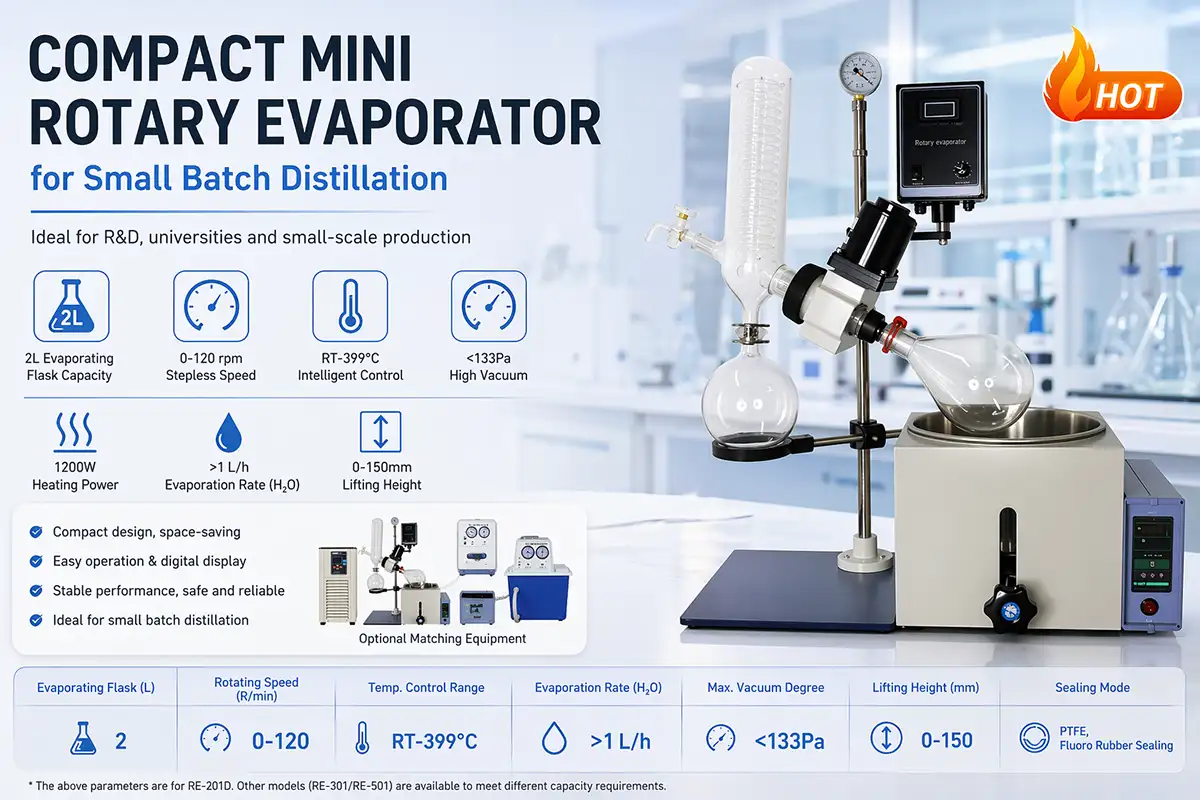
| RE-201D | 2L | 1L | 0-120 rpm | 40W | 1200W | RT-399℃ | >1L/h (H₂O) | 0-150 mm |
| RE-301 | 3L | 2L | 0-120 rpm | 40W | 1500W | RT-399℃ | >1.5L/h (H₂O) | 0-120 mm |
| RE-501 | 5L | 3L | 0-120 rpm | 40W | 1500W | RT-399℃ | >1.5L/h (H₂O) | 0-120 mm |
| RE-1002 | 10L | 5L | 0-120 rpm | 180W | 3000W | RT-99(250)℃ | >3L/h (H₂O) | 0-220 mm |
| RE-2002 | 20L | 10L | 0-90 rpm | 250W | 5000W | RT-99(250)℃ | >5L/h (H₂O) | 0-220 mm |
| RE-5002 | 50L | 20L | 0-90 rpm | 250W | 7000W/9000W | RT-99(250)℃ | >9L/h (H₂O) | 0-220 mm |
| R1005 | 5L | 3L | 10-140 rpm | 40W | 2KW total | Application-based | — | Electric 0-150 mm |
| R1010 / R1020 / R1050 | 10L / 20L / 50L | 5L / 10L / 20L | 20-120 rpm | Brushless 250W | 3-4KW total | Application-based | — | Electric + hand lift |
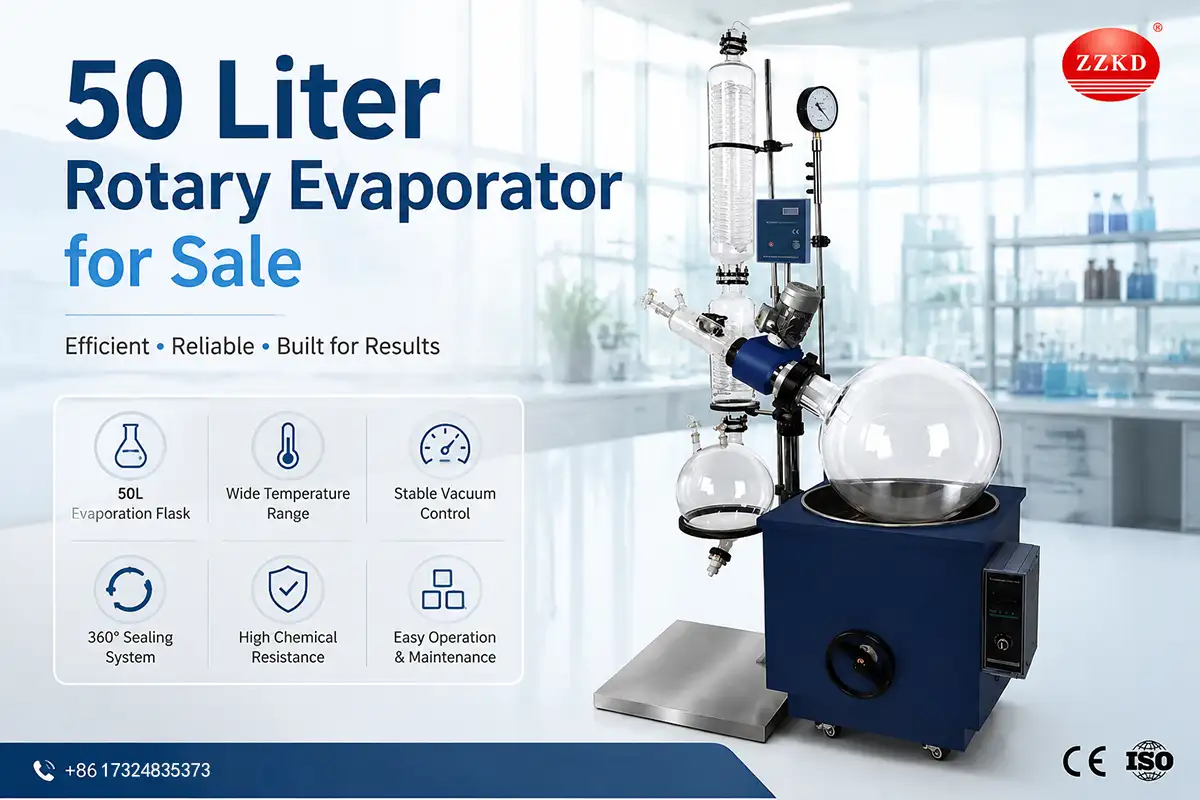
Large-capacity rotary evaporator for pilot and production environments.
Buyers specifically comparing larger systems may also find it helpful to review the 50 liter rotary evaporator product page for more application-focused equipment details.
How to Select the Best Rotovap for Sale by Application
For University and Research Labs
Compact 2L, 3L, and 5L models are usually the most practical. They require less bench space, are easier to operate, and fit routine solvent recovery, sample concentration, and teaching demonstrations. Models such as RE-201D, RE-301, and RE-501 are often strong entry choices.
For Pharmaceutical and Chemical Development
10L and 20L units are often preferred for scale-up studies, intermediate recovery, and pilot validation. Greater evaporation rates and stronger motor systems make these models more suitable for repeated daily operation and larger solvent loads.
For Botanical Extraction and Solvent Recycling
20L and 50L systems are more appropriate when ethanol recovery volume is high or production continuity matters. In these environments, condenser efficiency, seal durability, and bath power become critical purchase criteria.
Users comparing workflow basics may also benefit from reading how to use a rotovap to better understand the relationship between rotation, vacuum, heating, and condensation during real operation.
What Specifications Matter Most in Daily Performance?
Which parameter should receive the most attention when comparing a rotovap for sale: flask size, motor power, or evaporation rate?
In most real purchasing situations, evaporation rate and application fit deserve the most attention. Flask size shows nominal capacity, but throughput depends on the combined effect of vacuum, bath power, condenser efficiency, and rotation stability. A well-balanced 10L unit may outperform an oversized but poorly matched system in actual production rhythm.
Important Buying Checklist Before Ordering
Solvent Type
Check whether the machine will mainly handle ethanol, methanol, acetone, water, or mixed solvents. Different solvents place different demands on vacuum level and condenser efficiency.
Daily Batch Volume
Estimate realistic batch size and total daily evaporation volume, not only occasional peak use. This prevents under-specification or costly oversizing.
Utility Conditions
Confirm voltage requirements such as 220V/50Hz or 380V/50Hz, as well as cooling water, vacuum pump compatibility, and available installation space.
Lifting Preference
Small units may use straightforward lift designs, while larger systems often benefit from electric or combined electric-plus-manual lifting for safer positioning.
Maintenance and Seals
PTFE and fluoro rubber sealing systems are common for chemical resistance. Seal quality matters for vacuum retention, service life, and routine maintenance cost.
Expansion Planning
If future scale-up is likely, selecting a model family with larger upgrade paths can simplify training, spare parts sourcing, and long-term process consistency.
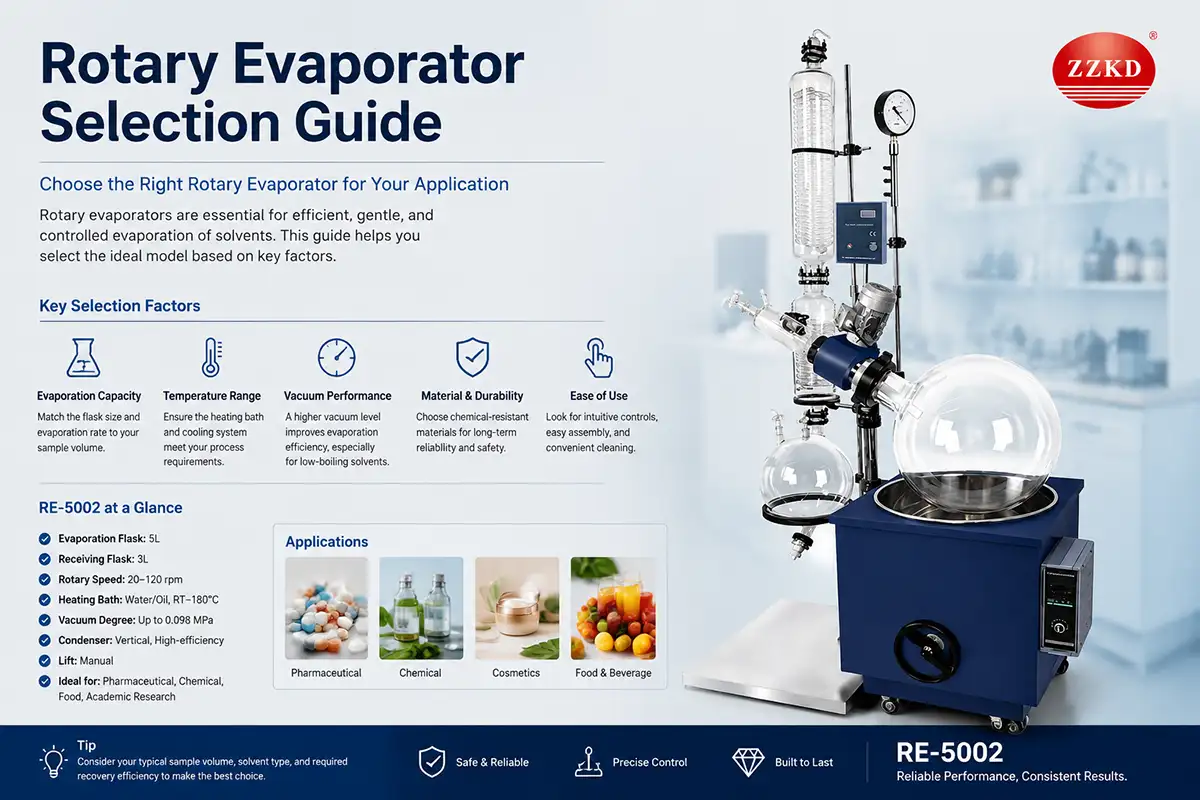
Comparing rotary evaporator specifications before purchase.
Another Common Buyer Question
Can a benchtop unit still be a good choice when future demand may increase?
Yes, if current throughput is low and process validation is still developing. Starting with a 5L or 10L system can be an efficient way to establish evaporation parameters, solvent behavior, and operator routine. Once demand becomes stable, scaling to 20L or 50L equipment is usually more informed and less risky.
Final Thoughts on Choosing a Rotovap for Sale
A successful purchase starts with matching equipment size and design to actual process needs. For basic laboratory work, compact 2L to 5L systems are often enough. For pilot and process development, 10L and 20L units bring stronger productivity. For large-scale solvent recovery and continuous workload, 50L systems offer the greatest throughput potential.
When comparing any rotovap for sale, focus on evaporation efficiency, vacuum compatibility, heating stability, condenser structure, lifting convenience, and long-term operating reliability. That combination—not price alone—is what determines whether the machine becomes a dependable production asset.
Looking for the Right Rotary Evaporator Configuration?
From compact research systems to large-capacity solvent recovery equipment, the best configuration depends on volume, solvent type, temperature sensitivity, and target evaporation speed.
Choose from 2L, 3L, 5L, 10L, 20L, and 50L formats
Compare bath power, condenser type, lifting mode, and sealing structure
Match the equipment to laboratory, pilot, or production requirements