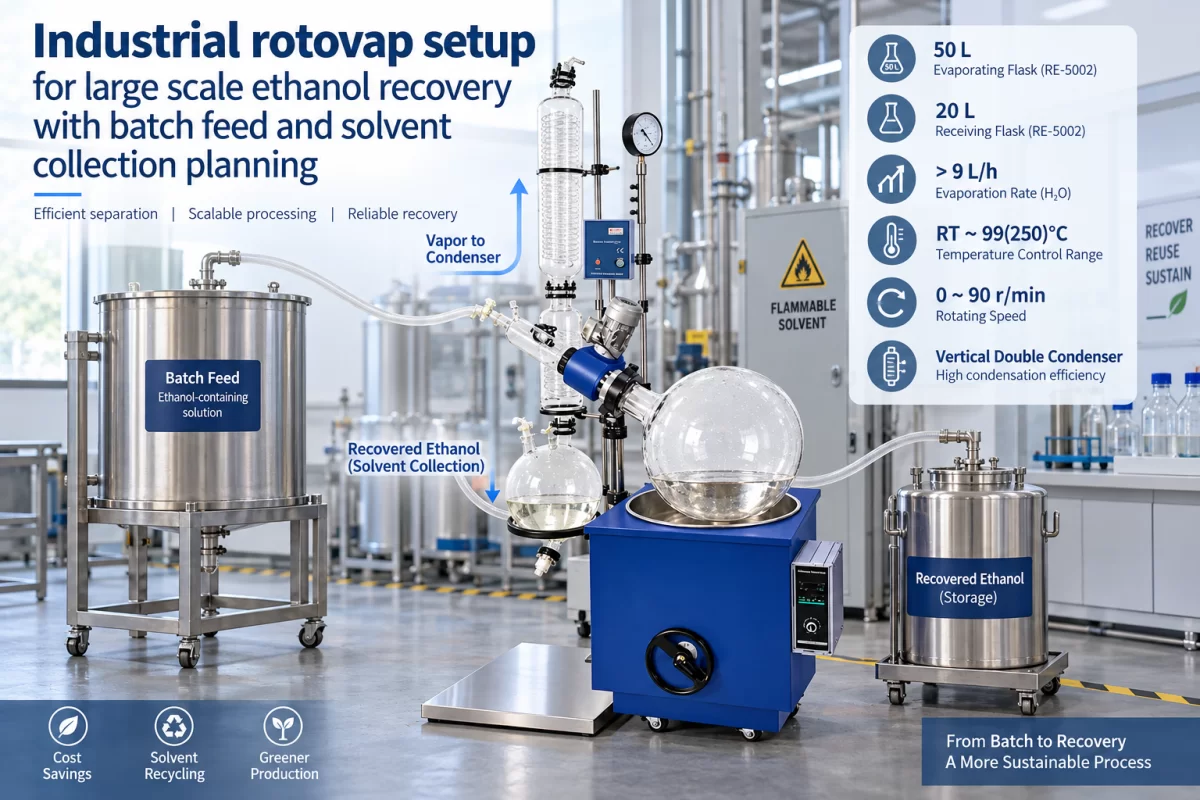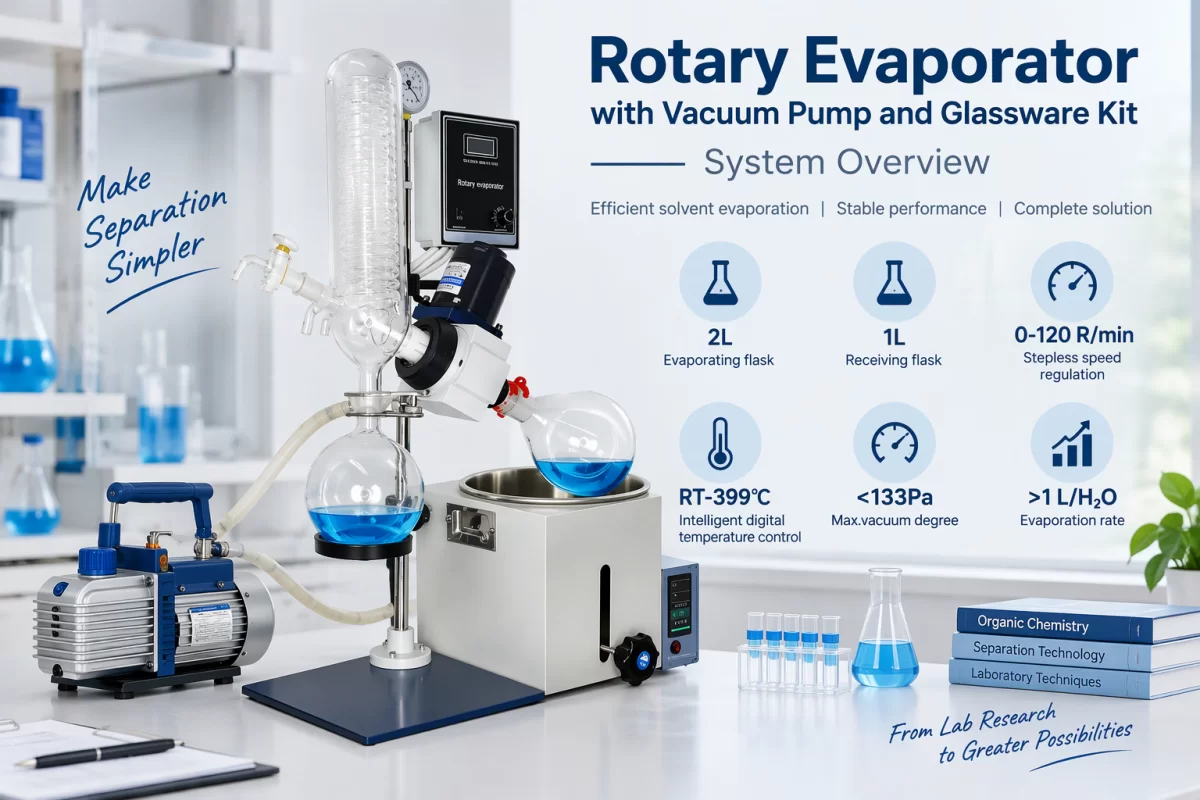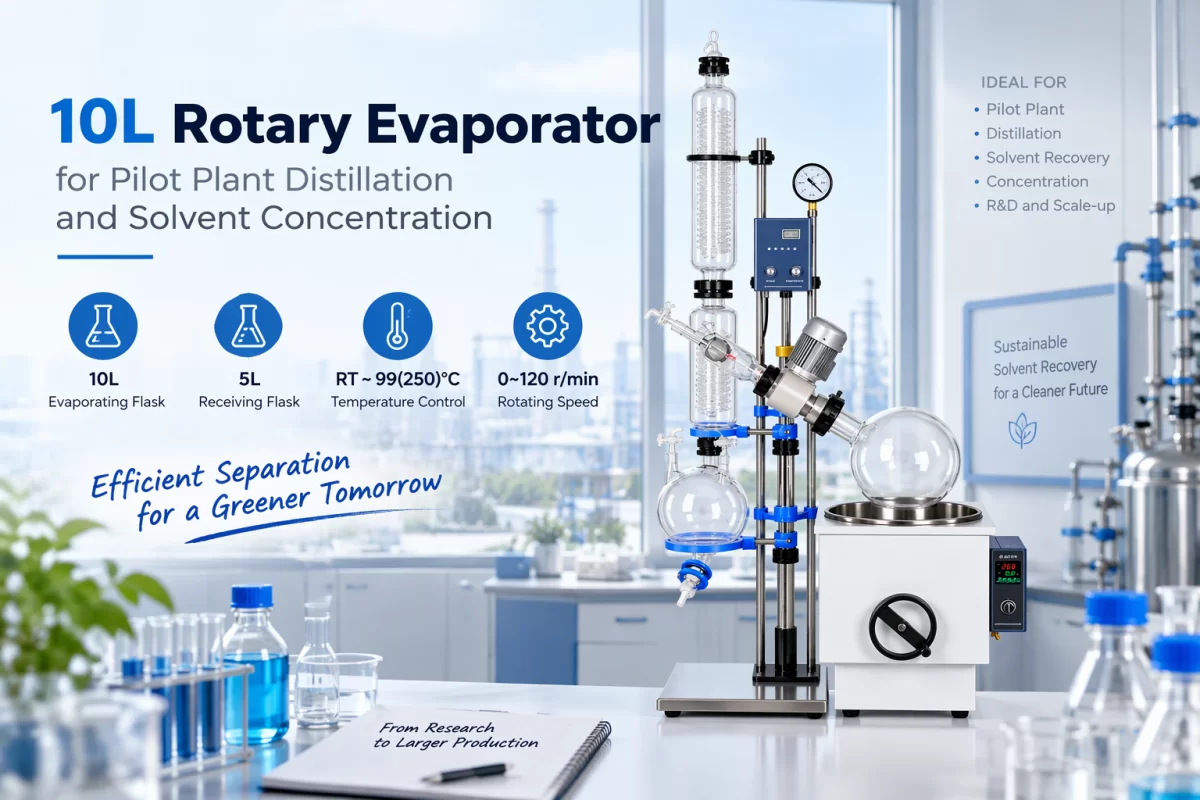
High efficiency rotary evaporator for ethanol recovery
Selecting a high efficiency rotary evaporator for ethanol recovery means finding a system that completes a defined batch promptly, collects a measurable quantity of ethanol and delivers solvent suitable for its next use. A large flask or a fast initial boil does not establish that result on its own.
Define efficiency around the finished batch
For laboratories recovering ethanol from extraction liquor or concentrating ethanol-containing samples, the practical question is how much usable solvent can be recovered during a complete operating cycle. That cycle includes preparation, heating, evaporation, receiver handling, unloading and cleaning—not just the period when condensate first appears.
Rotary evaporation combines reduced pressure with a rotating liquid film and controlled heating. However, its useful recovery rate depends on the whole vapor path: evaporation, transport, condensation and collection. If the condenser cannot handle the vapor load, increasing heat may increase solvent loss rather than usable recovery.
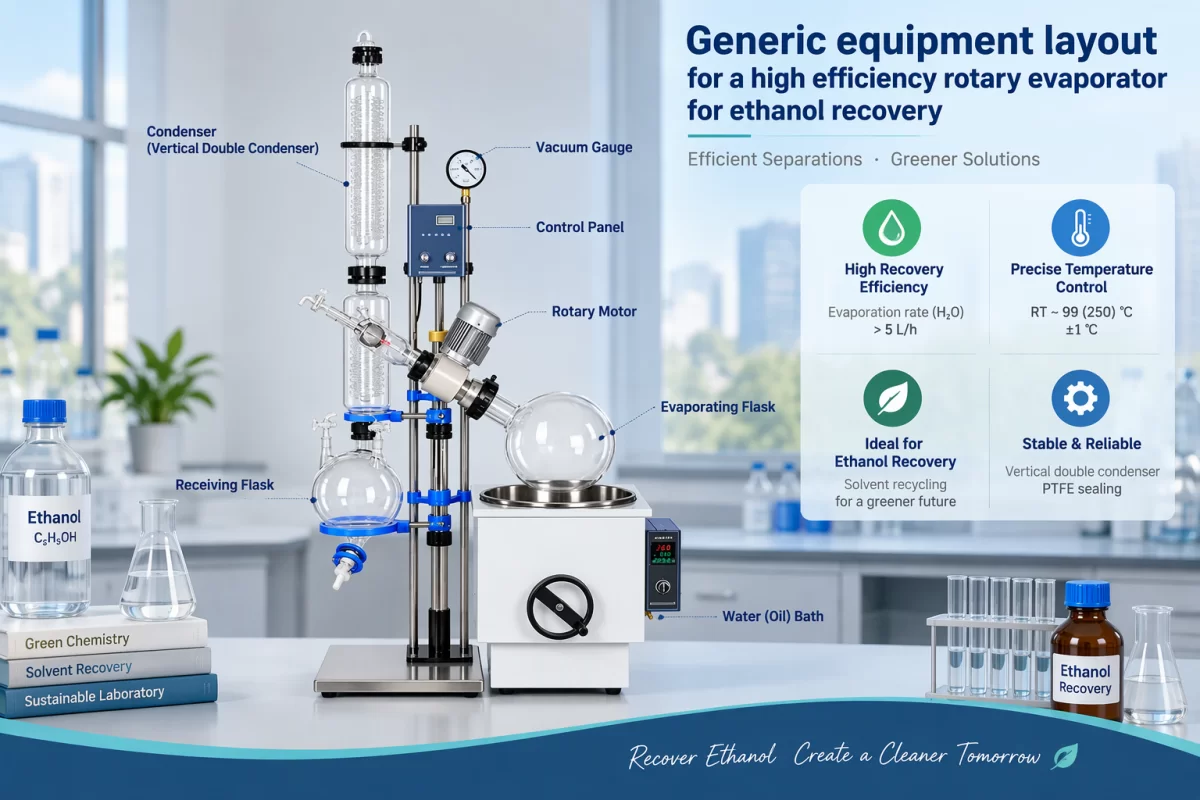
Does faster evaporation always mean more efficient ethanol recovery?
My answer is no. I would compare total cycle time and collected ethanol at the same endpoint. A faster evaporation phase can be offset by receiver interruptions, foaming, vapor breakthrough or additional cleaning caused by carryover.
Compare the same feed and the same endpoint
Start with representative feed from one well-mixed source. Keep batch volume, ethanol content, water content and dissolved or suspended material comparable. Define the final concentrate condition before testing: for example, a specified residual ethanol concentration or a validated concentration endpoint. Stopping one run earlier creates an unfair speed advantage.
The supplied documents do not establish an ethanol recovery rate or matched-batch completion time for RE-1002. A useful comparison therefore requires recorded trials rather than an assumed liters-per-hour claim. Use the following worksheet for two candidate configurations or two operating settings.
| Measurement | Unit or basis | Run A | Run B |
|---|---|---|---|
| Feed charge and composition | L; ethanol mass fraction | Record; match Run B | Record; match Run A |
| Final concentrate endpoint | Residual ethanol or validated endpoint | Same defined endpoint | Same defined endpoint |
| Evaporation time | min | Measure | Measure |
| Complete batch cycle | min, including handling and cleaning | Measure | Measure |
| Collected distillate | kg; measured ethanol mass fraction | Weigh and analyze | Weigh and analyze |
| Ethanol recovered | kg ethanol per batch | Calculate from collection data | Calculate from collection data |
| Operating conditions | °C, absolute pressure, rpm, coolant flow | Record throughout the run | Record throughout the run |
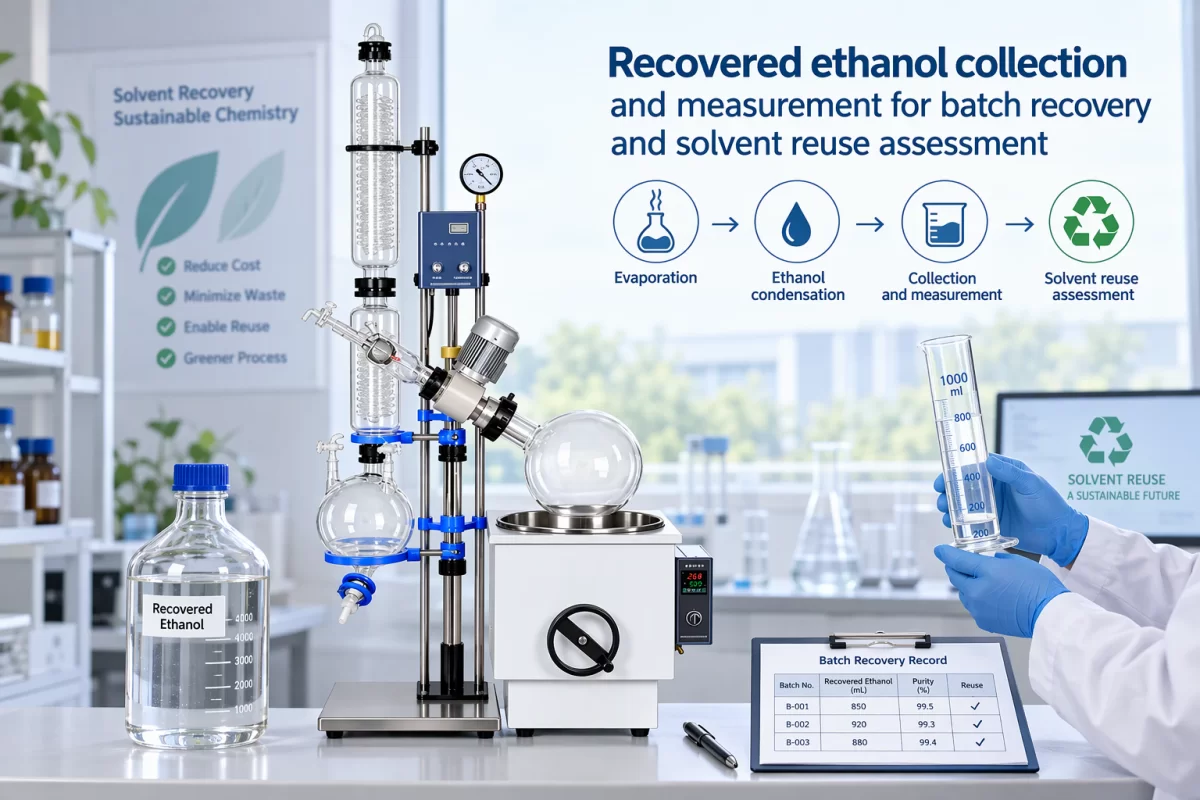
Weigh each collected fraction and determine its ethanol mass fraction using an appropriate validated method. Include all receiver transfers. Distillate volume alone is not an ethanol recovery measurement because the collected liquid may also contain water and other volatile components.
Divide recovered ethanol mass by total cycle time in hours to compare practical throughput. Also report the recovered fraction of the ethanol initially charged. If energy efficiency matters, measure electricity consumption over the same cycle and report energy per kilogram of ethanol recovered. Repeat trials to distinguish a consistent improvement from normal run-to-run variation.
Find the conditions limiting ethanol recovery
A batch may begin quickly and slow as ethanol is depleted, water becomes more prominent or the concentrate becomes more viscous. Record operating conditions throughout the batch, especially near the endpoint. An initial collection rate should not be extrapolated across the entire run.
- Heating and film formation: bath temperature, immersion, rotation and liquid behavior affect heat transfer. Excessive heating can promote bumping or unwanted thermal exposure.
- Vacuum under load: a pump’s ultimate vacuum is not the operating pressure during solvent evaporation. Leaks, vapor load and pressure-control stability affect performance.
- Cooling capacity: assess chiller performance at the intended coolant temperature and load, together with coolant flow and condenser condition.
- Collection interruptions: receiver changes and vacuum recovery can materially lengthen the total cycle.
For the vacuum side of the system, the guide to selecting a vacuum pump for efficient rotary evaporation provides relevant background for configuration discussions.
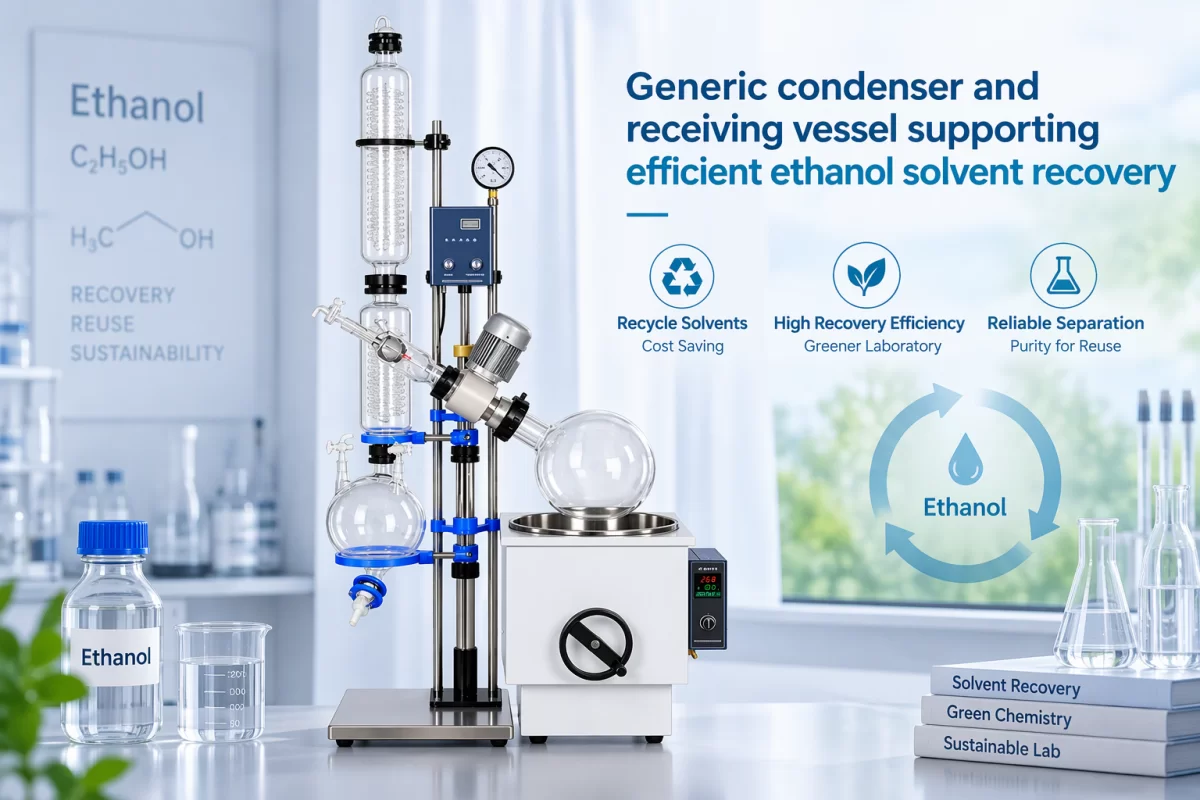
Match RE-1002 to the actual recovery workload
The RE-1002 10L rotary evaporator is a relevant product example for this selection process. Its 10L designation is supported by the supplied product listing, but nominal flask capacity must not be treated as an approved 10L working charge. Suitable loading depends on manufacturer instructions and the feed’s foaming and boiling behavior.
Detailed RE-1002 parameters were not included in the readable specification material. Receiving volume, approved working fill, heating power, condenser performance and operating limits should therefore be confirmed for the quoted configuration. Parameters from the R-series or the smaller RE-201D, RE-301 and RE-501 models should not be transferred to RE-1002.
| Selection parameter | Supported information | Decision check |
|---|---|---|
| Nominal evaporating flask | 10 L product designation | Confirm permissible working charge for the feed. |
| Solvent removal per batch | Application-specific; not supplied | Calculate from feed composition and final endpoint. |
| Receiving capacity | Confirm for the quoted configuration | Allow for mixed distillate, safe fill and transfers. |
| Ethanol recovery throughput | No verified ethanol rate supplied | Request a representative matched-batch trial. |
| Recovered solvent quality | Depends on feed and operation | Test against the intended reuse specification. |
Can a 10L flask process a 10L ethanol-containing charge?
I would not approve that loading from the nominal size alone. I would first verify the permitted working fill and leave the headspace required by the operating instructions and feed behavior. I would then compare expected distillate collection with the receiver’s usable—not merely nominal—capacity.
Receiver planning should use the amount of solvent to be removed, not simply the feed volume. Include water and any other expected condensable components. If collection exceeds usable receiver capacity, confirm the approved transfer procedure and include its downtime in the batch comparison; do not assume continuous discharge is available.
Let the recovered ethanol’s next use set the quality target
Ethanol intended for another extraction batch may need a defined ethanol concentration, water limit and carryover limit. Solvent intended for sensitive analytical work may require a different acceptance specification. Rotary evaporation does not, by itself, guarantee anhydrous or analytical-grade ethanol.
Check both sides of the process: whether the concentrate meets its residual-solvent requirement and whether the collected solvent meets its reuse requirement. The discussion of rotary evaporation in high-purity ethanol extraction offers additional context for quality-focused applications.
Reference price and quotation scope
Company reference price: US$1,480
This reference is selected from the supplied company price list using the lower-middle price after ascending sorting. It is a company-list reference, not a model-specific RE-1002 quotation or a guaranteed complete-system price. The actual quotation is subject to configuration and inquiry results.
Ask the quotation to identify the evaporator, condenser arrangement, receiving equipment, chiller, vacuum pump, pressure control and required accessories. Comparing an evaporator-only offer with a bundled system can obscure both purchase scope and the likely operating bottleneck.
What evidence supports a high-efficiency purchase decision?
I would ask for a trial using representative feed, a shared endpoint, measured recovered ethanol and a complete cycle-time record. I would also request confirmation of receiver handling and solvent quality. Those results are more useful than an unsupported recovery percentage or a water evaporation figure presented as ethanol performance.
Choose measurable ethanol recovery efficiency
A high efficiency rotary evaporator for ethanol recovery should be selected around a repeatable process result: the same feed reaches the same endpoint with an acceptable complete cycle time, a measured ethanol recovery quantity and solvent quality suitable for reuse.
Use RE-1002 as a product candidate, then confirm working charge, solvent removal load, receiving capacity and supporting utilities for the proposed configuration. For a focused inquiry, provide feed volume, ethanol and water content, expected solvent removal, final concentrate specification, intended solvent reuse and required batch schedule. These details make the equipment recommendation and quotation meaningfully comparable.