Rotovap Vacuum Pump: How to Choose the Right System for Efficient Rotary Evaporation
A rotovap vacuum pump is not just an accessory. It is one of the most important parts of a complete rotary evaporation system because it directly affects boiling point reduction, evaporation speed, solvent recovery efficiency, and process stability. When the pump and the rotary evaporator are properly matched, solvent removal becomes faster, gentler, and much easier to control across research, teaching, extraction, and pilot-scale applications.
Why the Pump Matters So Much
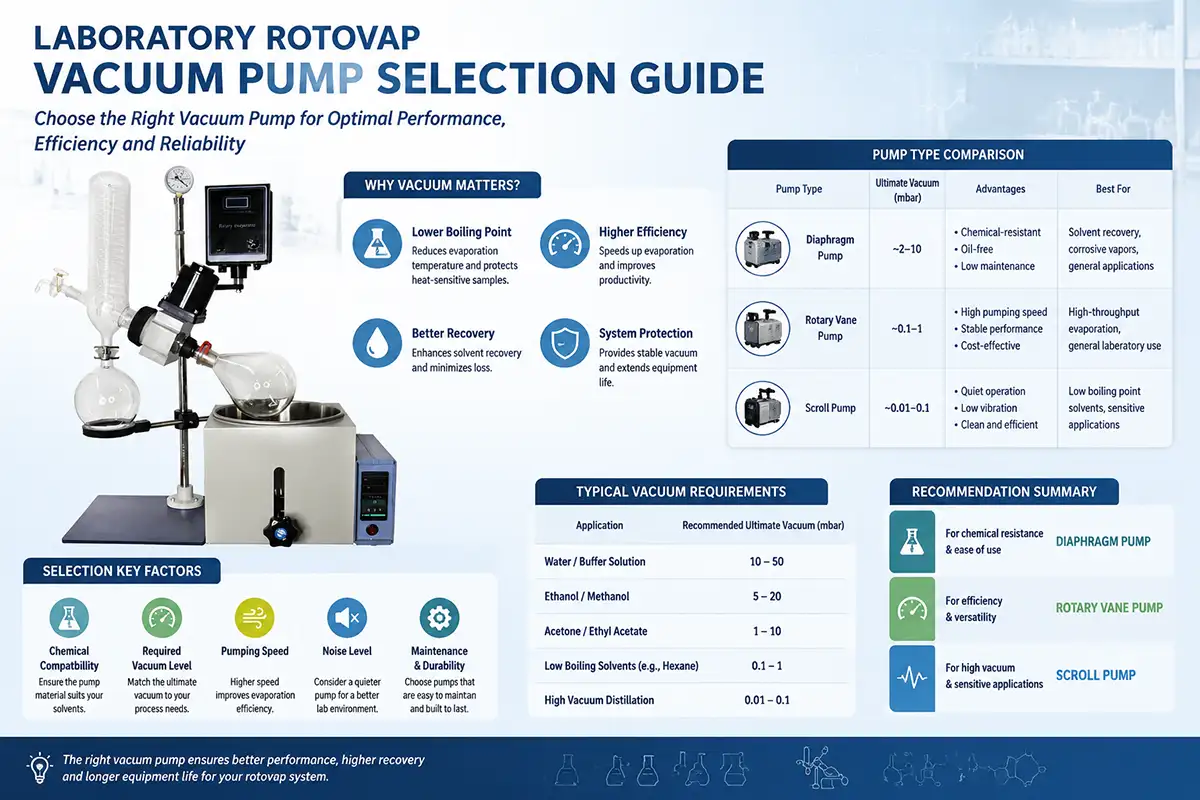
Rotary evaporators work by combining rotation, gentle heating, condensation, and reduced pressure. Among these factors, vacuum is what allows solvents to evaporate at lower temperatures. That matters when protecting heat-sensitive compounds, improving recovery quality, and reducing total process time.
A weak or unstable vacuum source can slow evaporation, create bumping, increase bath temperature requirements, and reduce condenser efficiency. In contrast, a properly selected rotovap vacuum pump supports smooth evaporation and better repeatability from batch to batch.
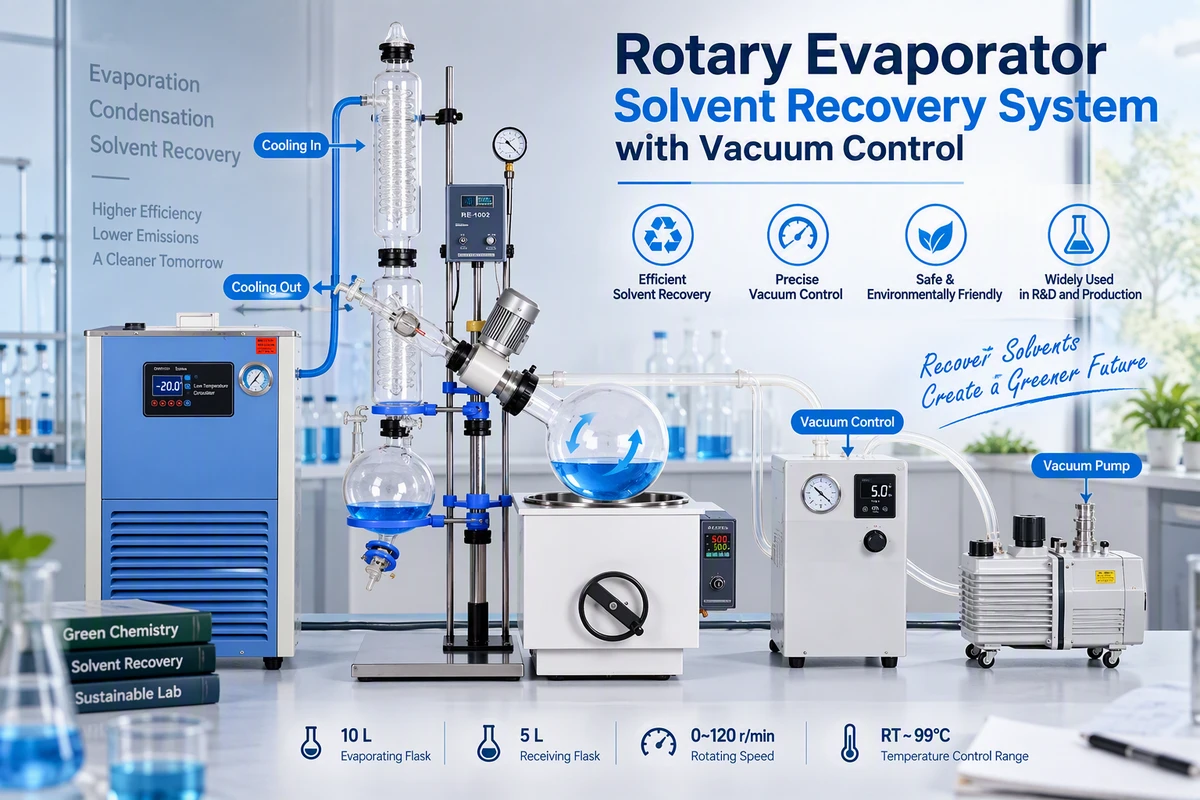
What a Complete System Looks Like
In practice, a rotary evaporator performs best when paired with a compatible vacuum pump and a suitable cooling unit. That is why many buyers evaluate the rotovap as part of a system rather than as a standalone instrument.
For readers comparing general application background, it also helps to review rotary evaporator chemistry and the evaporation mechanism before selecting hardware.
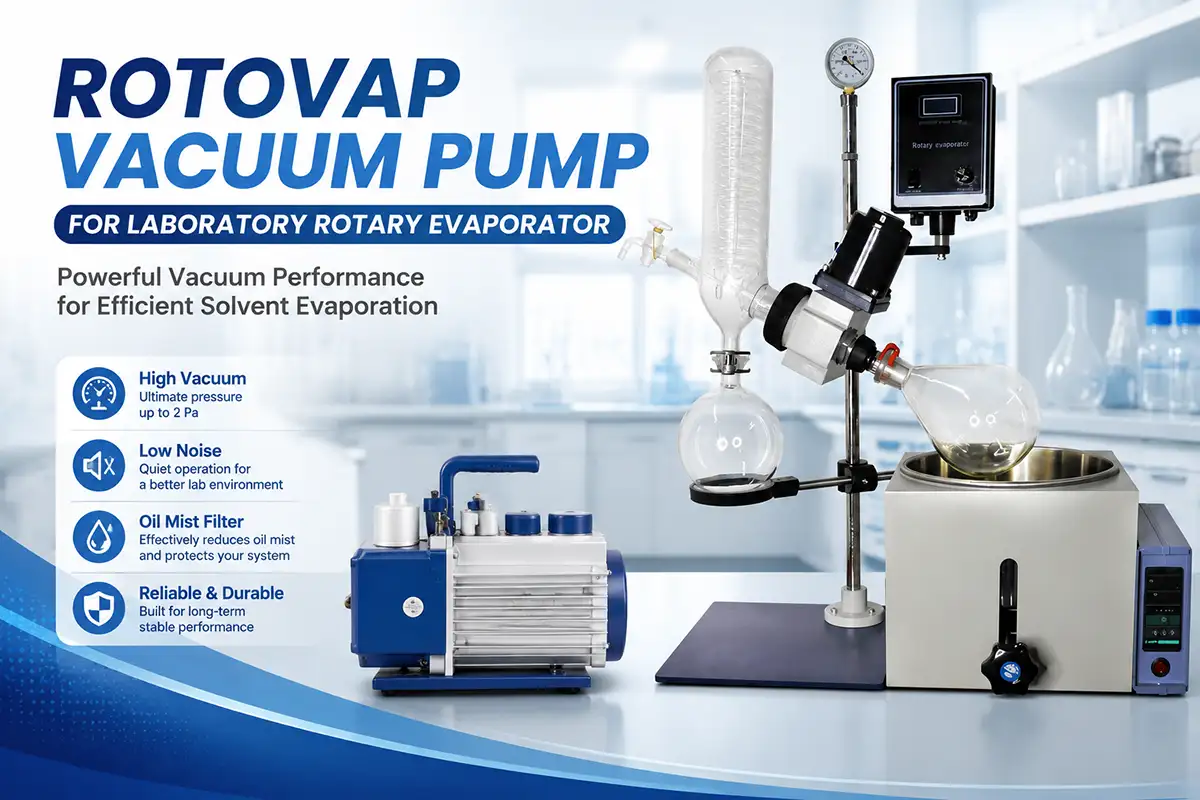
How a Rotovap Vacuum Pump Improves Performance
In rotary evaporation, the pump lowers system pressure so that solvents boil below their atmospheric boiling points. This creates several direct benefits:
Lower evaporation temperature for thermally sensitive samples
Faster solvent removal under controlled conditions
More stable distillation behavior with less sudden bumping
Improved condenser collection when the whole system is balanced
Reduced exposure time for valuable extracts, intermediates, or reaction mixtures
Choosing the Right Rotary Evaporator Size Before Selecting the Pump
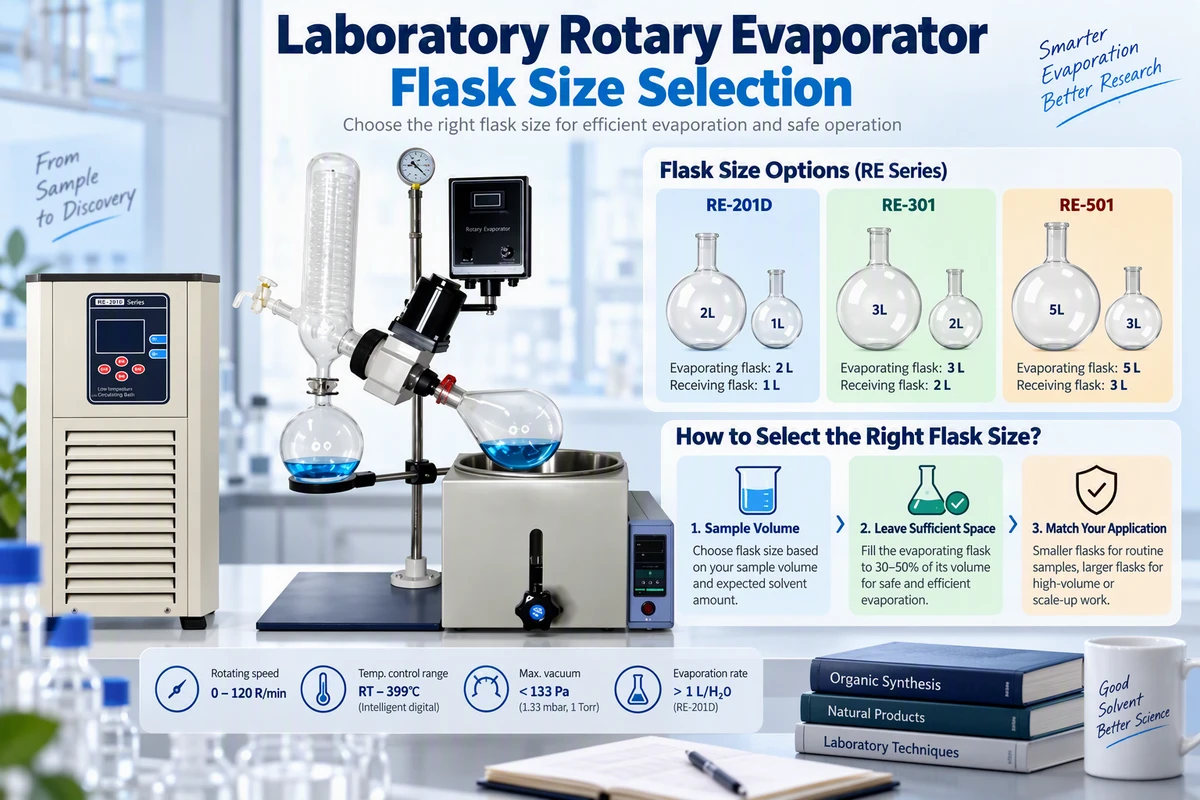
Pump selection should always be connected to evaporating flask size, receiving flask size, expected evaporation rate, and overall workflow. Based on the provided rotary evaporator parameters, the product range covers compact bench units, medium-capacity laboratory systems, and larger pilot-oriented models.
| Model | Evaporating Flask | Receiving Flask | Speed Range | Bath Power | Evaporation Rate (H₂O) | Max Vacuum Degree | Lifting |
|---|---|---|---|---|---|---|---|
| RE-201D | 2L | 1L | 0-120 rpm | 1200W | >1L/h | <133Pa | 0-150 mm |
| RE-301 | 3L | 2L | 0-120 rpm | 1500W | >1.5L/h | <133Pa | 0-120 mm |
| RE-501 | 5L | 3L | 0-120 rpm | 1500W | >1.5L/h | <133Pa | 0-120 mm |
| RE-1002 | 10L | 5L | 0-120 rpm | 3000W | >3L/h | System matched for deep vacuum use | 0-220 mm |
| RE-2002 | 20L | 10L | 0-90 rpm | 5000W | >5L/h | System matched for deep vacuum use | 0-220 mm |
| RE-5002 | 50L | 20L | 0-90 rpm | 7000W / 9000W | >9L/h | System matched for deep vacuum use | 0-220 mm |
| R1005 / R1010 / R1020 / R1050 | 5L / 10L / 20L / 50L | 3L / 5L / 10L / 20L | 10-140 or 20-120 rpm | Total power 2-4kW | Application dependent | Configured with efficient reflux condenser | Electric or electric + hand lift |
Recommended Pump Thinking by Capacity Range
Compact lab evaporation
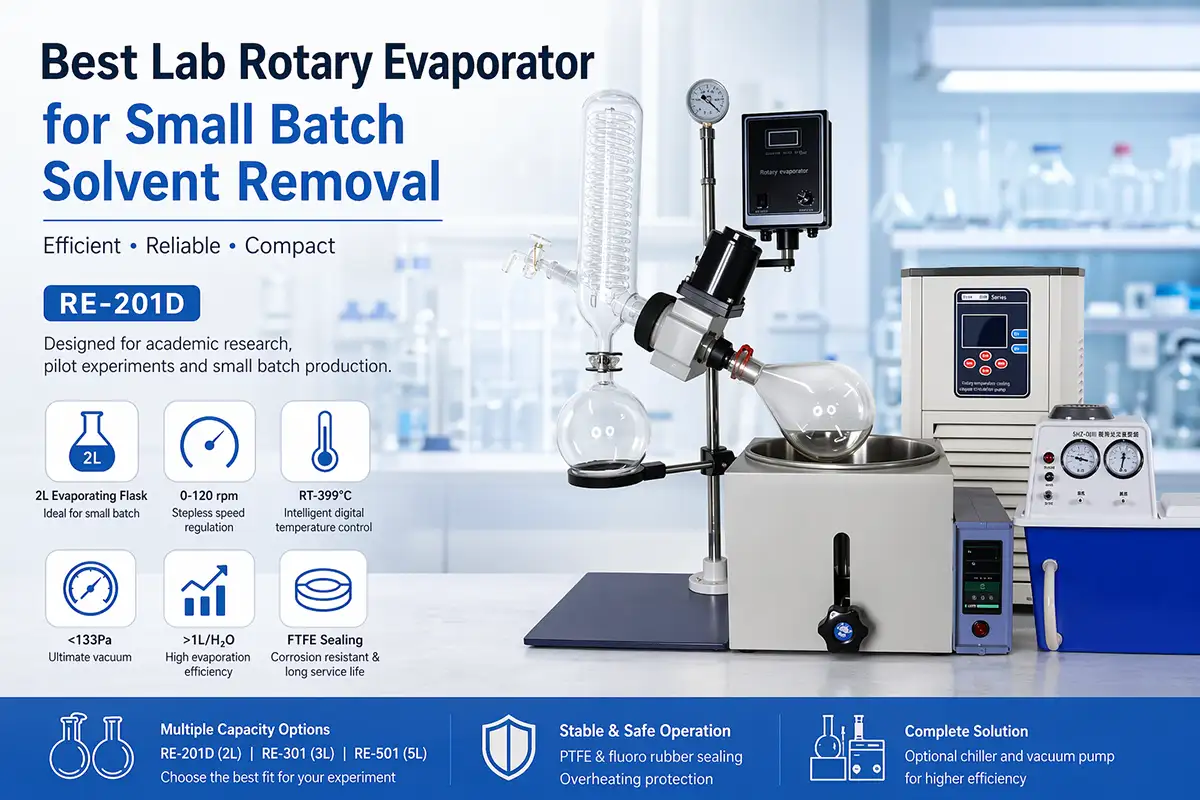
Small rotovaps such as RE-201D, RE-301, and RE-501 are often used for academic labs, routine solvent removal, formulation work, and small-batch extraction. These systems benefit from compact vacuum sources that deliver stable vacuum without overcomplicating the setup.
Higher throughput lab work
RE-1002 and RE-2002 class machines move significantly more vapor. At this level, vacuum stability becomes even more important because the condenser load is higher, the bath power is stronger, and process continuity matters more.
Pilot-scale solvent recovery
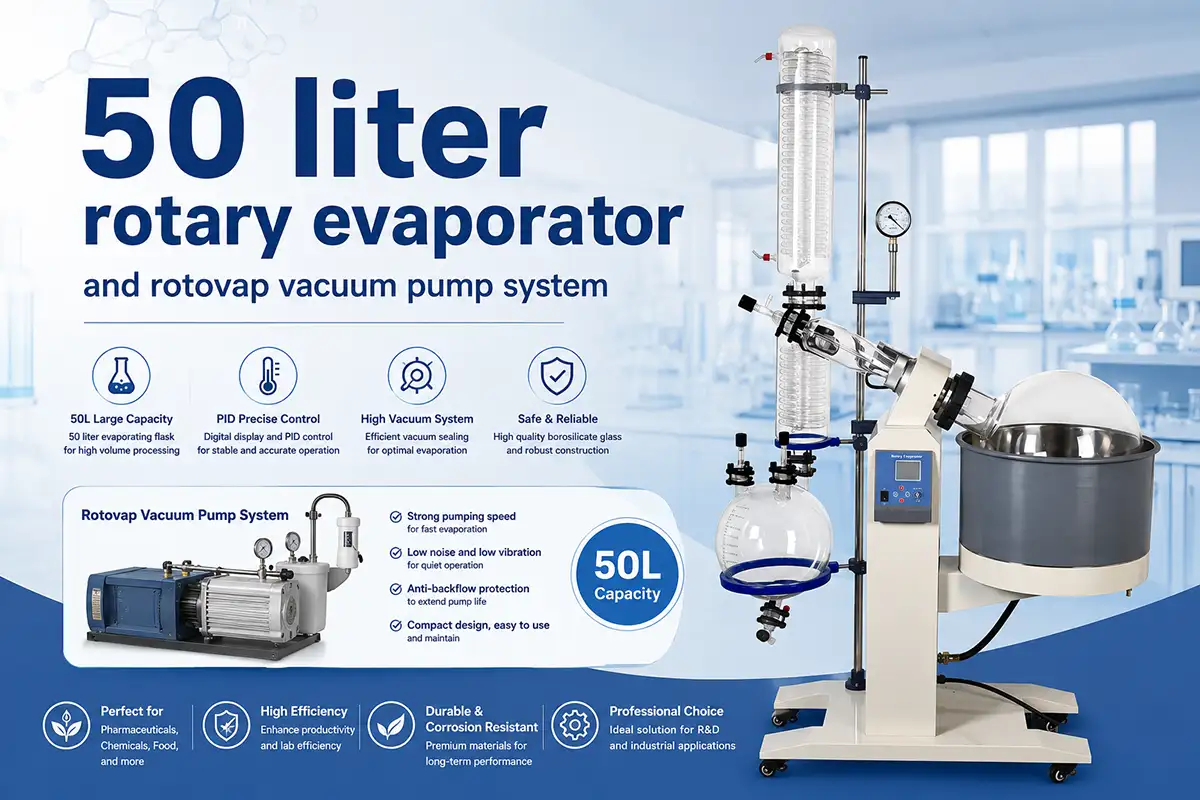
A 50L rotary evaporator can deliver substantial evaporation capacity, especially with evaporation rates above 9L/h for water reference conditions. This class needs a vacuum source chosen with throughput, resistance to vapor exposure, and long-run operational reliability in mind.
For readers evaluating larger systems specifically, the 50 liter rotary evaporator category is especially relevant when vacuum pump capacity and condenser efficiency must scale together.
Typical Product Pricing Reference
Based on the supplied price list, a few representative references help illustrate how buyers often budget for the evaporation system and the vacuum component separately. When multiple prices were listed as ranges, the lower middle value was selected as requested.
Laboratory Chemical Vacuum Diaphragm Membrane Vacuum Pump
Reference price: $595
A diaphragm-style option is often considered where cleaner, oil-free operation and compatibility with laboratory glass systems are priorities.
RE-2000E Vacuum Rotary Evaporator
Reference price: $920
This price point shows how compact rotary evaporator systems can enter the market at accessible levels, though complete system matching still matters.
Laboratory Rotovapor Manufacturer Price
Reference price: $1,350
A useful benchmark for buyers comparing entry-level to mid-range rotovap setups.
Rotary Evaporator with Chiller and Vacuum Pump
Reference price: $1,961
Bundled systems are attractive because the condenser, pump, and evaporator are intended to work together under similar operating expectations.
50L Industrial Rotary Evaporator with Vacuum Pump
Reference price: $2,536
Larger-scale systems naturally move upward in price as frame strength, condenser volume, motor requirements, and vacuum matching become more demanding.
What to Check When Matching a Vacuum Pump to a Rotovap
1. Ultimate vacuum and usable operating range
Deep vacuum capability matters, but usable control range matters even more. The pump should support the practical pressure range required by the target solvent system without constant fluctuation.
2. Vapor tolerance
Solvent vapor exposure is unavoidable in many evaporation workflows. A pump chosen for rotovap duty should be considered from the viewpoint of chemical resistance and service life.
3. Pumping speed versus flask volume
A 2L benchtop unit and a 50L production-support unit do not place the same demand on vacuum recovery speed. Larger systems need stronger vapor handling and better vacuum recovery under changing load.
4. Condenser and chiller coordination
Strong vacuum without sufficient condensation can overload the system. Matching the vacuum pump with the cooling side is critical to maintain good recovery and reduce solvent carryover.
5. Noise, maintenance, and cleanliness
Lab environments often prefer quieter and cleaner systems, especially where multiple instruments operate side by side or where sample purity is important.
6. Process repeatability
The right pump is not only about reaching a vacuum number. It is about helping the rotovap repeat the same process profile day after day.
Application Examples Across the KD Rotary Evaporator Range
The smaller RE-201D, RE-301, and RE-501 units use a 40W rotating motor with stepless speed regulation and provide practical evaporation rates for routine laboratory use. Their compact dimensions and moderate bath power make them suitable for teaching labs, synthesis support, and small-scale solvent concentration.
The RE-1002, RE-2002, and RE-5002 models move into a more demanding throughput range with 10L, 20L, and 50L evaporation flasks. These systems are paired with stronger bath power up to 9000W on the 50L version and water or oil bath manual lifting. Vacuum pump choice becomes more strategic here because evaporation throughput rises sharply.
The R series adds another layer of equipment sophistication with electric lift designs, brushless motor options on larger units, and high-efficiency reflux condensers. These features make the pump-system relationship even more important for smooth, controlled evaporation.
Common Buying Paths for Different Users
University and teaching labs
These buyers usually focus on compact footprint, simple controls, stable vacuum performance, and ease of maintenance. A 2L to 5L system is frequently the right starting point.
Chemical and synthesis laboratories
Here, solvent diversity and process repeatability are more important. Pump compatibility with multiple solvent types and better vacuum control become higher priorities.
Extraction and concentration workflows
These users often look for faster solvent recovery and a system package approach. In many cases, that means selecting the rotary evaporator, chiller, and rotovap vacuum pump together.
Pilot and pre-production applications
Larger 20L to 50L models call for more attention to condenser efficiency, bath power, lifting design, and sustained vacuum performance over longer runs.
Internal Knowledge That Supports Better Selection
Buyers often move from broad research questions into equipment comparison. For that reason, it can be useful to connect technical content around system design, operation, and application background. Readers still comparing operation basics can review how to use a rotovap to better understand how vacuum, bath temperature, and rotation work together.
This internal content pathway also supports broader search visibility because the same audience often searches for rotary evaporation principles, rotovap operation, and equipment sizing before sending an inquiry.
Final Thoughts on Selecting a Rotovap Vacuum Pump
The best rotovap vacuum pump is the one that fits the evaporator size, solvent characteristics, throughput goal, and desired level of process control. Small systems can work very well with compact laboratory vacuum solutions, while larger 10L, 20L, and 50L systems require a more deliberate system match.
Across the KD rotary evaporator range, the hardware specifications show clear progression in bath power, evaporation rate, flask volume, and lifting design. As system capacity increases, the importance of a properly selected pump increases as well. Stable reduced pressure is what turns a rotary evaporator from a simple heating-and-rotation device into a highly efficient solvent recovery tool.
Looking for the Right Rotary Evaporator and Vacuum Configuration?
Whether the requirement is a compact 2L lab unit or a high-throughput 50L system, selecting the right evaporator, condenser, and rotovap vacuum pump combination can significantly improve solvent recovery efficiency and operating consistency.
A well-matched system helps lower process temperature, increase evaporation speed, and support more reliable day-to-day performance.
Explore KD Rotary Evaporator Solutions