Rotary Evaporator · Industrial Batch Planning
Industrial rotovap setup for large scale ethanol recovery
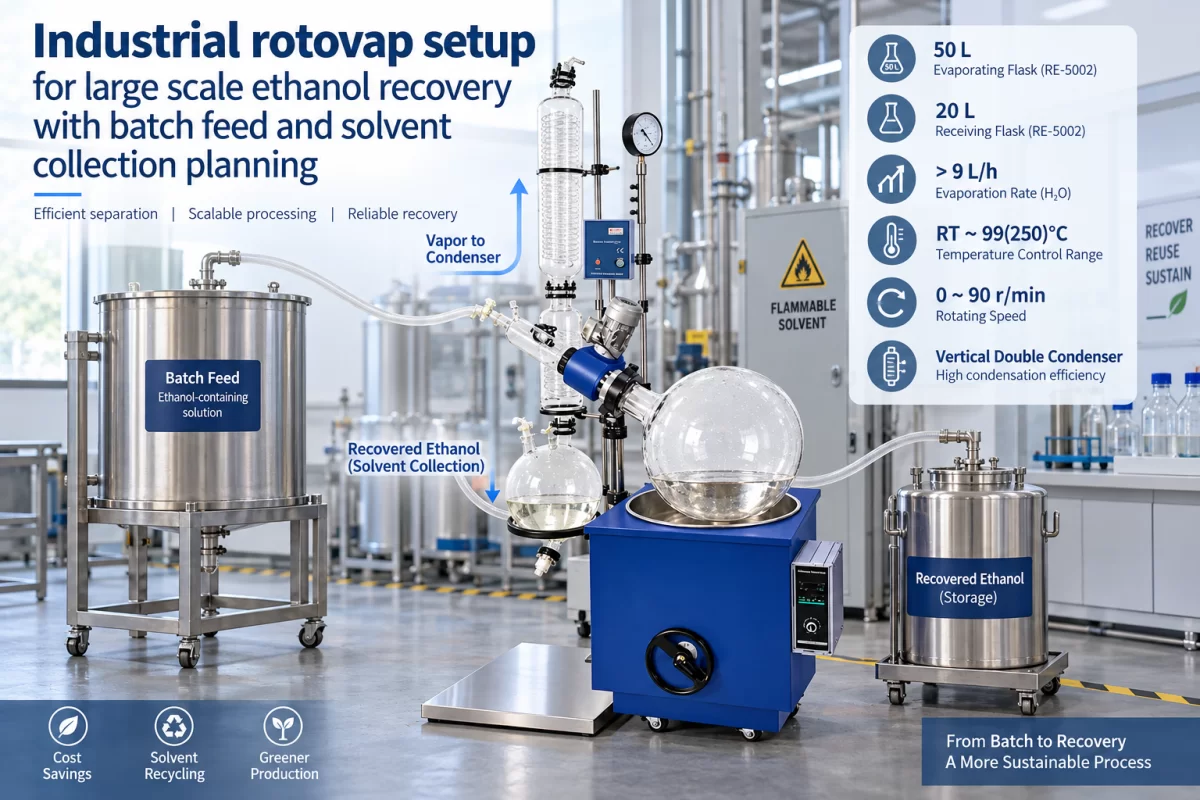
An industrial rotovap setup for large scale ethanol recovery should be specified from the production batch backward: how much feed enters, how much solvent must leave, where the condensate goes, and what quality is required before that ethanol returns to service.
Start with the batch duty, not the flask label
“Large scale” does not define a single equipment size. A facility concentrating intermittent extract batches has different requirements from a line generating solvent-rich feed throughout a shift. A rotary evaporator may be a candidate for scheduled batch recovery, but its suitability depends on the complete cycle and supporting equipment—not simply the largest flask available.
Prepare a batch specification covering feed volume, ethanol and water content, dissolved solids, foaming behavior, desired concentrate endpoint, and operating hours. Also identify whether incoming material can wait between batches. These details determine whether one evaporator can keep pace or whether additional capacity or another process configuration needs evaluation.
- Feed batch: Record the actual mixture volume and composition, including expected variation.
- Solvent removal duty: Establish the quantity to remove from a measured mass balance, rather than treating the entire feed as recoverable ethanol.
- Collection duty: Include water and other volatile components that may enter the receiver.
- Recovery destination: Define whether condensate will be reused in extraction, held for testing, or sent for further purification.
Does a 50 L rotary evaporator process a 50 L charge?
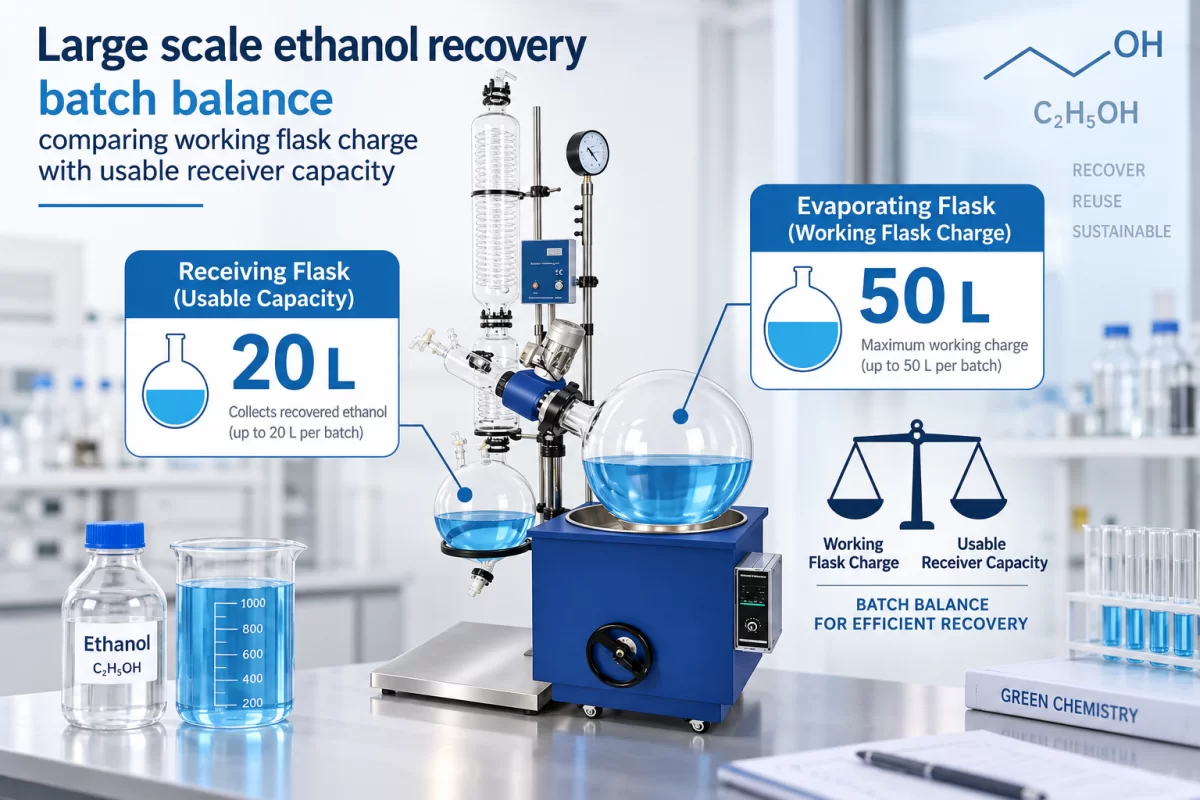
I would not interpret a nominal 50 L flask as permission to load 50 L of feed. Nominal vessel volume, approved working charge and hourly processing capacity describe different things. Working charge must leave the manufacturer-required operating space and account for the actual feed’s foaming and boiling behavior.
RE-5002: a 50 L-class example that needs configuration verification
The supplied product listing identifies the RE-5002 as a 50 L rotary evaporator for essential-oil distillation. That makes it a relevant model to investigate for larger batch solvent-removal duties. However, the available RE-1002/RE-2002/RE-5002 document contains no readable technical values here, so the listing alone does not establish an ethanol processing rate, approved working fill, receiver capacity or installation specification.
For ethanol recovery, treat the RE-5002 as a candidate for a feed trial and a configuration-specific quotation—not as a verified continuous-production system. Parameters from the separately supplied R-series table must not be transferred to the RE-5002, even where another model also has a 50 L rotating bottle.
| Selection item | Available RE-5002 information | Required purchasing check |
|---|---|---|
| Nominal size (L) | 50 L, as identified in the supplied listing | Confirm the supplied evaporating flask and assembly |
| Working charge (L/batch) | Not established by the available information | Obtain the approved fill for the proposed feed |
| Receiver capacity (L) | Not established by the available information | Confirm nominal volume, usable volume and discharge procedure |
| Ethanol removal rate (L/h or kg/h) | No verified ethanol rate supplied | Request a feed-specific test with documented conditions |
| Utilities and hazardous-area suitability | Not established for this configuration | Verify electrical supply, cooling duty, vacuum equipment and applicable approvals |
If the verified working charge is substantially smaller than the proposed batch, include splitting, transfers and extra cleaning in the comparison. For smaller segregated batches, the RE-1002 10 L rotary evaporator product page offers another model to investigate; its suitability likewise requires confirmation against the actual duty.
Match receiver capacity to solvent load and batch time
The receiving flask can become the practical bottleneck before the evaporating flask does. Compare anticipated total condensate against usable collection volume, not the receiver’s nominal size. Allow for the specified operating margin and establish how collected liquid is removed without exposing operators or disrupting the batch unnecessarily.
If the expected condensate exceeds usable receiver capacity, define the required collection events before purchasing. Do not assume that a drain valve permits discharge under vacuum, or that receiver changes can occur without stopping. Ask for the configuration’s documented isolation, venting and transfer sequence.
Which throughput figure matters for production scheduling?
I use solvent removed per complete operating cycle, then check the result over a representative shift. A rate measured only during steady evaporation leaves out charging, warm-up, receiver handling, final concentration, unloading and cleaning. Those activities can materially change usable daily capacity.
Effective solvent-removal throughput = measured solvent removed ÷ total cycle time
Keep units consistent: solvent removal in kg/h is not interchangeable with feed processing in L/h. Likewise, the water evaporation figures supplied for the smaller RE-201D, RE-301 and RE-501 models are not ethanol performance data and cannot establish RE-5002 capacity.
Ask the supplier to document feed composition, working charge, bath conditions, operating pressure, coolant conditions, endpoint and total elapsed time during acceptance testing. Repeat the test with a representative difficult batch, not only the easiest feed.
Build the industrial ethanol recovery setup around site utilities
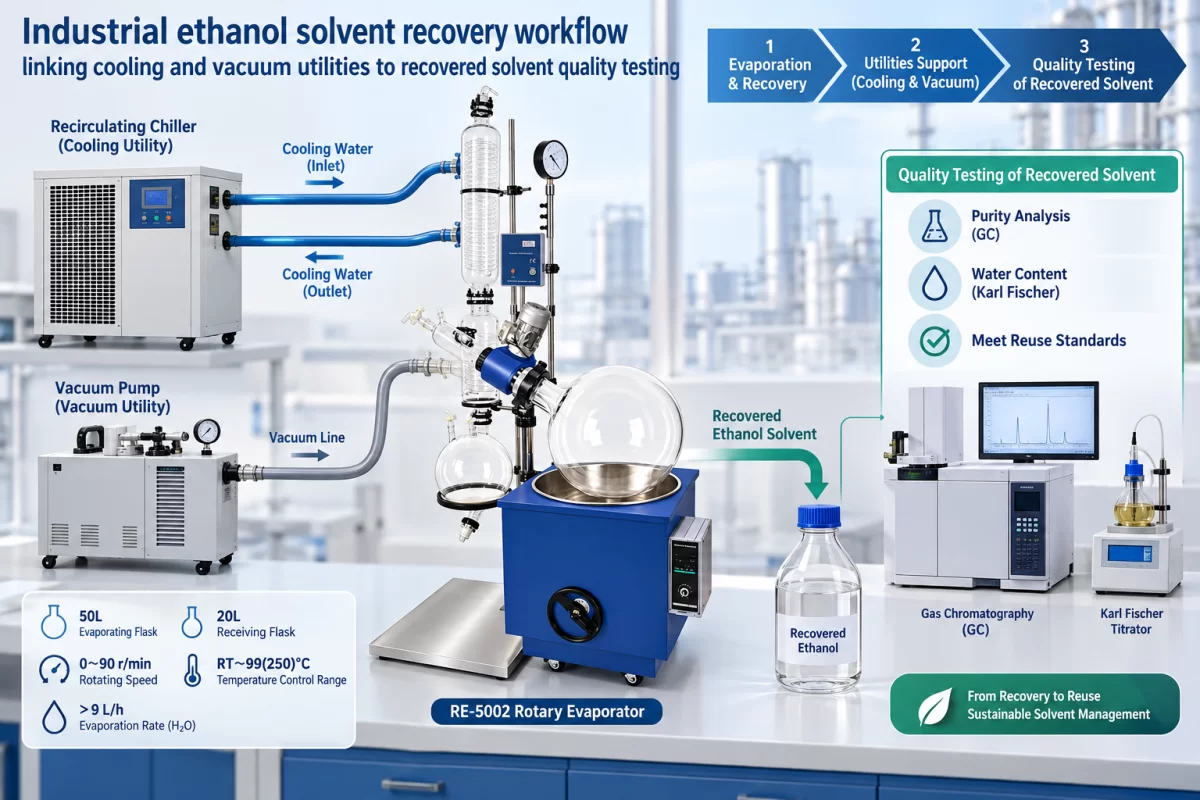
An evaporator, condenser, chiller and vacuum system must work as a matched assembly. Cooling capacity should be checked at the intended coolant temperature and ambient conditions. A chiller’s headline rating alone does not establish that it can condense the proposed vapor load throughout the batch.
Vacuum selection also requires more than an ultimate-pressure number. Confirm solvent compatibility, control under vapor load, exhaust handling and protection against liquid carryover. The guide to selecting a rotovap vacuum system provides useful background for that purchasing discussion.
- Electrical service: Verify the actual quoted voltage, phase, frequency and total connected load.
- Cooling connections: Confirm hose compatibility, required flow, coolant selection and leak-management provisions.
- Installation space: Include access for flask handling, service work, solvent transfer and safe operator movement.
- Flammable-solvent controls: Have qualified site personnel assess ventilation, ignition sources, grounding and bonding, solvent storage and local requirements.
Configuration-specific verification: No explosion-proof, CE, ETL or other certification claim is established for the RE-5002 by the available technical information. Descriptions of other listed products do not demonstrate approval for this model or the complete installed system.
Specify recovered ethanol for its next use
Condensing ethanol-containing vapor is not the same as producing ethanol of a guaranteed purity. Water and other volatile components may be collected with it. Set the reuse specification before equipment selection: ethanol concentration, water content, relevant impurities, storage conditions and any limits imposed by the downstream process.
Can recovered ethanol return directly to extraction?
I would release it only after testing against the extraction process’s solvent specification. Depending on feed composition and the required quality, further treatment or blending may be necessary. A rotary evaporator listing does not establish that condensate is anhydrous, food-grade or suitable for every extraction process.
The application article on rotary evaporation in high-purity ethanol extraction offers related context. For an industrial installation, translate those quality goals into measurable batch-release criteria and a documented solvent-handling procedure.
Reference pricing and a configuration-ready inquiry
The company-supplied equipment price list provides a company reference price of US$1,480, selected using the specified middle-price method after ordering the listed prices from low to high. This is a reference across the supplied equipment listings, not an RE-5002 quotation or a complete industrial recovery-system price. The actual quotation is subject to configuration and inquiry results.
For a useful RE-5002 inquiry, submit the feed specification, batch volume, solvent removal target, shift schedule, recovered-ethanol quality requirement and available site utilities. Request an itemized scope identifying the evaporator, receiving arrangement, cooling system, vacuum equipment, controls, installation needs and acceptance test.
Before ordering, establish which components are included and which remain the facility’s responsibility. A clear scope and a representative batch trial provide a stronger basis for comparing configurations than nominal flask volume or listing price alone.
Choose a setup that matches the complete recovery cycle
A credible industrial rotovap setup for large scale ethanol recovery aligns working charge, solvent removal duty, usable receiver capacity, site utilities and condensate quality. The RE-5002 is a relevant 50 L-class example to evaluate, but its suitability must be confirmed with configuration-specific documentation and a representative feed test.
For the next step, prepare a batch-based specification and request an RE-5002 configuration review. Define success as meeting the required recovery duty within the available operating time, with controlled solvent handling and ethanol that meets its intended reuse specification.