Laboratory equipment • Configuration guide
Rotary evaporator with vacuum pump and glassware kit
Choosing a rotary evaporator with vacuum pump and glassware kit is an interface-matching decision, not simply a search for a box containing several parts. The glass joints must fit, the pump must maintain useful pressure while solvent is evaporating, and the cooling system must capture vapor before it reaches the pump.
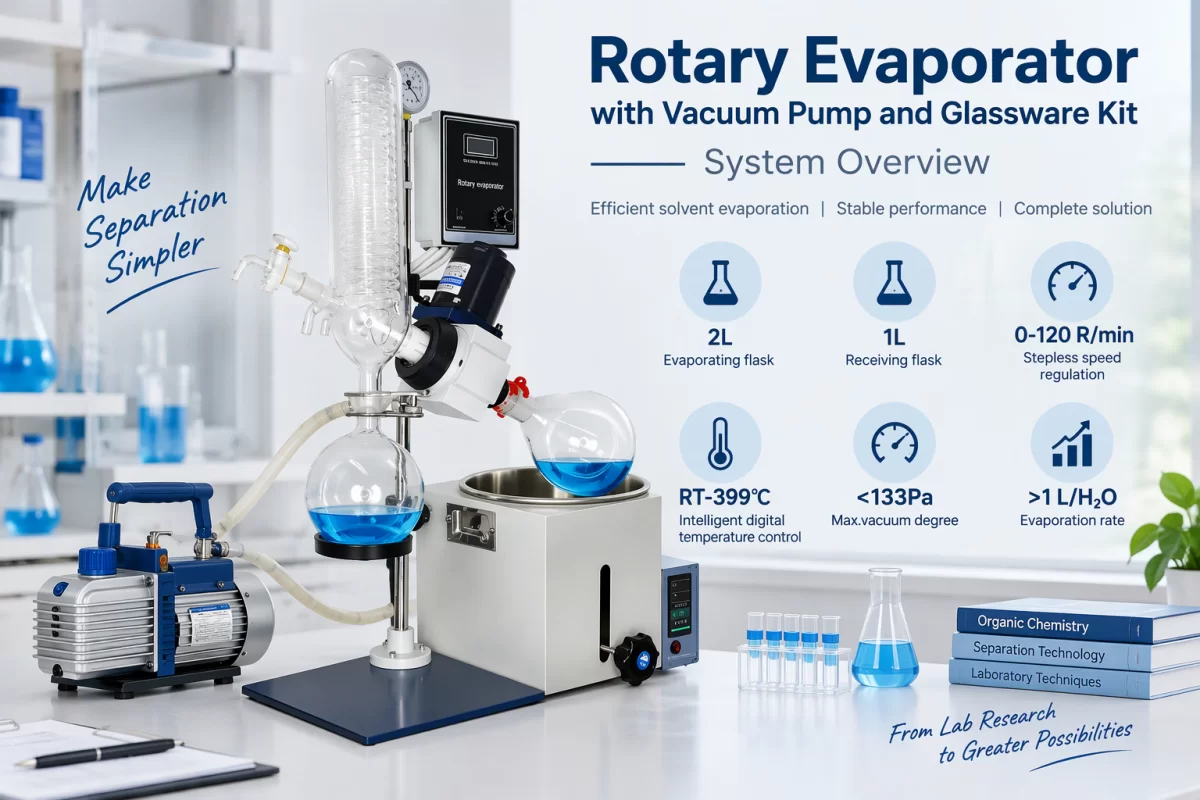
For laboratories considering small-batch concentration or solvent removal, the RE-201D provides a relevant product example. Its supplied specifications establish flask sizes and operating features, but they do not establish a complete pump-and-glassware package. A reliable purchase therefore starts with the solvent, the intended batch, and a written configuration list.
Start with the solvent and the working batch
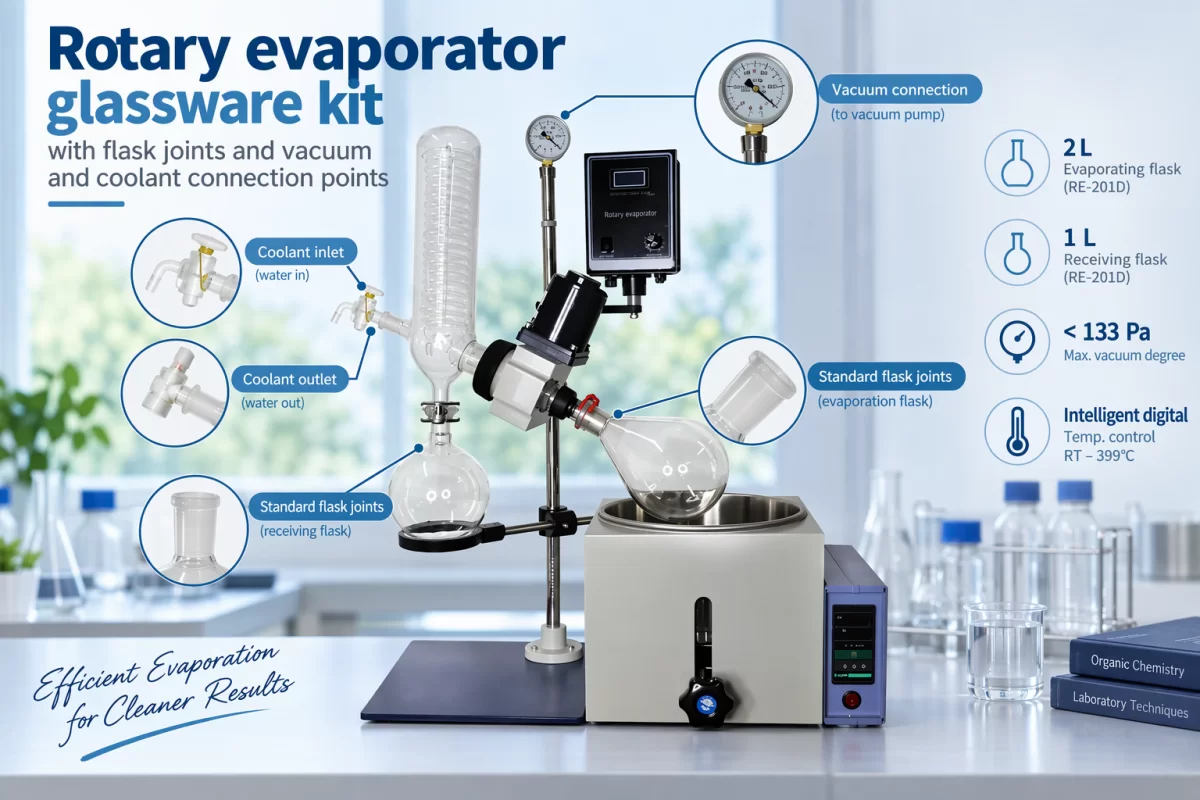
The RE-201D is specified with a 2 L evaporating flask and a 1 L receiving flask. These nominal capacities make it a candidate for small laboratory workflows rather than large-volume production. The evaporating flask’s nominal volume is not its permitted liquid charge: adequate headspace is necessary for rotation, foaming, and bumping. Confirm the approved working fill in the operating instructions.
Before selecting the vacuum pump, define the solvent or mixture, starting liquid volume, desired evaporation temperature, expected foaming, and collection volume. An aqueous sample and an acetone-rich sample can require substantially different pressure control and cooling arrangements, even when both use the same flask.
For a broader view of available equipment, consult the rotary evaporator product range. Keep the final selection tied to the actual process rather than flask capacity alone.
Does a 2 L evaporating flask permit a 2 L liquid charge?
My recommendation is to treat 2 L as the flask’s nominal capacity, not a batch instruction. I would confirm the manufacturer’s working-fill guidance and reduce the charge when foaming or bumping is likely. The 1 L receiver also needs a collection plan that prevents overfilling.
RE-201D: specifications relevant to the kit decision
The following values come from the supplied RE-201D technical parameter sheet. They describe the evaporator, not a verified bundled pump or chiller. A water evaporation figure should not be applied directly to ethanol, acetone, or mixed-solvent samples.
| Parameter | RE-201D specification | Configuration implication |
|---|---|---|
| Evaporating flask | 2 L | Confirm permitted fill and flask-joint dimensions. |
| Receiving flask | 1 L | Plan condensate collection and receiver-emptying procedures. |
| Rotating motor | 40 W; stepless speed regulation | Adjust rotation to the sample and operating instructions. |
| Rotating speed | 0–120 r/min | Check stable operation with the intended flask and charge. |
| Lifting height | 0–150 mm | Check bath clearance and access during setup. |
| Water evaporation rate | >1 L/h, stated for H₂O | Test conditions are not supplied; this is not a solvent-specific guarantee. |
| Maximum vacuum degree | <133 Pa, approximately 1.33 mbar | A listed vacuum limit is not a confirmed pressure under evaporation load. |
| Sealing mode | “FTFE, fluoro rubber sealing” | Confirm the exact polymer and elastomer grades before solvent use. |
The seal wording is reproduced as supplied. It should not be silently interpreted as a confirmed PTFE specification. Clarify bath ratings, permitted heating media, electrical supply, and installation requirements in the model-specific quotation and manual.
Match the glassware kit, vacuum line, and cooling connections
A glassware kit must be mechanically compatible with the selected evaporator. Similar-looking glass components are not necessarily interchangeable. The supplied RE-201D sheet does not give joint sizes, hose-barb diameters, condenser geometry, or coolant requirements; these details must be confirmed rather than assumed.
- Main unit to glassware: confirm the vapor duct attachment, rotating-flask joint size and taper, retaining hardware, seal dimensions, condenser support, and clearance through the lift range.
- Glassware to collection: confirm the condenser-to-receiver joint, receiver support, clips, and any vent or feed assembly. Require an itemized list with quantities and compatible replacement part references.
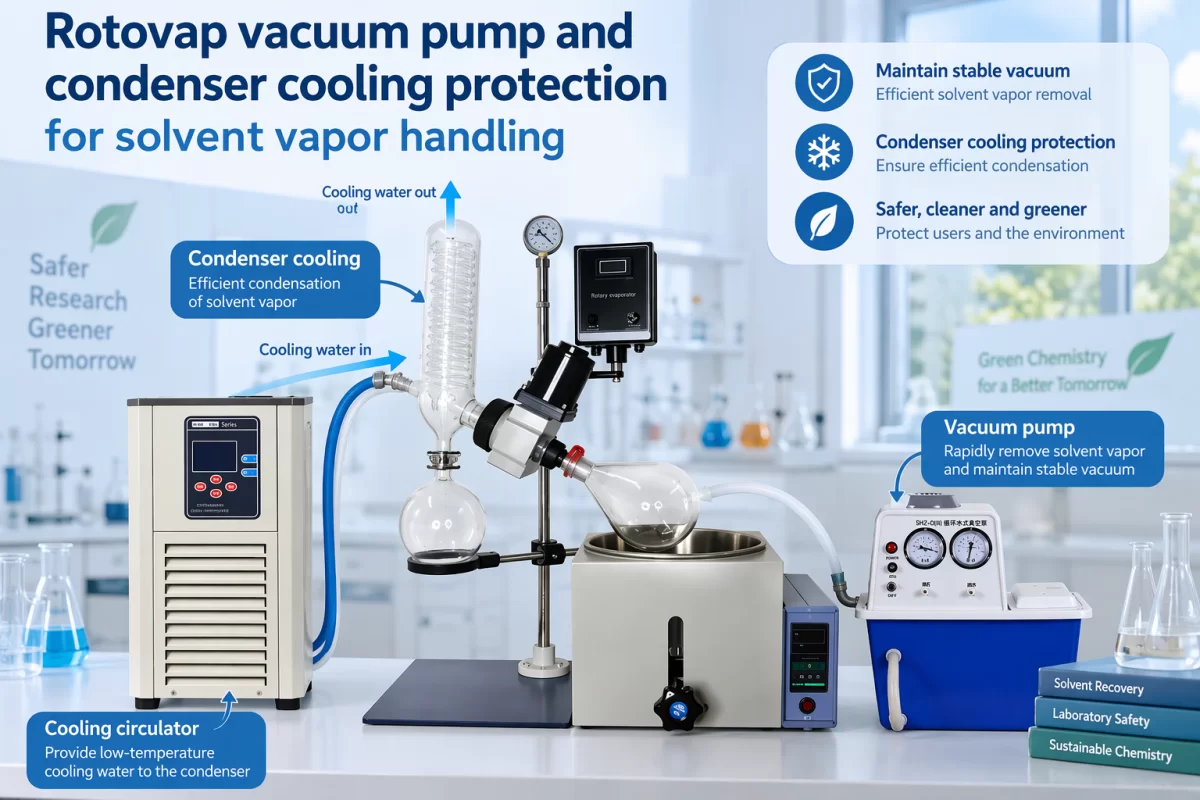
- Glassware to vacuum: match the vacuum takeoff, hose internal diameter, pump inlet fitting, and any controller or trap connections. Specify solvent-compatible tubing rated against collapse under vacuum.
- Condenser to cooling: verify coolant inlet and outlet fittings, hose size, permitted coolant, required circulation, and allowable pressure. Check the chiller’s capacity at the intended operating temperature, not only its lowest temperature rating.
- Utilities and exhaust: verify power requirements for every powered component and provide a suitable pump-exhaust route under the laboratory’s ventilation and solvent-safety procedures.
The guide to essential rotary evaporator components can help identify the assemblies that need to appear on the quotation.
Separate standard supply, optional equipment, and consumables
Standard supply: the technical sheet identifies an evaporator configuration with 2 L and 1 L flasks, but it is not a packing list. Obtain written confirmation of the main unit, bath, condenser, flasks, vapor duct, seals, supports, and connection hardware included as standard.
Optional equipment: treat the vacuum pump, vacuum controller, recirculating chiller, cold trap, bump trap, and additional glassware as separately specified items unless the quotation explicitly includes them. Equipment necessary for a particular solvent process can still be optional in the seller’s standard package.
Consumables and service spares: distinguish tubing, replacement seals, gaskets, coolant, and any pump-specific filters or service fluids from durable equipment. Spare flasks and condensers are replacement glassware, not routine consumables.
Does “with vacuum pump and glassware kit” establish a complete supply scope?
I would not rely on the package title alone. I would ask for the pump model, glassware inventory, fitting sizes, and cooling arrangement in writing. A kit can include a pump yet omit the hoses, adapters, or condenser protection needed for the intended solvent.
Choose vacuum and condenser protection for the actual solvent
Working pressure should be selected from the solvent’s vapor-pressure behavior at the intended evaporation temperature. It is not automatically the deepest vacuum available. Introduce vacuum gradually and use suitable regulation to avoid abrupt boiling. For mixtures, the vapor composition changes as evaporation proceeds, so one fixed setting may not remain appropriate.
The pump must handle residual vapor, leaks, and noncondensable gases while maintaining the process pressure. Ask for pumping performance at that pressure and confirmation of solvent-vapor tolerance. No pump model, pumping-speed curve, or chiller capacity is supplied for the RE-201D example, so a numerical solvent-specific operating recipe would be unsupported.
| Solvent scenario | Pressure and vapor-load decision | Materials and condensation protection |
|---|---|---|
| Water / aqueous samples | Select pressure for the intended boiling temperature. Verify performance during sustained water-vapor generation. | Confirm water-vapor handling and a condensation-management procedure. Provide enough cooling to limit vapor reaching the pump. |
| Ethanol or ethyl acetate | Regulate vacuum for controlled boiling; size pumping and cooling for the planned removal rate. | Check all wetted seals, tubing, valves, and pump parts against the solvent. Provide effective condensation and managed exhaust for flammable vapor. |
| Acetone | Its volatility makes gradual pressure reduction and adequate vapor capture particularly important. | Verify solvent resistance of elastomers and tubing. Assess whether colder cooling or an additional trap is needed to reduce carryover. |
| Dichloromethane | Choose pressure from the intended temperature and verify operation under volatile solvent load. | Require explicit compatibility for chlorinated solvent exposure throughout the pump’s wetted path. Assess additional trapping and suitable exhaust handling. |
A chemically resistant diaphragm pump may be worth evaluating for organic-solvent work, but the pump category alone does not prove compatibility. Obtain confirmation for diaphragms, valve materials, seals, and other exposed components. An oil-sealed pump introduces additional questions about solvent contamination of oil, maintenance, and exhaust treatment.
Effective condensation protects both solvent recovery and the vacuum source. A bump trap primarily limits liquid entrainment; a cold trap addresses vapor carryover. Neither replaces adequate primary condenser cooling. For more selection detail, read the guide to choosing a rotovap vacuum pump.
Is the listed maximum vacuum a suitable operating pressure for every solvent?
No. I would select the process pressure from the intended solvent boiling temperature, then verify that the connected system can maintain it during evaporation. The RE-201D’s listed vacuum figure does not demonstrate pump performance under solvent load or prove that maximum vacuum is desirable.
Reference price and a configuration-specific quotation
After sorting the supplied company price entries from low to high and selecting the lower of the two middle entries, our company’s reference price is:
US$1,480
This is a reference drawn from the supplied company listings, which cover different equipment sizes, accessories, and configurations. It is not a confirmed RE-201D price or a price for a complete pump-and-glassware kit. The actual quotation depends on the selected configuration and the inquiry result.
Information to include in the inquiry
- State the solvent names, mixture composition where known, batch size, intended evaporation temperature, and desired removal rate.
- Request the RE-201D main unit specification and the exact glassware inventory, including joint dimensions and retaining hardware.
- Ask for the proposed pump model, pressure-control method, performance under the expected vapor load, and written solvent-compatibility confirmation.
- Specify available cooling or request a matched chiller, including connection requirements and capacity at the selected coolant temperature.
- Require separate identification of standard items, optional accessories, consumables, service spares, and any additional connection parts.
Build a matched rotary evaporation kit
A rotary evaporator with vacuum pump and glassware kit is useful only when its components work together under the intended solvent load. The RE-201D’s 2 L evaporating flask, 1 L receiver, and adjustable rotation provide a documented starting point for evaluating small-batch laboratory work.
To move from a product example to a suitable configuration, confirm glassware interfaces, working pressure, pump-material compatibility, cooling duty, and exhaust protection. Request an itemized RE-201D quotation with a solvent-specific pump and glassware proposal, rather than assuming that a package name guarantees readiness for the process.