Which Rotary Evaporator Is Best for Pilot Plant Solvent Recovery?
For most pilot plants, a 20L rotary evaporator is the best all-around choice. It offers meaningful throughput without the utility demand, floor-space requirement, and handling burden of a 50L system. A 50L rotary evaporator becomes the better investment when large feed volumes are processed every shift.
Match the Rotary Evaporator to Real Pilot Throughput
The best rotary evaporator for pilot plant solvent recovery is not automatically the largest model. It is the unit that completes the required batches inside the working shift while keeping boiling stable, condensation complete, and operation manageable. Pilot plants also change formulas more often than full production facilities, so flexibility matters.
Best for small pilot batches
Suitable for process development, frequent solvent changes, and lower daily volume. Easier glassware handling and cleaning are important benefits.
Best for most pilot plants
Combines useful batch capacity with moderate power, footprint, and operator workload. It leaves room to scale without immediately moving to a large production-style system.
Best for bulk recovery
Designed for sustained high-volume work where solvent feed is predictable and utilities can support the higher vapor and heat load.
Is a 20L or 50L rotary evaporator better for a pilot plant?
Author’s answer: A 20L system is better for general pilot work because it is flexible and easier to operate. A 50L system is better only when the measured daily solvent load justifies it and the facility can provide adequate cooling, ventilation, power, vacuum, and safe transfer procedures.
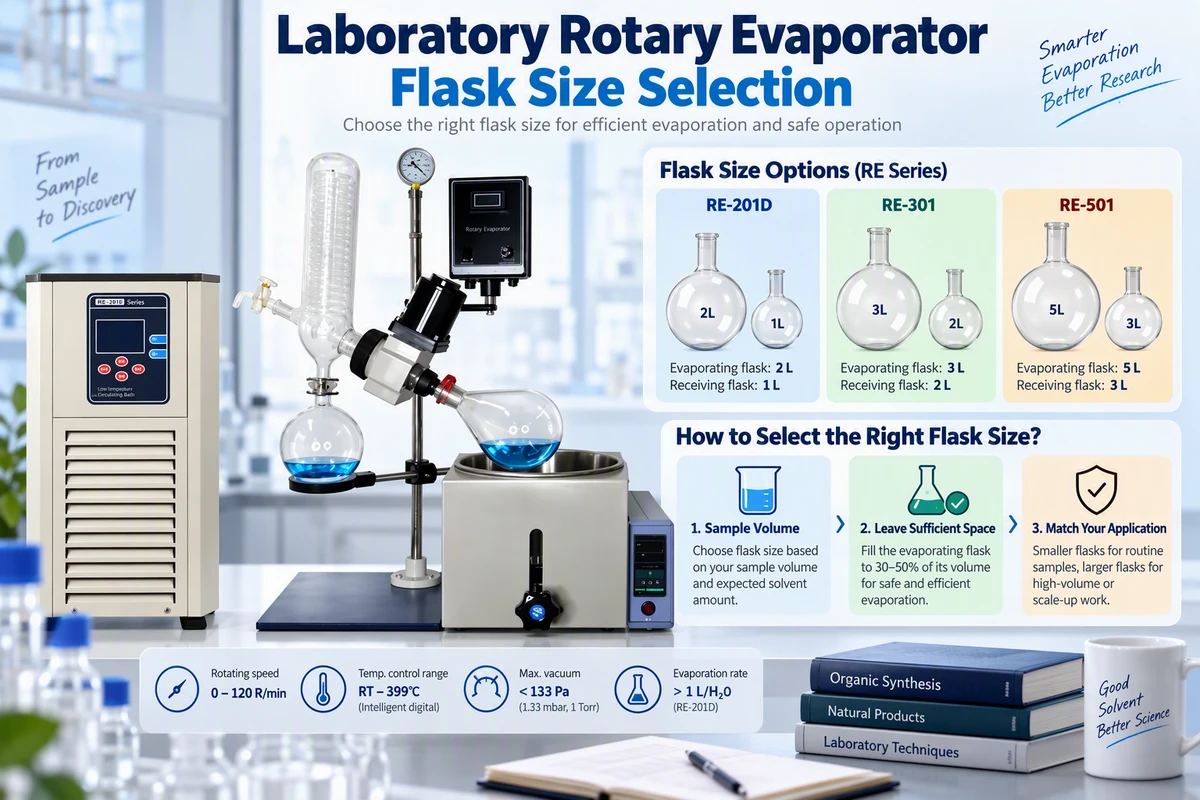
Do not fill an evaporation flask to its nominal capacity. Working charge depends on foaming, viscosity, bumping risk, and feed strategy. A conservative batch plan commonly leaves substantial headspace. Calculate required cycles with the actual working charge rather than the number printed on the flask.
10L, 20L, and 50L Rotary Evaporator Comparison
The following values come from the supplied equipment parameters. Water evaporation rate is a useful comparison benchmark, but it is not a guaranteed rate for ethanol, acetone, botanical extract, or a mixed solvent. Real recovery depends on pressure, bath temperature, condenser temperature, heat-transfer area, feed composition, and product concentration.
Swipe horizontally to view all specifications →
| Model | Evaporating Flask | Receiving Flask | Speed | Bath Power | Water Rate | Condenser | Lift |
|---|---|---|---|---|---|---|---|
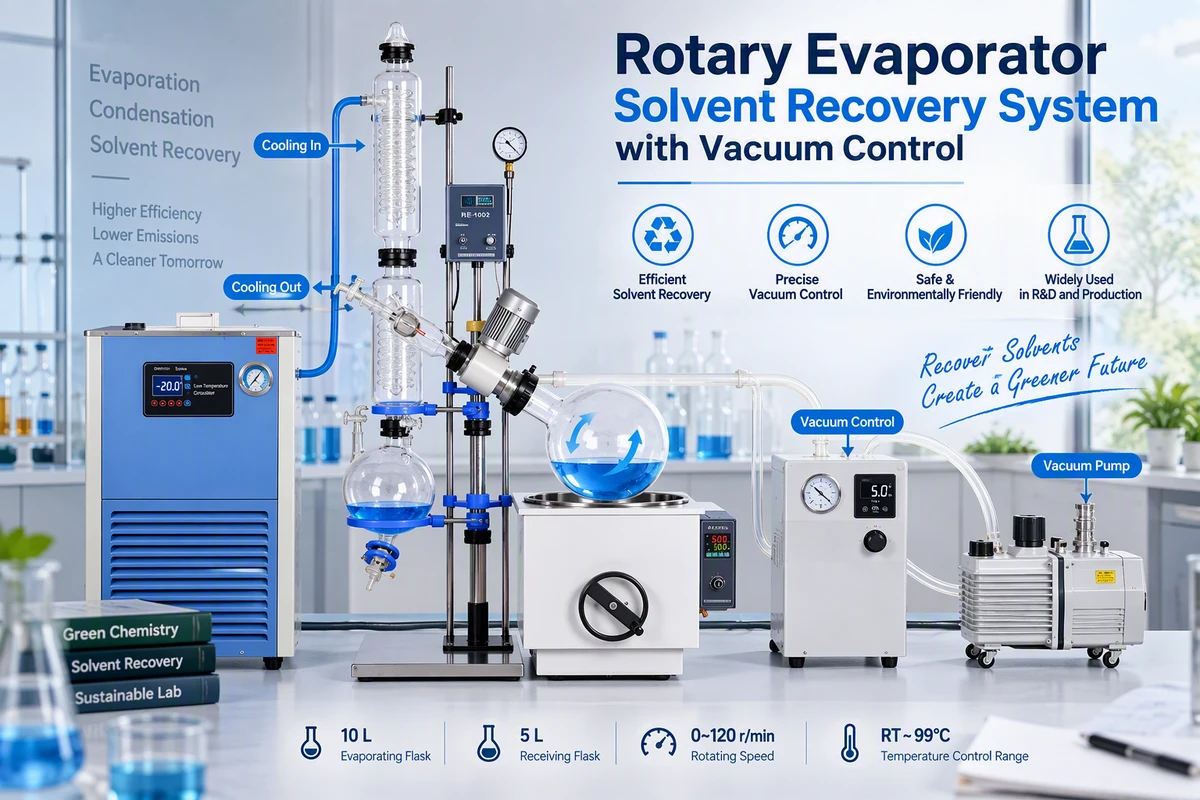
| RE-1002 | 10L | 5L | 0–120 rpm | 3000W | >3L/h | Vertical double | Manual bath, 0–220mm |
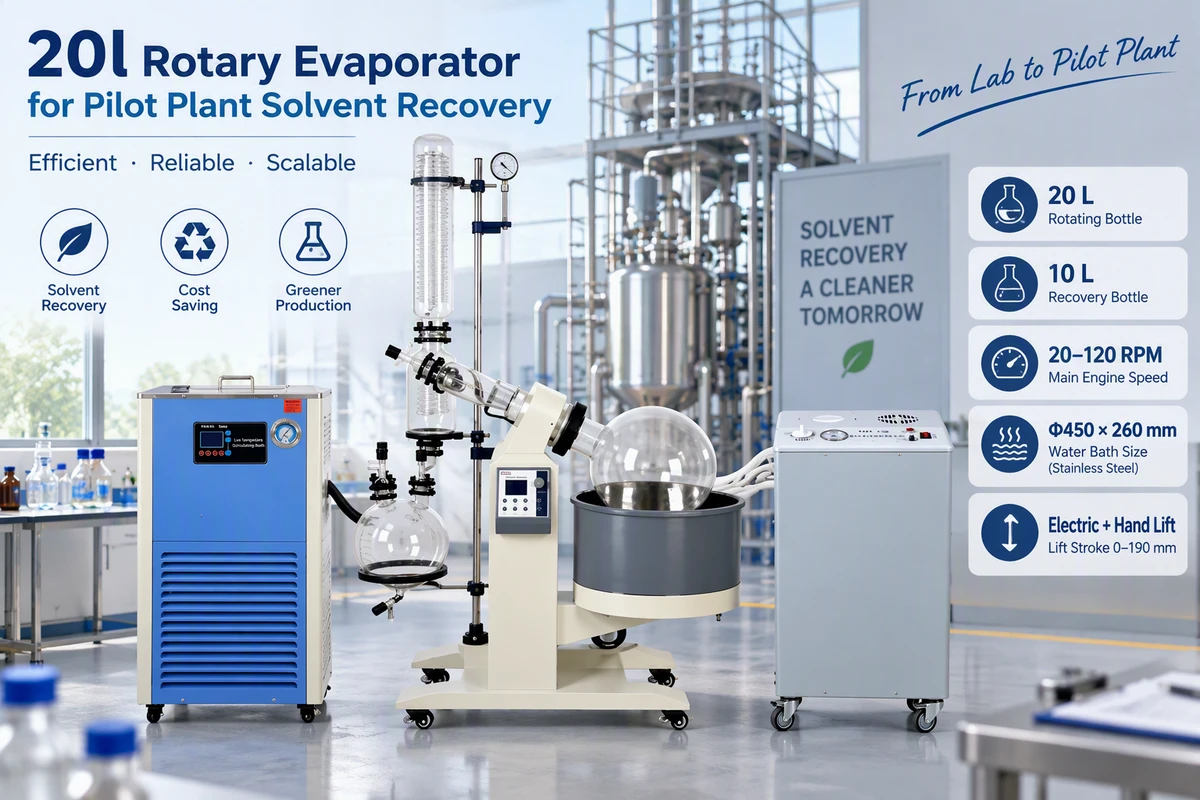
| RE-2002 | 20L | 10L | 0–120 rpm | 5000W | >5L/h | Vertical double | Manual bath, 0–220mm |
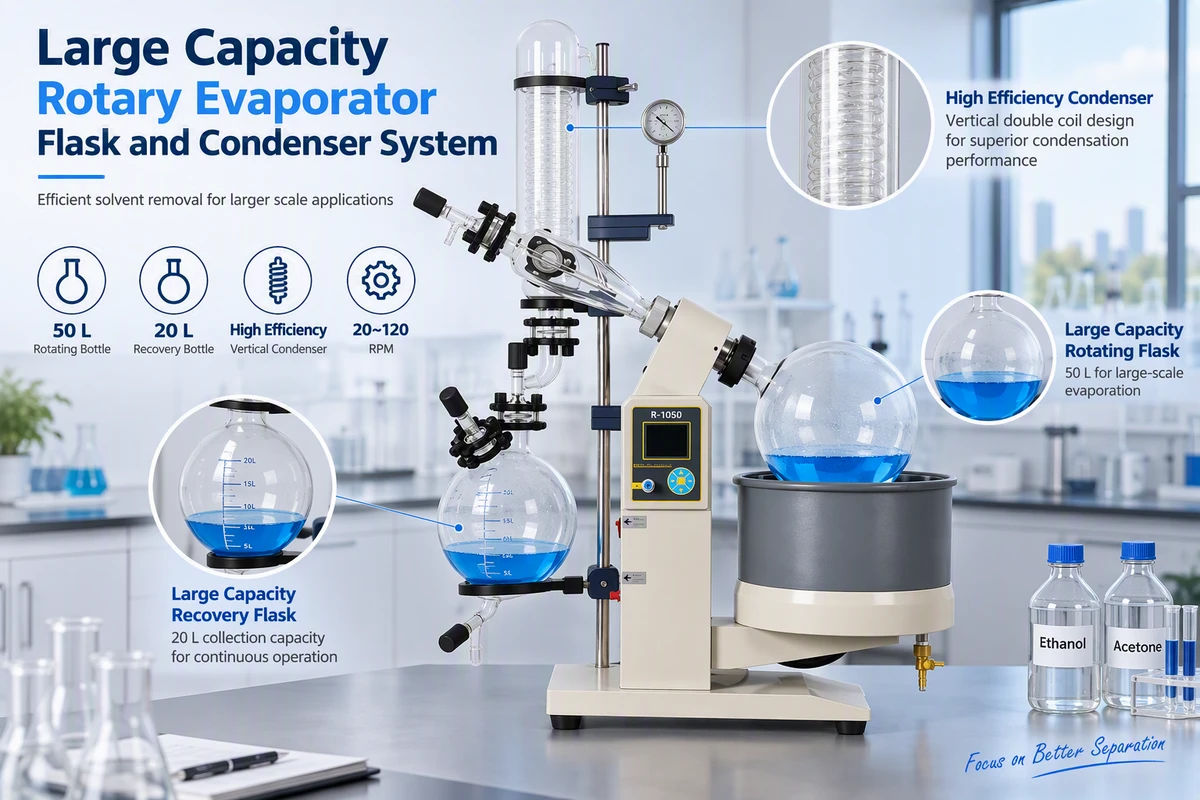
| RE-5002 | 50L | 20L | 0–90 rpm | 7000/9000W | >9L/h | Vertical double | Manual bath, 0–220mm |
| R1010 | 10L | 5L | 20–120 rpm | 3kW whole power | Not stated | High-efficiency reflux type | Electric + hand, 0–160mm |
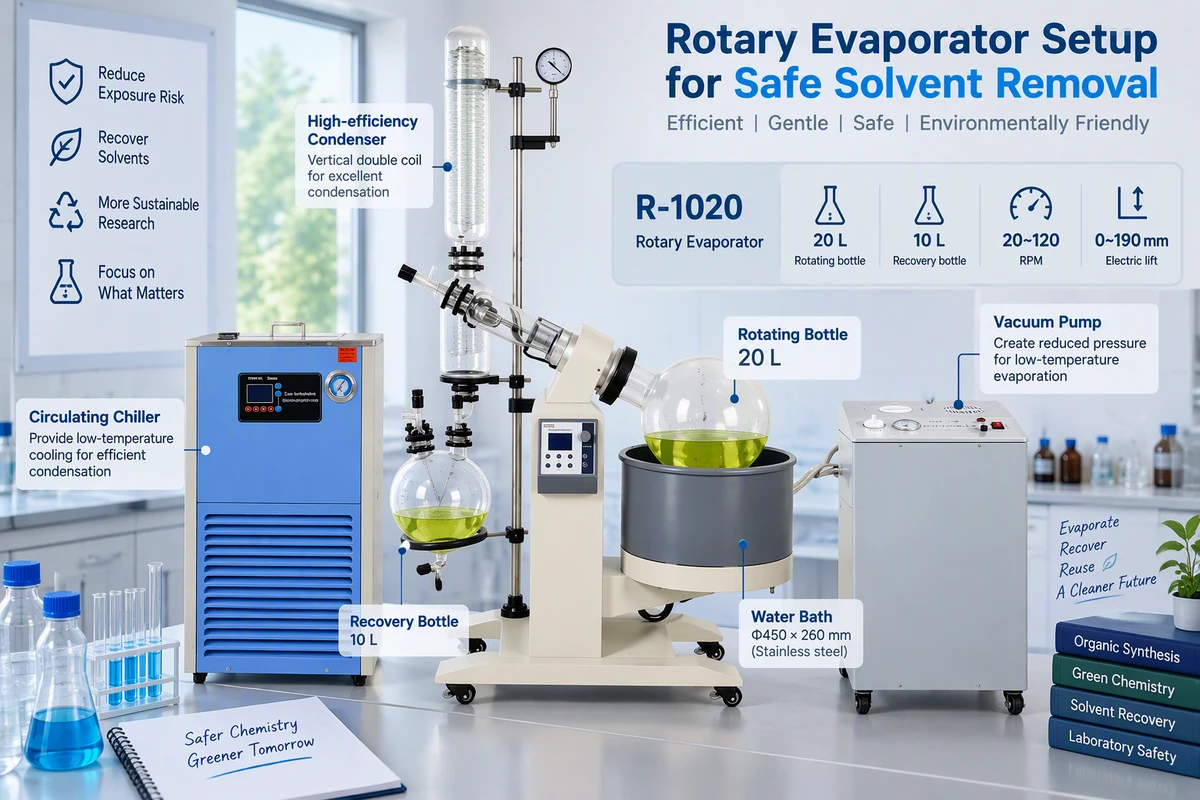
| R1020 | 20L | 10L | 20–120 rpm | 4kW whole power | Not stated | High-efficiency reflux type | Electric + hand, 0–190mm |
| R1050 | 50L | 20L | 20–120 rpm | 4.0kW at 220–240V | Not stated | High-efficiency reflux type | Electric + hand, 0–180mm |
The RE-2002 is attractive where a stated water benchmark above 5L/h and a simple manual bath lift suit the workflow. The R1020 is attractive where electric-plus-hand lifting, a brushless 250W drive, and a high-efficiency reflux condenser are priorities. For bulk extraction, the RE-5002 has a stated water benchmark above 9L/h, while the R1050 offers an electric-plus-hand lift and a listed 20–120 rpm range. A deeper look at a 50L rotary evaporator for bulk extraction can help determine whether the larger format is justified.
Should flask size be selected from total daily feed volume?
Author’s answer: No. Selection should use safe working charge, expected cycle time, cleaning time, and required cycles per shift. A 50L flask does not mean that 50L should be loaded at once, especially with foaming or bump-prone mixtures.
Vacuum and Cooling Determine Actual Recovery Performance
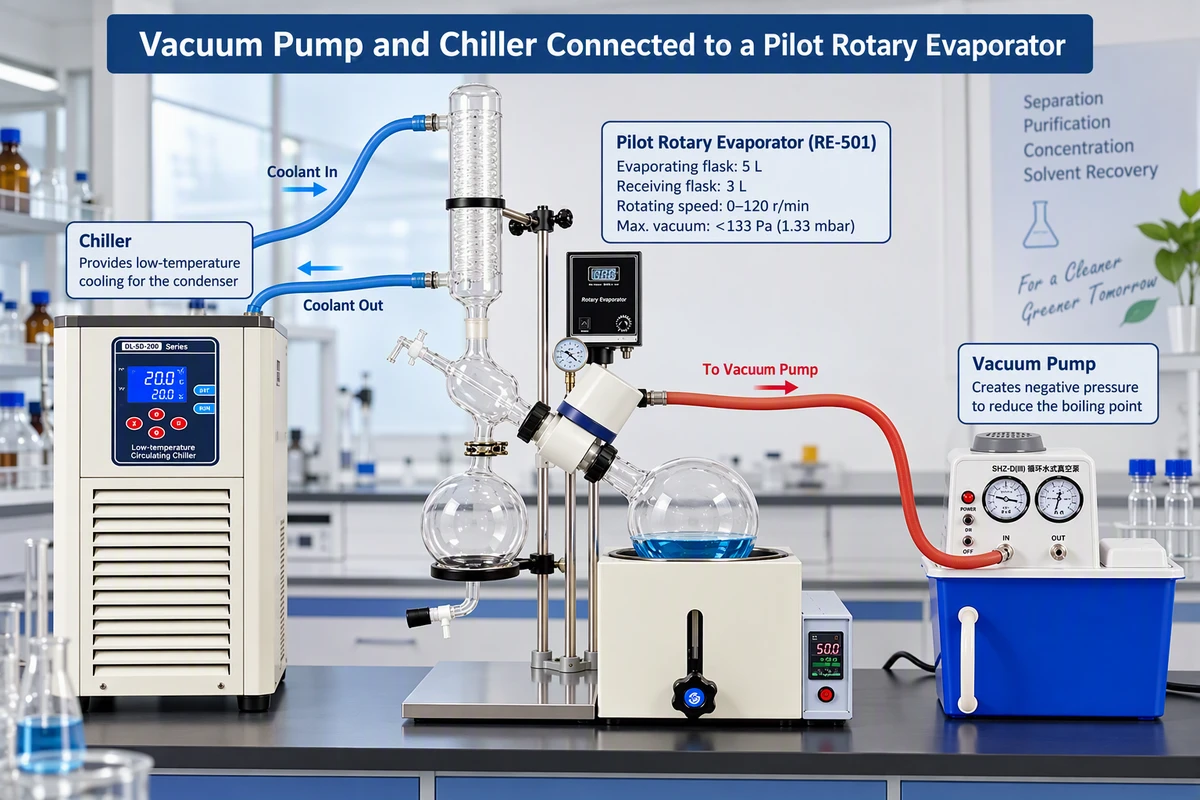
A pilot plant rotary evaporator is only one part of the solvent recovery system. The vacuum pump lowers boiling temperature, the bath supplies heat, and the chiller removes heat from the solvent vapor. If any one component is undersized, a large evaporation flask will not deliver its expected throughput.
According to the NIST Chemistry WebBook, ethanol boils at about 78.4°C and ethyl acetate at about 77.1°C at normal atmospheric pressure. Controlled vacuum lowers their boiling temperatures, which can reduce thermal stress on concentrates. The goal is not the deepest possible vacuum; the goal is a stable pressure at which vapor generation matches condenser capacity.
Does the highest vacuum always produce the fastest solvent recovery?
Author’s answer: No. Excessive vacuum can cause bumping, foaming, solvent carryover, or vapor overload. Stable and adjustable vacuum, combined with correct bath and coolant temperatures, usually gives better recovery and cleaner operation.
Choose a chemically compatible pump and use pressure control. A diaphragm pump is often suitable for organic vapor and controlled operation. A cold trap can reduce vapor entering the pump. For more detail, compare the operating needs of a vacuum pump for a rotary evaporator.
What utilities should be confirmed?
Available voltage, frequency, phase, circuit capacity, and grounding.
Chiller temperature range and cooling capacity at that temperature.
Vacuum pump chemical compatibility and usable pumping speed.
Ventilation or fume-control provisions for the solvent inventory.
Floor space, ceiling height, access route, and glassware service clearance.
Safety, Materials, and Maintenance Come Before Maximum Speed
Many recovered solvents are flammable. The NIOSH Pocket Guide reports an ethanol flash point of approximately 55°F (13°C), showing why vapor containment, ignition control, ventilation, grounding, and facility review are essential even when the liquid is processed under vacuum. Equipment suitability must be assessed for the actual solvent and the hazardous-location requirements of the installation.
The listed systems use PTFE and fluoro-rubber sealing. Compatibility still needs confirmation for every solvent mixture and operating temperature. Inspect glassware before each run, use protective shielding where appropriate, and never operate damaged, deeply scratched, or incorrectly clamped glass. Worn seals can reduce vacuum stability and recovery efficiency; this guide to rotary evaporator parts explains the components that commonly require inspection.
Best purchase checklist for a pilot plant
Choose 20L by default for moderate throughput and changing pilot campaigns.
Choose 50L when measured feed volume, shift targets, and utilities support bulk recovery.
Choose 10L for lower-volume development, frequent cleaning, or limited space.
Request a recovery test or engineering estimate using the actual solvent mixture.
Size the receiving flask for the planned collection interval and prevent overfilling.
Confirm spare seals, flasks, condensers, and service support before commissioning.
Include pump, chiller, tubing, traps, controls, installation, and training in total cost.
Final verdict: the 20L class is the best rotary evaporator for most pilot plant solvent recovery applications. The RE-2002 is a straightforward choice when a stated >5L/h water benchmark and 5000W bath are suitable. The R1020 is a strong alternative when assisted lifting and a brushless drive are valued. Move to a 50L RE-5002 or R1050 only when repeatable bulk throughput outweighs higher space, utility, cleaning, and safety demands.
Specify a Complete Pilot Plant Solvent Recovery System
Provide the solvent name, feed volume per shift, desired cycle time, product sensitivity, available voltage, and coolant conditions. These details make it possible to match the rotary evaporator, vacuum pump, chiller, and accessories as one balanced system.
Request a Pilot Plant RecommendationFinal equipment selection and installation should be reviewed under the facility’s process-safety and electrical requirements.