How to Choose Rotary Evaporator Size for Lab?
The right rotary evaporator size is determined by the normal liquid charge, required processing time, solvent behavior, condenser capacity, available utilities, and laboratory space—not simply by choosing the largest flask within budget.
Size the Flask Around the Real Batch
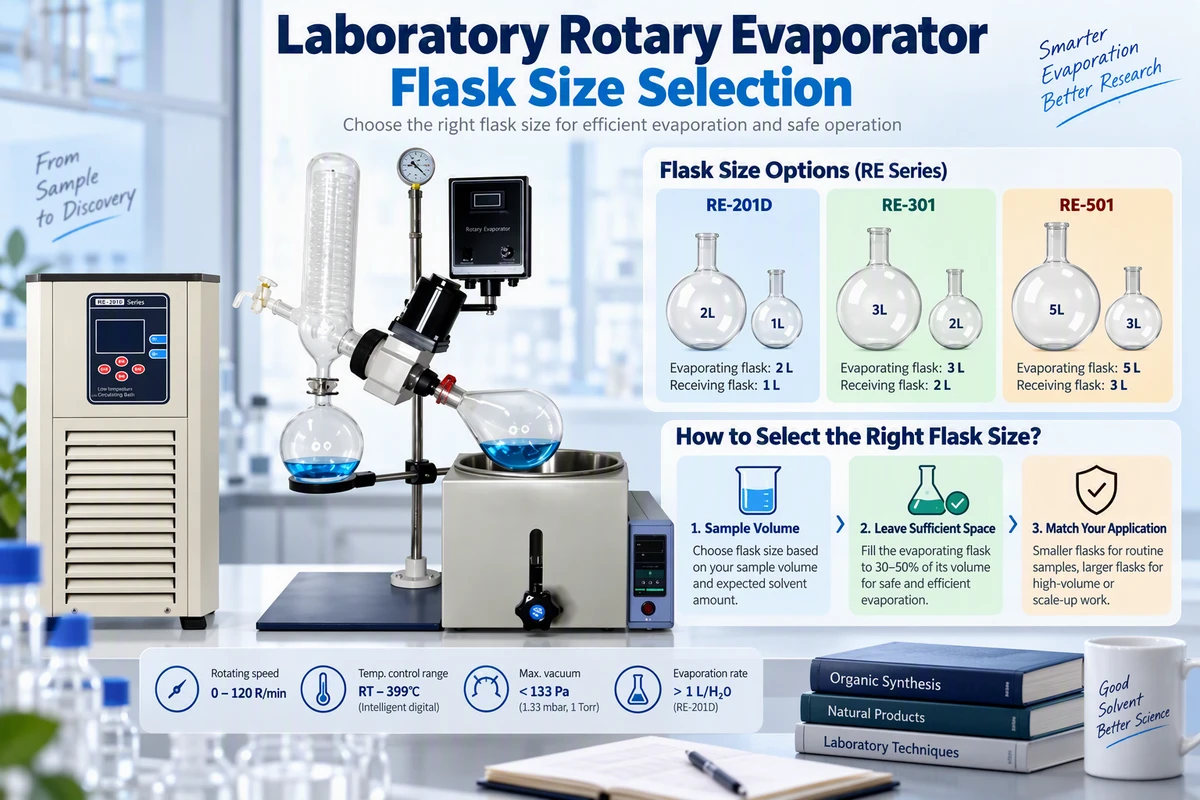
A rotary evaporator flask needs empty space. Rotation spreads liquid into a thin film, but the sample can foam, surge, or bump when vacuum is applied. Filling a flask to its labeled capacity removes this safety margin and can push liquid into the vapor duct or condenser.
Recommended flask size = normal batch volume ÷ 0.50 to 0.67In simple terms, a 1 L charge belongs in a 2 L flask, while a 2.5–3 L charge is better suited to a 5 L flask. Foaming botanical extracts, viscous concentrates, and mixtures that bump easily should stay closer to 50% fill. Clean, predictable solvents may be processed nearer 60–67% fill when the operating procedure has been validated.
No. I treat the marked flask volume as total physical capacity, not the recommended working charge. Leaving roughly one-third to one-half of the flask empty improves film formation and gives vapor and foam room to move safely.
Also consider the smallest batch. A 50 L machine is a poor match for a few hundred milliliters because the large glassware, bath, cooling loop, and cleaning workload add time without creating a useful advantage. For small-batch solvent removal, this guide to the best lab rotary evaporator provides a more focused comparison.
Rotary Evaporator Size Comparison for Labs
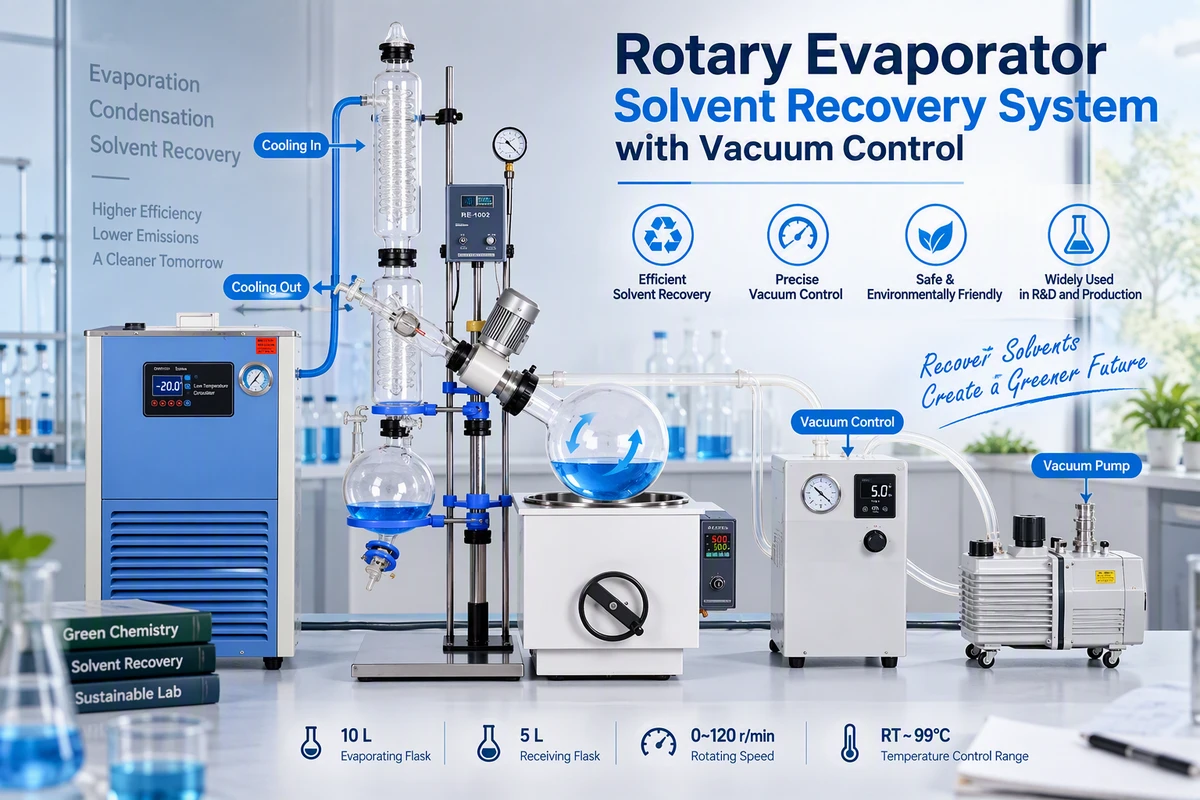
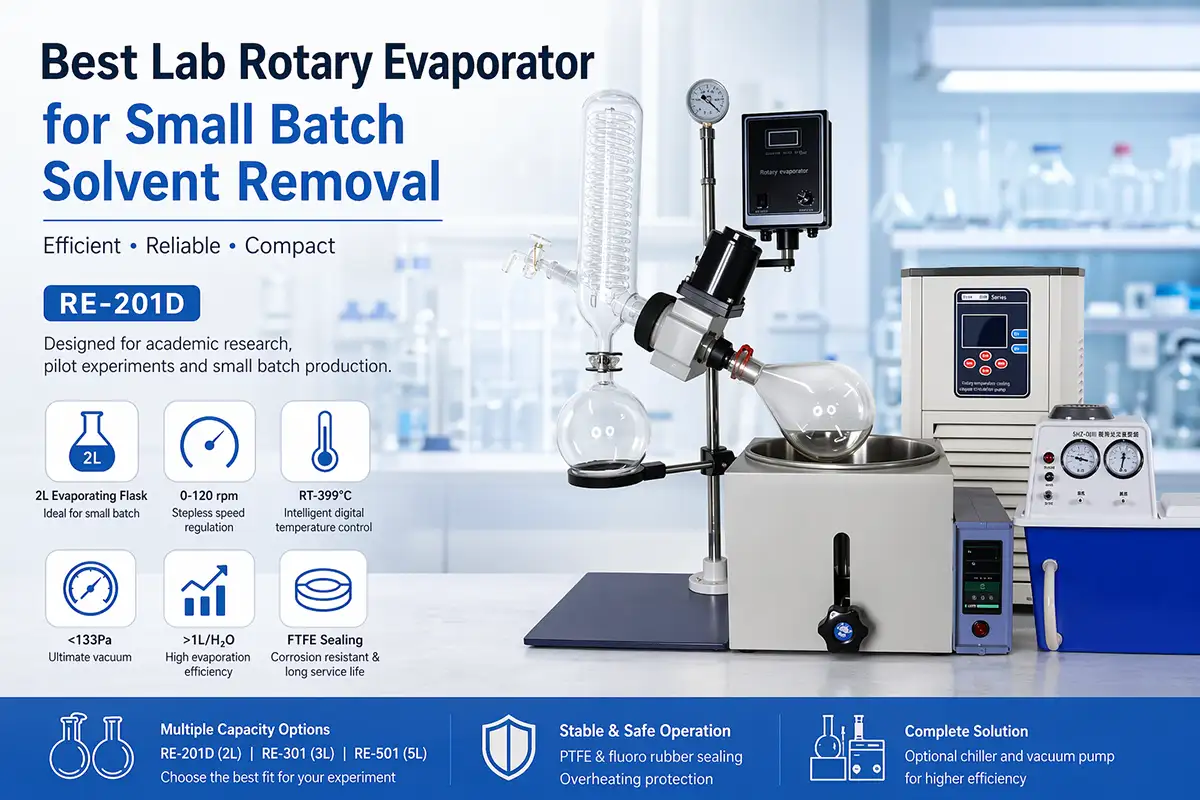
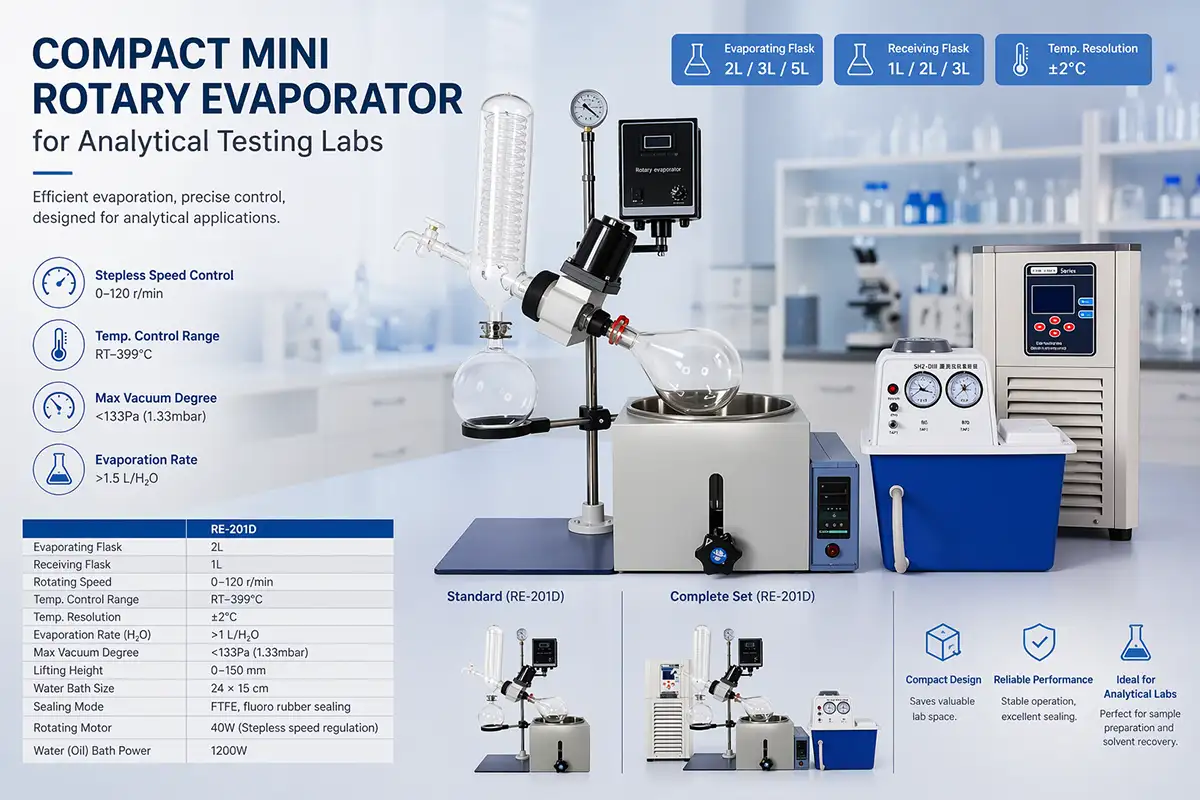
The supplied specifications show a clear division between benchtop systems and pilot-scale equipment. RE-201D, RE-301, and RE-501 models use 2 L, 3 L, and 5 L evaporation flasks with 0–120 rpm rotation. Larger RE-1002, RE-2002, and RE-5002 units provide 10 L, 20 L, and 50 L flasks with rated water evaporation above 3, 5, and 9 L/h respectively.
| Model / Size | Sensible Routine Charge | Receiver | Rated Water Evaporation | Bath Power | Typical Use | Indicative Listed Price |
|---|---|---|---|---|---|---|
| RE-201D / 2 L | 0.5–1.3 L | 1 L | >1 L/h | 1,200 W | R&D and analytical batches | about $595 |
| RE-301 / 3 L | 1–2 L | 2 L | >1.5 L/h | 1,500 W | Medium bench batches | about $800 |
| RE-501 / 5 L | 2–3.3 L | 3 L | >1.5 L/h | 1,500 W | Frequent lab recovery | about $920 |
| RE-1002 / 10 L | 4–6.5 L | 5 L | >3 L/h | 3,000 W | Scale-up and pilot work | about $1,900 |
| RE-2002 / 20 L | 8–13 L | 10 L | >5 L/h | 5,000 W | Pilot solvent recovery | about $2,200 |
| RE-5002 / 50 L | 20–33 L | 20 L | >9 L/h | 7,000/9,000 W | Bulk extraction and production | about $2,545 |
Prices are representative equipment-list figures supplied for planning, not final quotations. Configuration, voltage, freight, vacuum pump, chiller, controls, and glassware package can change the total system cost.
I recommend a 2 L rotary evaporator for a normal 1 L starting charge. It provides comfortable headspace, remains compact, and avoids the utility demand of a pilot-scale system.
Capacity Alone Does Not Determine Throughput
A larger flask creates more film area, yet actual speed depends on bath temperature, rotation, vacuum level, condenser temperature, solvent boiling point, and heat transfer. The listed rates use water as the test liquid, so they should not be copied directly into an ethanol, acetone, or viscous-extract production forecast.
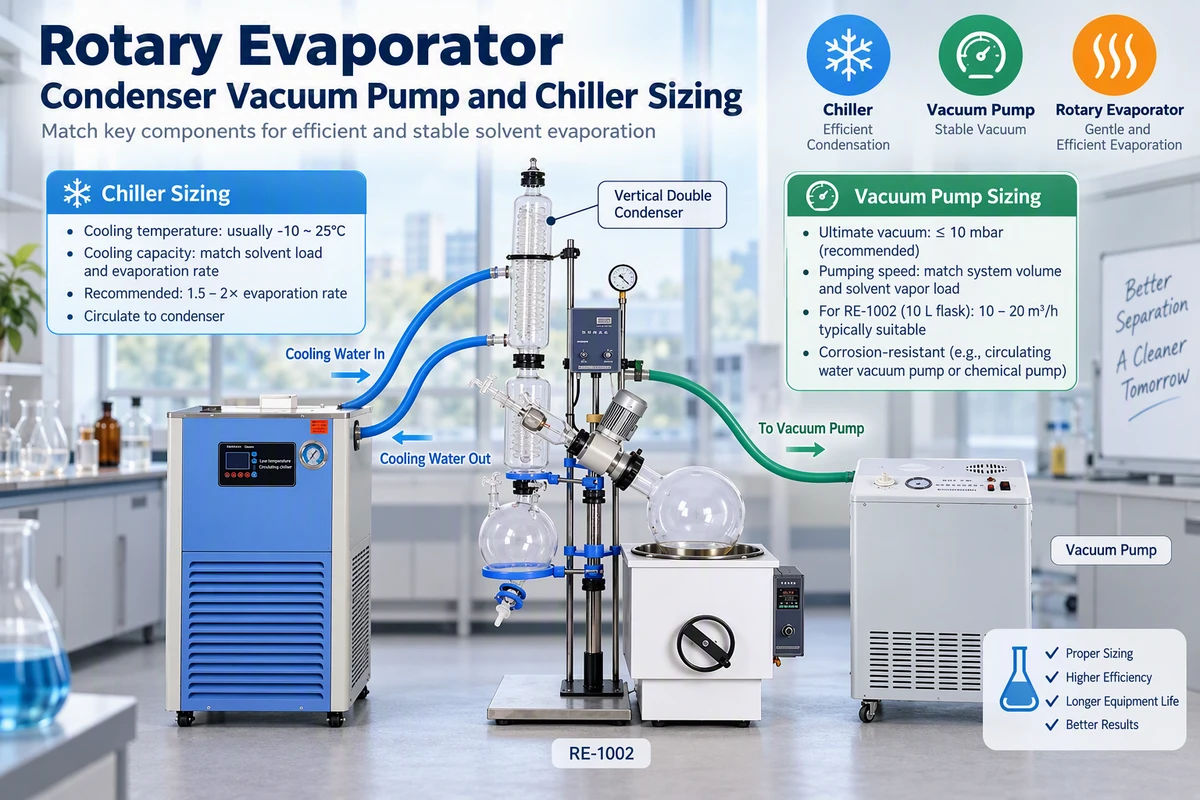
For safety context, OSHA lists an 8-hour permissible exposure limit of 1,000 ppm for ethanol and acetone, while methylene chloride is regulated at 25 ppm as an 8-hour time-weighted average. These limits show why a sealed evaporation path, effective condensation, compatible vacuum equipment, and suitable ventilation matter when sizing a system. More capacity can release more vapor per hour, so the condenser and chiller must grow with the evaporator.
Check bath power and electrical service
Small 2–5 L models use 1,200–1,500 W baths. The 10 L, 20 L, and 50 L models step up to 3,000 W, 5,000 W, and 7,000/9,000 W. The 50 L specification calls for 380 V/50 Hz, while 10 L and 20 L versions list 220 V/50 Hz. Voltage and frequency must be confirmed before purchase, especially where the laboratory supply differs from the standard configuration.
Match the pump to the vapor load
The small RE series lists a maximum vacuum below 133 Pa under specified conditions, but ultimate pump vacuum is only part of the decision. Chemical compatibility, flow rate, vapor tolerance, vacuum regulation, and solvent capture are equally important. A detailed vacuum pump for rotary evaporator guide can help prevent an undersized or chemically incompatible pump.
No. I would choose 50 L only when the feed volume, cooling capacity, power supply, operator workflow, and recovery target support it. For a 2 L daily charge, a well-controlled 5 L system can finish the job with less setup, warm-up, cleaning, and floor-space demand.
Measure Space, Glass Handling, and Cleaning Time
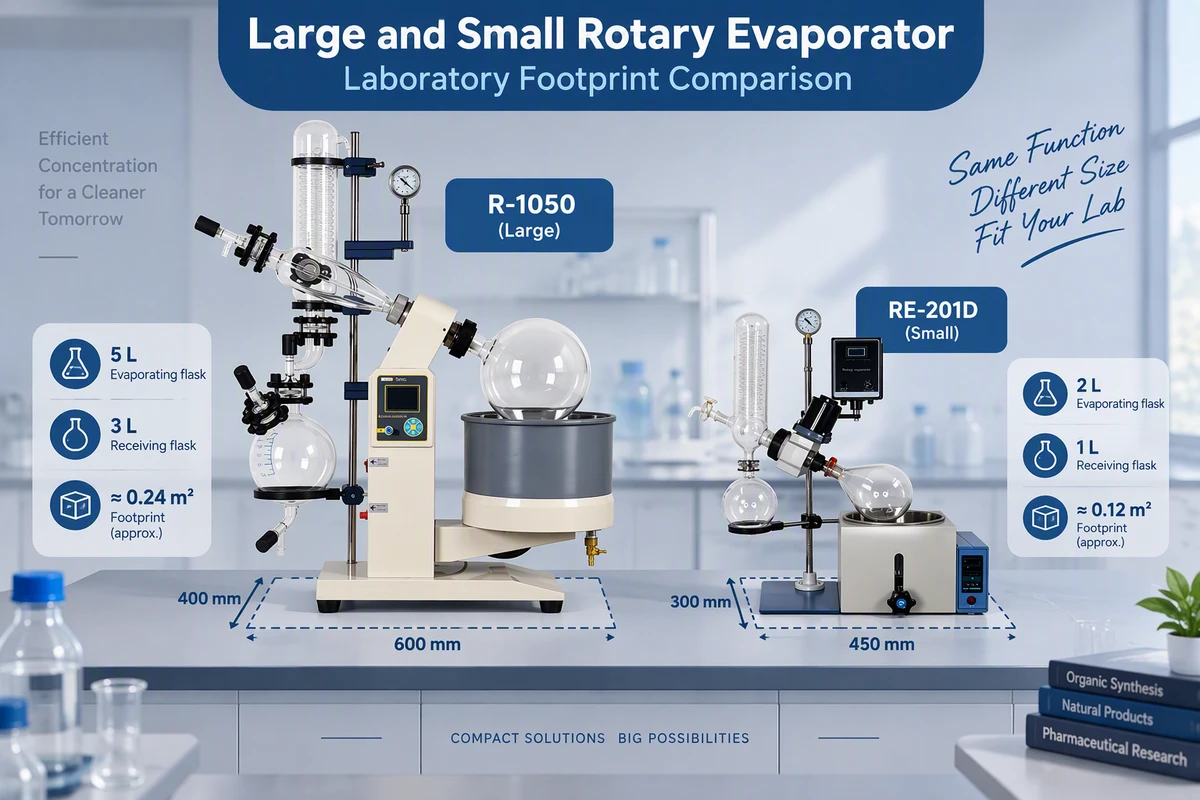
Benchtop capacity does not automatically mean a unit will fit under an existing shelf or inside an enclosure. The R-series dimensions show the scale difference: the 5 L R1005 is approximately 660 × 400 × 1,020 mm, while the 50 L R1050 reaches about 1,320 × 770 × 2,340 mm. The larger system needs floor space, overhead clearance, safe access to the bath, and room for a chiller and vacuum pump.
Glassware weight also rises sharply with size. Check lift type, flask installation height, drain access, receiver handling, and whether one operator can safely load and unload the system. Replacement seals, vapor ducts, flasks, clamps, and receiving bottles should be included in ownership planning. The rotary evaporator parts guide explains the components that affect maintenance and uptime.
A Simple Rotary Evaporator Sizing Checklist
Record the usual and maximum starting volume. Size for routine work, not a rare oversized batch.
Divide the normal charge by 0.50–0.67. Round up to the next standard flask size.
Define the solvent and target processing time. Ask for evaporation data under comparable pressure and temperature.
Verify condenser and chiller capacity. Cooling must handle peak vapor generation, not merely maintain a low no-load temperature.
Confirm voltage, bath power, and vacuum compatibility. Include pumps, tubing, traps, and ventilation in the plan.
Measure the installation area. Allow clearance for lifting, flask removal, maintenance, and safe operator movement.
Compare complete-system cost. A low evaporator price may exclude the chiller, vacuum pump, controller, or required glassware.
Choose Capacity as a Complete System
A reliable recommendation should include feed volume, solvent, desired cycle time, bath temperature, available voltage, cooling-water conditions, and installation dimensions. With those details, flask size, condenser, chiller, and vacuum pump can be matched as one working rotary evaporation system.
Explore Rotary Evaporator Solutions