How to Choose a Rotary Evaporator for Solvent Recovery?
The right rotary evaporator is not simply the largest or cheapest machine. It is the system that matches the solvent, batch volume, required recovery speed, cooling load, vacuum range, and safety conditions. This guide gives a direct, easy-to-use method for making that choice.
Start with the Solvent, Not the Machine
A rotary evaporator recovers solvent by combining rotation, controlled heating, vacuum, and condensation. Vacuum lowers the boiling temperature, the rotating flask spreads liquid into a thin film, and the condenser turns vapor back into reusable liquid. A clear explanation of the underlying rotovap chemistry and rotary evaporation process is useful before comparing equipment.
Write down the main solvent, solvent mixture, expected vapor volume, product sensitivity, and desired final concentration. According to the NIST Chemistry WebBook, ethanol has a normal boiling point of about 78.4°C, while ethyl acetate boils at about 77.1°C at atmospheric pressure. A rotary evaporator can process both at substantially lower liquid temperatures under suitable vacuum, helping protect heat-sensitive extracts.
The vacuum pump must be compatible with solvent vapor. A chemically resistant diaphragm pump is often preferred for corrosive or organic vapors and precise pressure control. A water-circulating pump can be economical for general work, but its attainable vacuum and water temperature may vary. An oil-sealed pump may reach deeper vacuum, yet a cold trap is important to prevent solvent contamination of the oil.
Author’s answer: Stable, adjustable vacuum is usually more valuable. The deepest possible vacuum can cause violent boiling, bumping, product carryover, or condenser overload. Controlled pressure near the solvent’s required boiling condition gives cleaner recovery and more repeatable results.
For pump sizing and chemical compatibility details, review this practical guide to choosing a vacuum pump for a rotary evaporator.
Choose Flask Capacity from the Real Working Volume
Flask size is not the same as usable batch size. Space is needed for film formation and safe rotation, so the evaporating flask should not be filled to its nominal capacity. As a practical starting point, plan around roughly one-half of the flask volume, then reduce the charge for foaming or bump-prone materials. For example, a 5L flask is commonly a better match for a 2–3L charge than a 5L charge.
Do not size equipment from one batch alone. Calculate liters processed per day, number of shifts, acceptable batch time, cleaning time, and the possibility of future growth. A smaller system can be sufficient for occasional work, while a larger evaporator may reduce labor when many identical batches are processed.
Author’s answer: Not automatically. It offers greater batch capacity, but actual speed depends on heating power, condenser area, coolant temperature, vacuum stability, flask rotation, and solvent properties. A well-matched 20L system can outperform a poorly cooled 50L system.
Match the Condenser and Chiller to the Vapor Load
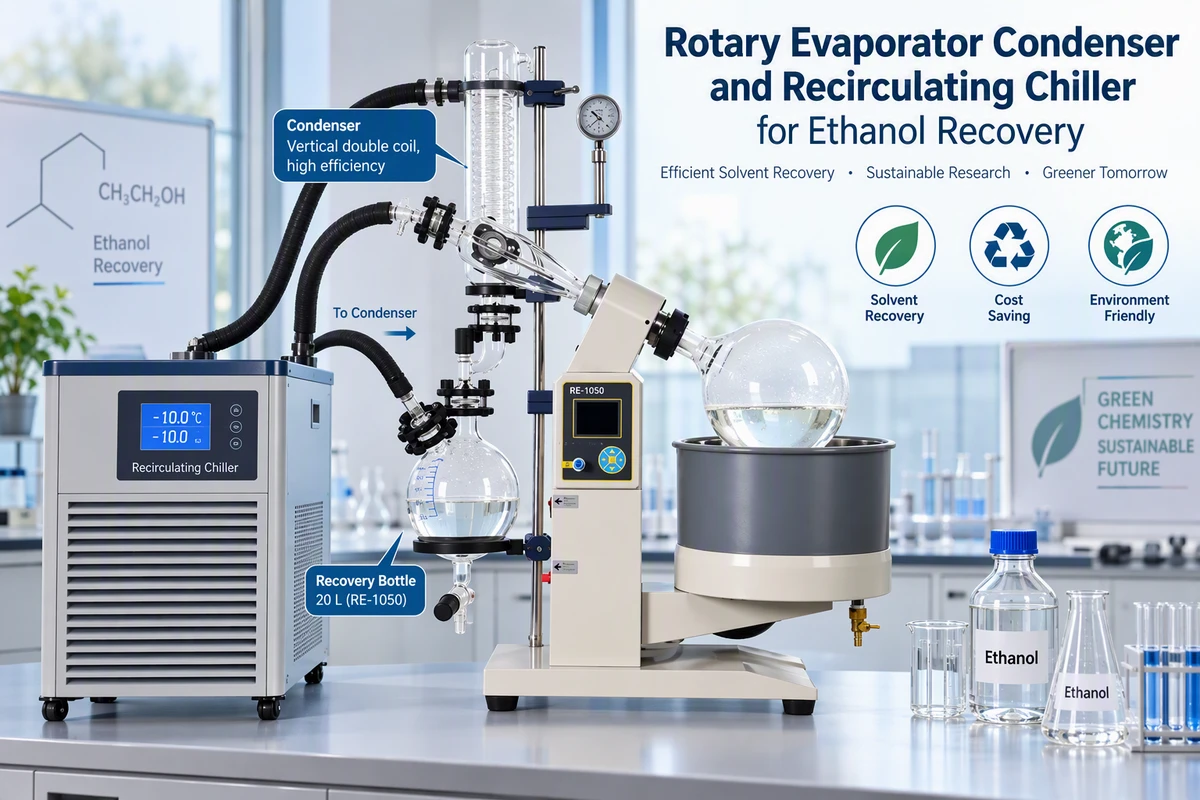
Successful solvent recovery is not only about evaporation; vapor must also be condensed. If cooling capacity is too low, vapor may pass through the condenser, solvent recovery falls, and the vacuum pump receives unnecessary vapor. Select coolant temperature according to the solvent and operating pressure, then confirm that the chiller can remove the expected heat load continuously.
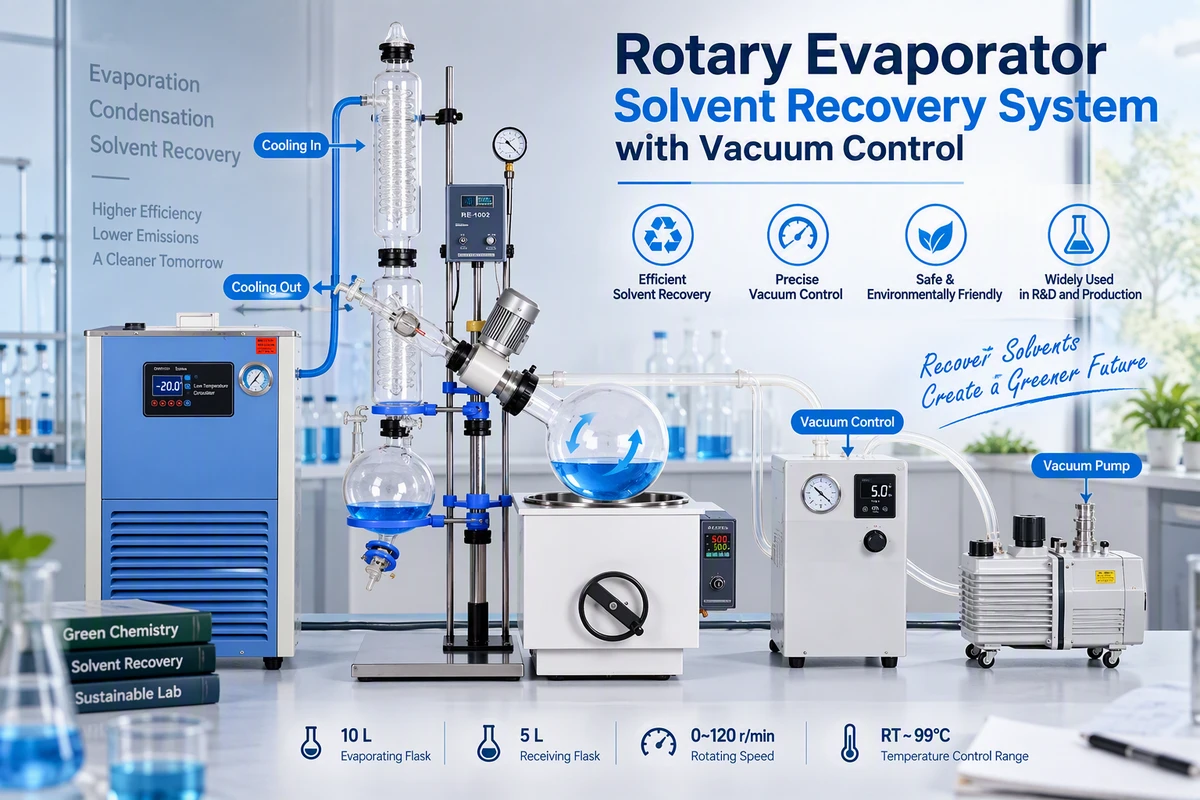
A vertical double condenser is a useful choice for medium and large systems because it provides more cooling surface. The supplied RE-1002, RE-2002, and RE-5002 specifications use a vertical double condenser, while the R1050 uses a high-efficiency reflux condenser arrangement. Keep coolant flow counter-current where the manufacturer specifies it, use insulated hoses when condensation forms, and keep hose diameter large enough to avoid flow restriction.
Compare Specifications That Affect Recovery
The following figures come from the supplied equipment parameter sheets. Water evaporation rates are useful for comparing models under test conditions, but they should not be treated as guaranteed rates for every solvent or mixture. Real performance changes with solvent vapor pressure, coolant temperature, vacuum quality, fill level, heat transfer, and ambient conditions.
| Model | Evaporating flask | Receiving flask | Rotation | Bath power | Water evaporation rate | Typical use |
|---|---|---|---|---|---|---|
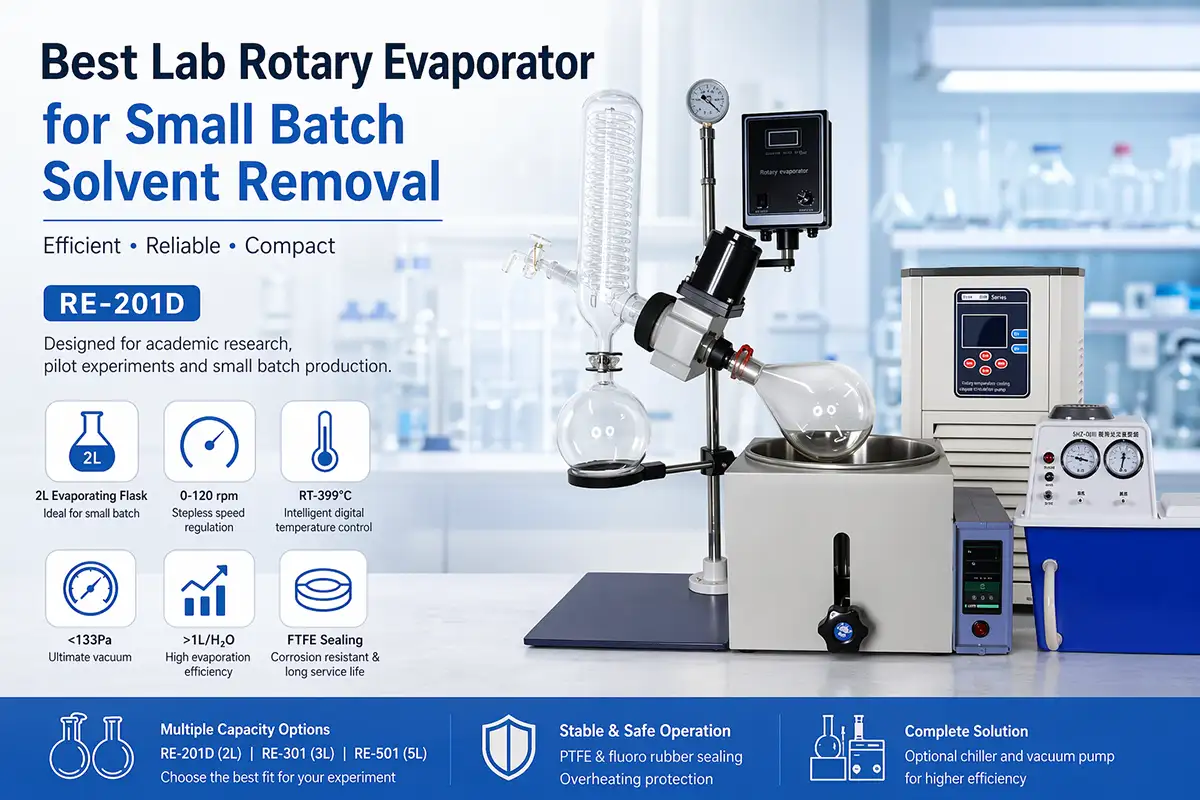
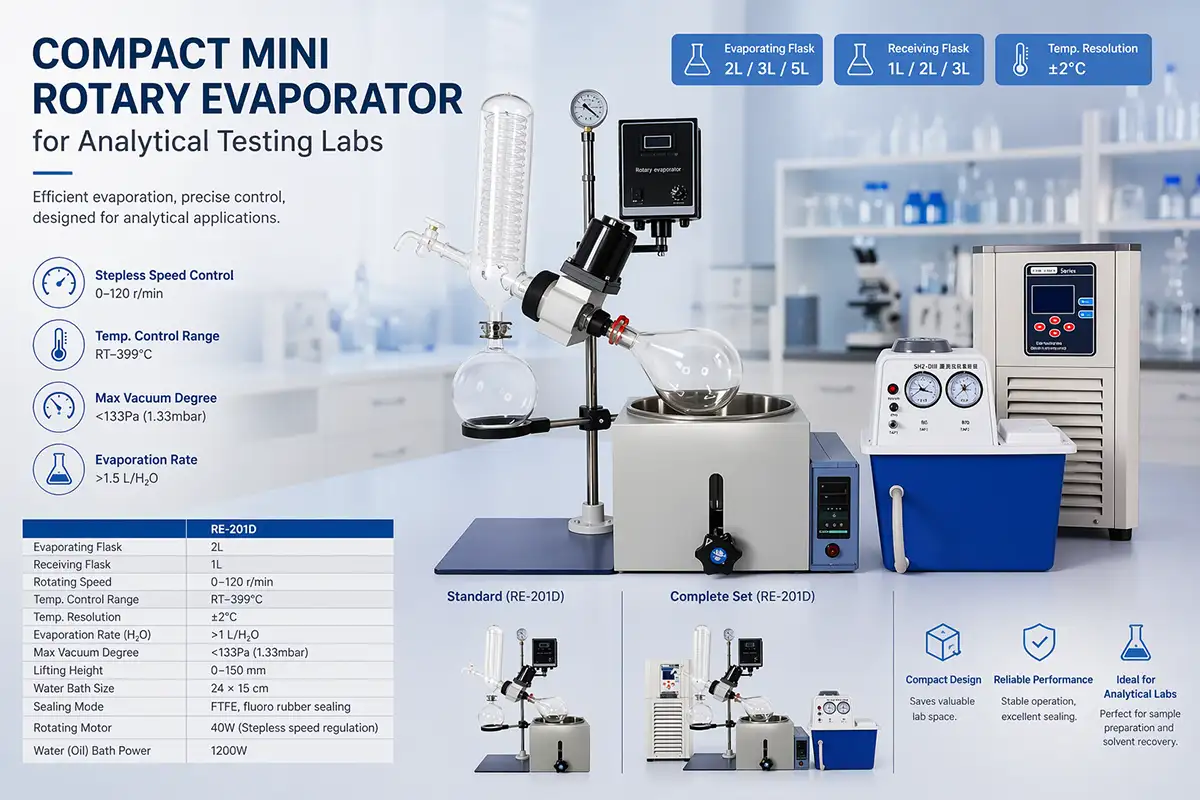
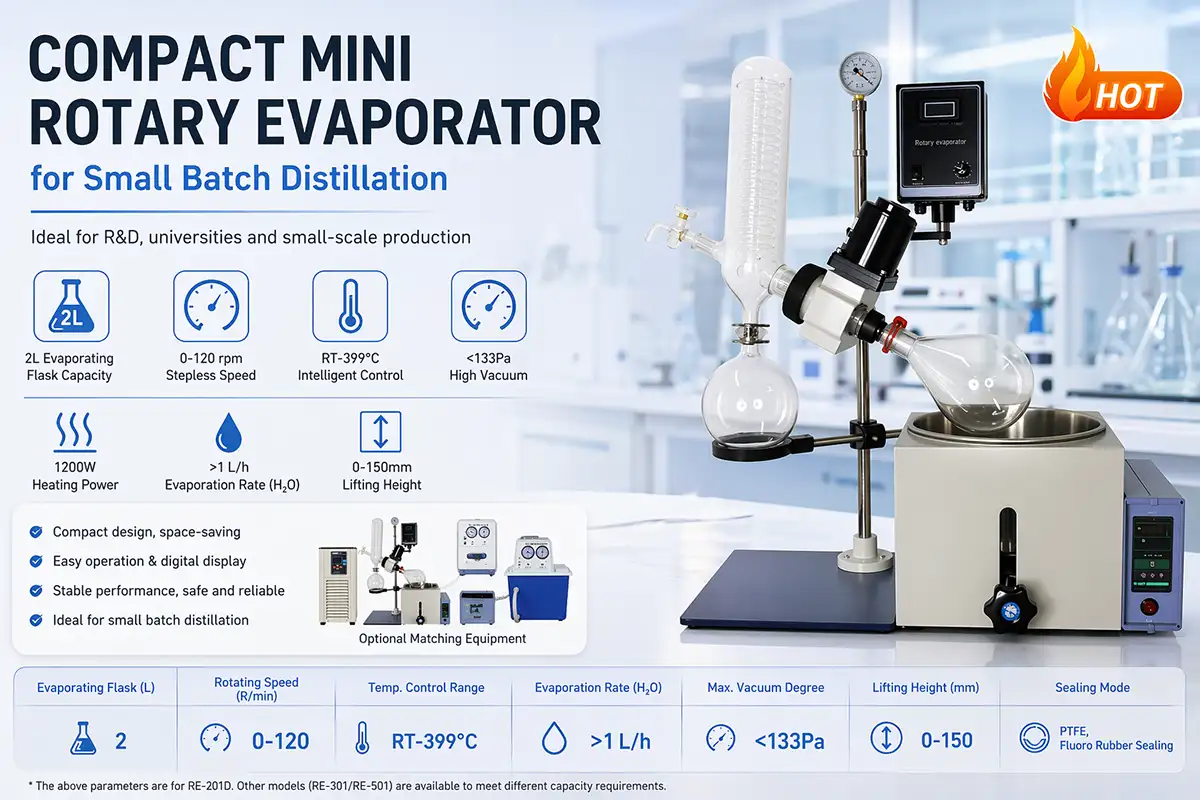
| RE-201D | 2L | 1L | 0–120 rpm | 1,200W | >1 L/h | Small laboratory batches |
| RE-301 | 3L | 2L | 0–120 rpm | 1,500W | >1.5 L/h | Research and formulation |
| RE-501 | 5L | 3L | 0–120 rpm | 1,500W | >1.5 L/h | Routine solvent removal |
| RE-1002 | 10L | 5L | 0–120 rpm | 3,000W | >3 L/h | Medium-volume recovery |
| RE-2002 | 20L | 10L | 0–120 rpm | 5,000W | >5 L/h | Pilot-scale recovery |
| RE-5002 | 50L | 20L | 0–90 rpm | 7,000/9,000W | >9 L/h | Bulk solvent recovery |
Also compare temperature stability, lift travel, motor torque, sealing materials, receiving-flask volume, drain design, glass replacement availability, and local voltage. The RE-1002/2002/5002 series specifies ±1°C temperature fluctuation and PTFE plus fluoro-rubber sealing. The 50L RE-5002 requires a 380V/50Hz supply in the listed configuration, so electrical compatibility must be confirmed before ordering.
Check Safety, Glass Quality, and Solvent Compatibility
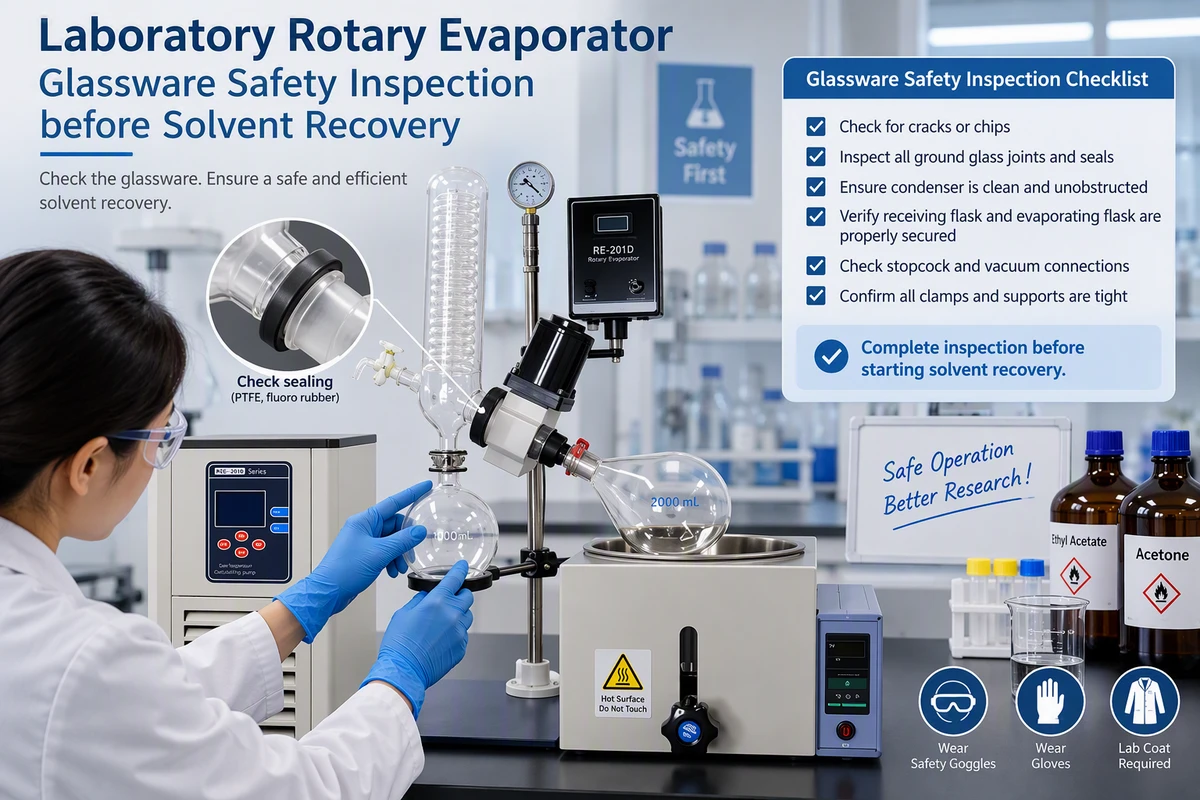
A rotary evaporator operates with heated liquid, rotating glassware, and vacuum. The American Chemical Society’s laboratory safety guidance emphasizes inspecting glassware for chips, cracks, and damage before use. This is especially important because damaged evacuated glass can implode. A protective shield, secure flask clip, stable frame, emergency stop, and easy bath lowering improve practical safety.
For flammable solvents such as ethanol, acetone, or ethyl acetate, assess room ventilation, electrical classification, ignition sources, static control, and local fire code requirements. Explosion-proof motors and electrical components may be required in classified locations; a standard laboratory evaporator should not be assumed safe for every hazardous area.
Confirm borosilicate glass and inspect it before every run.
Check PTFE seals, vacuum tubing, clips, and receiving-flask connections.
Use a bump trap or controlled vacuum ramp for foaming samples.
Keep the condenser cold before applying strong vacuum and heat.
Choose a lift mechanism that can remove the flask from the bath quickly.
Wear parts affect both safety and uptime. Before buying, verify access to vapor ducts, sealing rings, flask clips, condensers, and replacement glass. This guide to rotary evaporator parts explains what each component does.
Compare Total System Cost, Not Only Rotary Evaporator Price
The purchase price may exclude the vacuum pump, chiller, cold trap, controller, hoses, spare seals, freight, or voltage customization. A low-cost evaporator can become expensive if the condenser is undersized or replacement glass is difficult to obtain. Ask for a complete bill of materials and confirm which accessories are included.
Based on the supplied price list, small 2L units appear around US$595, common 5L systems around US$920, 10L RE-1002 equipment around US$1,900, 20L RE-2002 equipment around US$2,100, and a standard 50L RE-5002 configuration around US$2,545. Where a listing provided a range, the middle-lower value was used; for example, a US$900–930 5L listing is represented by about US$910 rather than the highest figure. These are reference product prices, not delivered quotations.
Author’s answer: Only when it still meets the process requirements. Vacuum control, cooling capacity, seal life, safe lifting, spare-part support, and solvent compatibility usually have a greater effect on long-term cost than a small saving at purchase.
A Simple Buying Decision
Choose a rotary evaporator for solvent recovery in this order:
Identify the solvent and required pressure. This determines pump compatibility, vacuum control, seal materials, and cooling temperature.
Calculate the true working batch and daily throughput. Select flask volume with safe headspace rather than filling to nominal capacity.
Match evaporation and condensation. Strong heating without adequate cooling causes solvent loss and unstable pressure.
Confirm utilities and safety. Check voltage, ventilation, hazardous-area requirements, lift type, glass protection, and hose connections.
Compare complete prices. Include pump, chiller, controller, cold trap, consumables, freight, and technical support.
For occasional small batches, a 2–5L rotovap is normally the simplest answer. For frequent medium batches, a 10–20L rotary evaporator provides a useful balance of throughput and control. For pilot production and bulk extraction, a 50L rotary evaporator becomes reasonable only when the vacuum pump and chiller are sized for the larger vapor load. That system-level match is the most reliable route to fast recovery, high solvent capture, and consistent product quality.
Build a Rotary Evaporator System Around the Process
Provide the solvent name, liters per batch, batches per day, target temperature, local voltage, and whether a pump and chiller are already available. These details make it possible to recommend the correct evaporator capacity and supporting equipment instead of oversizing or undersizing the system.