Which Rotary Evaporator Is Best for Pharmaceutical Production?
The best rotary evaporator for pharmaceutical production is the one that matches batch volume, solvent load, vacuum stability, condenser capacity, sealing materials, and scale-up risk. For most pharmaceutical labs, a 5L unit is ideal for formulation and process development, a 10L or 20L unit fits pilot production, and a 50L rotary evaporator is the stronger choice for repeated production-scale solvent recovery.
Quick recommendation
Best Choice by Pharmaceutical Production Stage
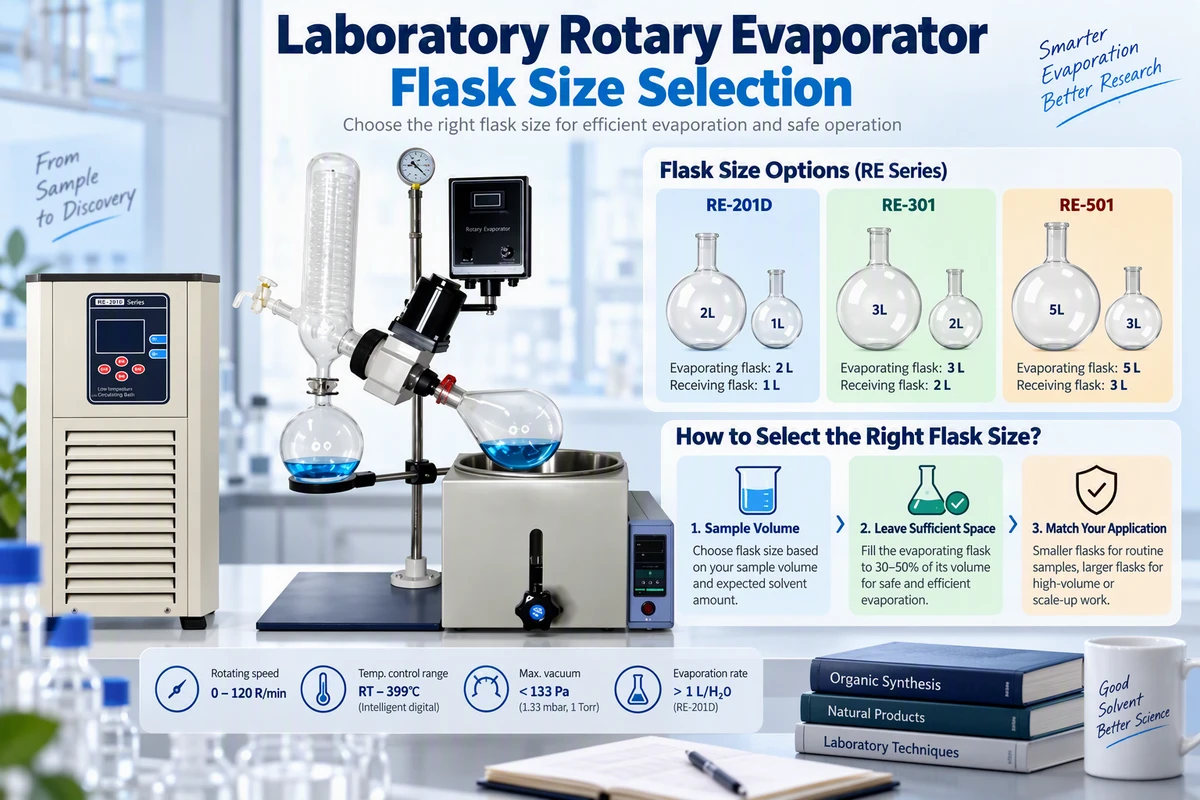
For pharmaceutical R&D, the RE-501 5L rotary evaporator is usually the most balanced starting point because it gives enough flask volume for formulation screening, crude extraction concentration, and solvent exchange without taking over the laboratory. For pilot production, the RE-1002 10L or RE-2002 20L models offer stronger evaporation capacity and higher bath power. For routine batch production, the RE-5002 50L rotary evaporator is the best fit when solvent recovery rate, receiving flask size, and condenser load become the limiting factors.
In practical terms, pharmaceutical production should be sized around throughput rather than the largest available flask. A larger evaporating flask only helps when the vacuum pump, chiller, condenser, bath power, and receiving flask are also sized for the same solvent load.
Selection logic
What Makes a Rotary Evaporator Suitable for Pharmaceutical Work?
A pharmaceutical rotary evaporator must do more than remove solvent. It needs repeatable evaporation behavior, clean solvent recovery, gentle temperature control, reliable sealing, and a configuration that can be documented for standard operating procedures. When a process moves from discovery chemistry to process development, the evaporator becomes part of the production workflow rather than a simple lab instrument.
For a refresher on the core operating principle, the guide to rotary evaporator chemistry explains how reduced pressure, flask rotation, bath temperature, and condensation work together. In pharmaceutical production, those same fundamentals become selection criteria.
Batch volume: Choose flask capacity based on working fill volume, foam risk, and solvent recovery schedule, not just the nominal flask size.
Vacuum control: Stable vacuum improves boiling consistency and helps protect temperature-sensitive APIs, intermediates, and excipients.
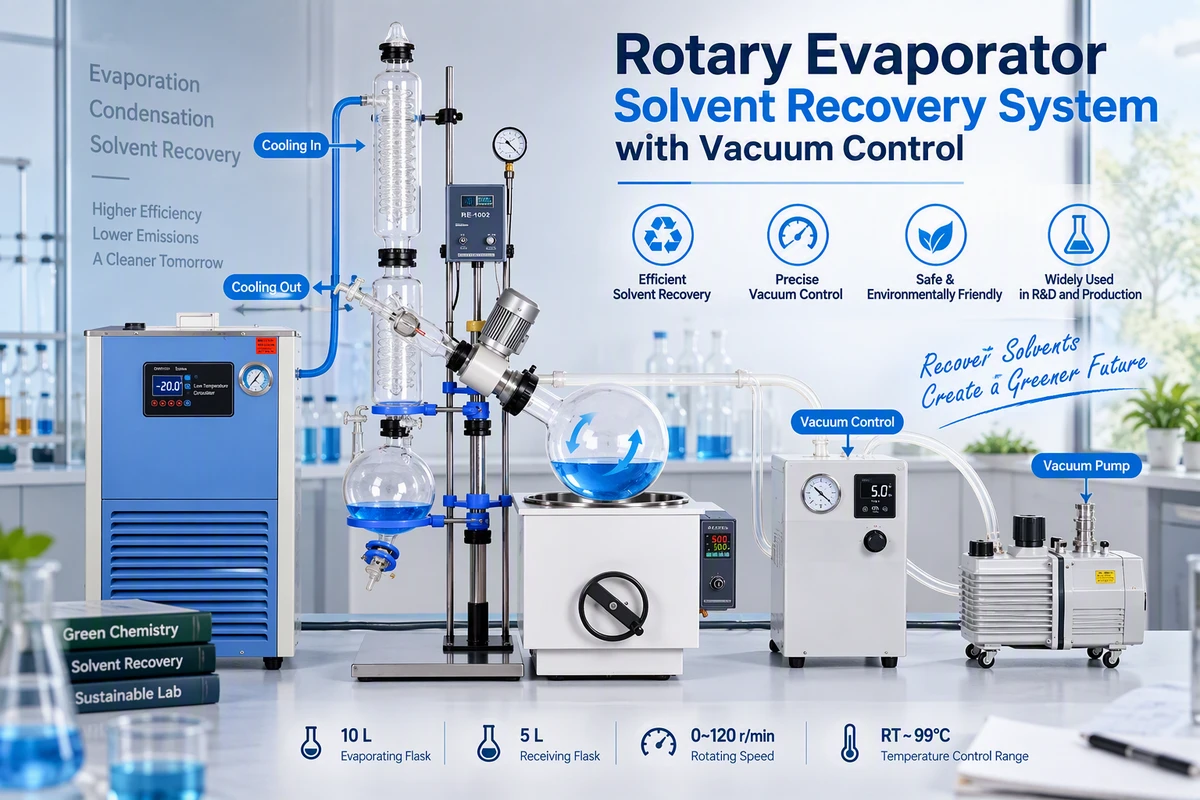
Condenser capacity: A production process needs enough cooling area to condense vapor before it reaches the pump or workspace.
Sealing materials: PTFE and fluoro rubber sealing are useful choices for solvent resistance in common pharmaceutical processes.
Bath performance: Higher bath power shortens warm-up time and supports larger evaporation loads, especially in 20L and 50L systems.
Scale-up readiness: The best system makes the transition from 5L testing to 20L or 50L production predictable.
Can one rotary evaporator cover both R&D and production?
The practical answer is sometimes, but only for very small production runs. A 5L evaporator can support formulation screening and small-batch concentration, while a 20L or 50L unit is usually more suitable when the same solvent removal step must be repeated every day. The author recommendation is to size the evaporator for the most frequent batch, then leave enough headroom for foaming and receiving capacity.
Model comparison
Rotary Evaporator Models for Pharmaceutical Production
The following comparison uses the provided product parameter documents and company price sheet. Reference prices are selected conservatively when a product appears with multiple prices, using the middle-lower option where applicable. Final quotation can vary with voltage, glassware, chiller, vacuum pump, explosion-proof configuration, and accessory package.
| Model | Best pharmaceutical use | Evaporating flask | Speed | Key detail | Reference price |
|---|---|---|---|---|---|
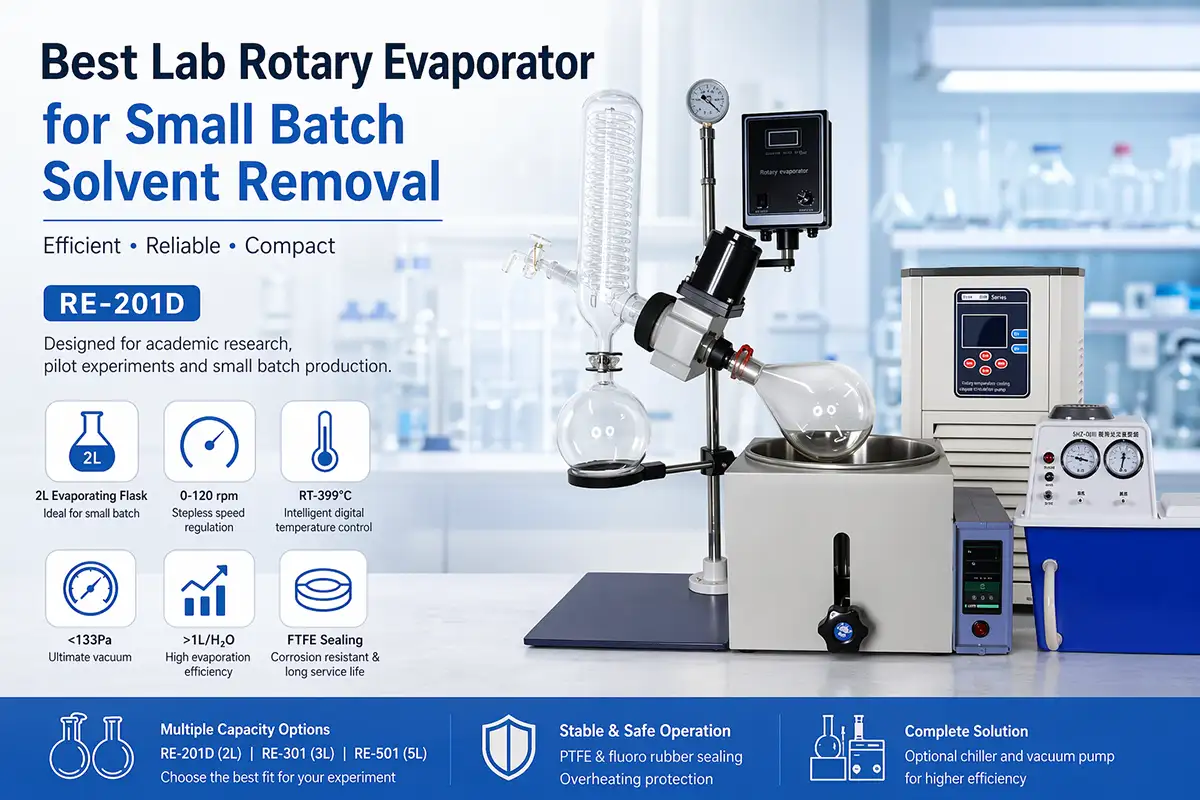
| RE-501 | R&D, formulation screening, solvent exchange, small GMP-adjacent batches | 5L | 0-120 r/min | PTFE and fluoro rubber sealing; intelligent digital temperature control | $780 |
| RE-1002 | Pilot process development and repeated small production batches | 10L | 0-120 r/min | Vertical double condenser; manual bath lifting; 220V/50Hz option | $1,818 |
| RE-2002 | Pilot production, extraction concentration, and batch solvent recovery | 20L | 0-120 r/min | PTFE and fluoro rubber sealing; 0-220 mm lifting height | $2,061 |
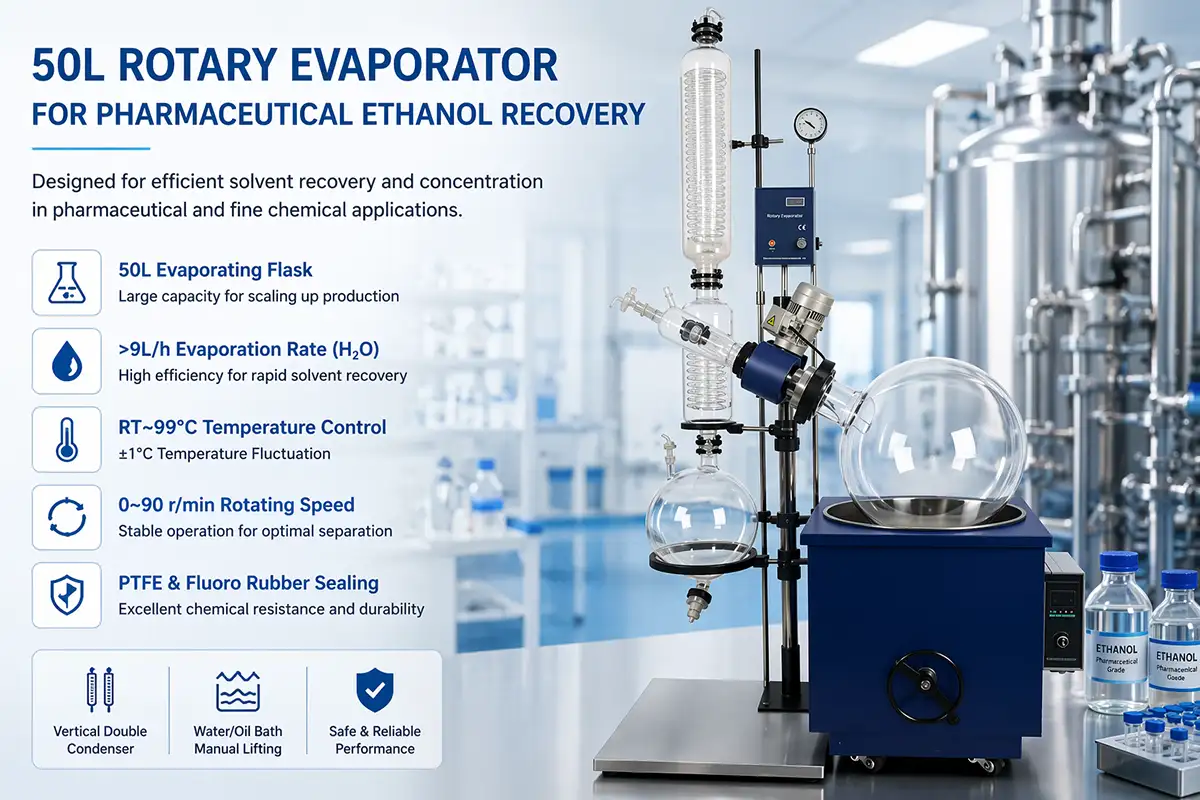
| RE-5002 | Production-scale solvent recovery and larger extraction concentration | 50L | 0-90 r/min | Vertical double condenser; 380V/50Hz option for larger loads | $2,545 |
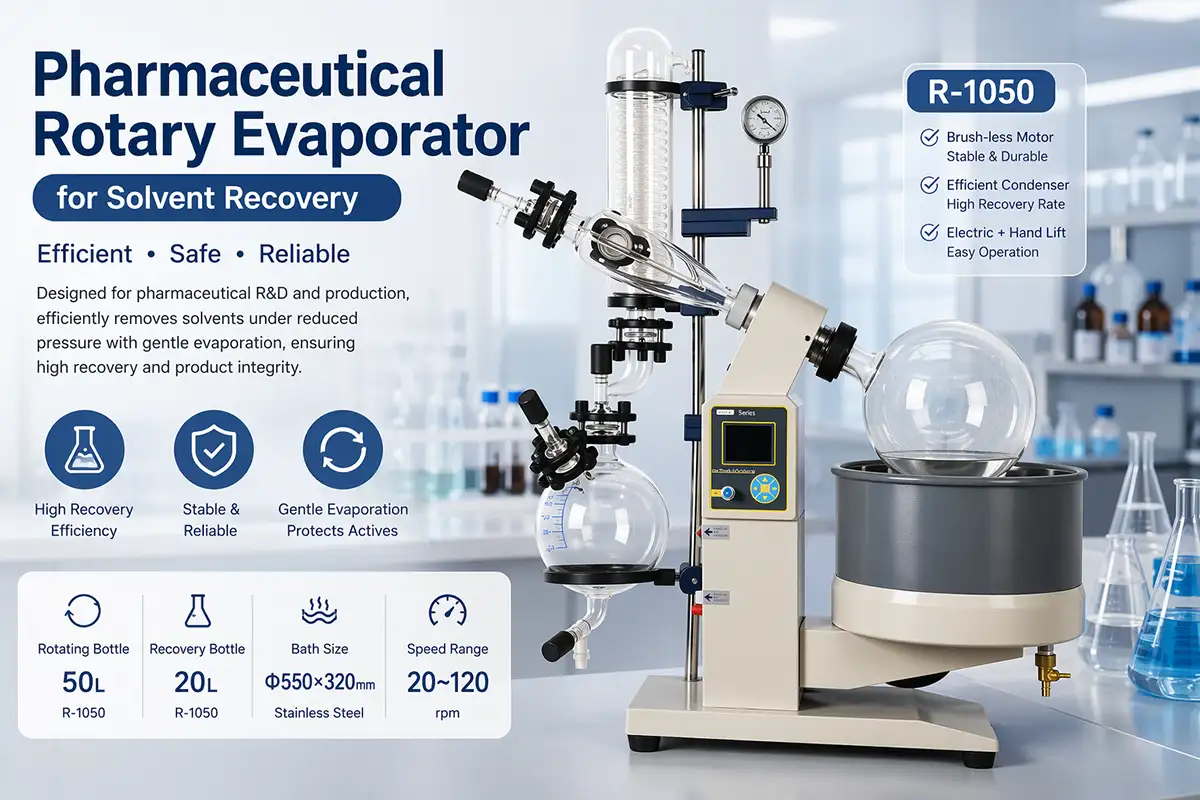
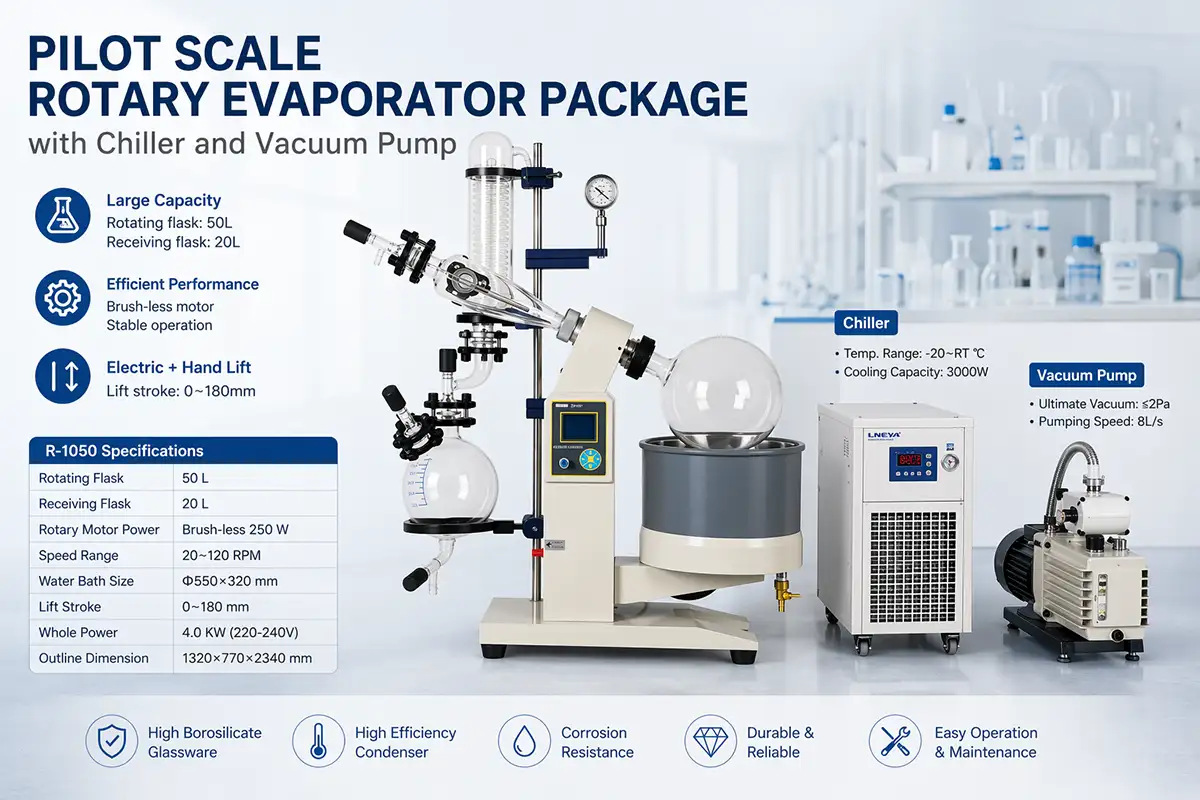
| R1050 | Large-batch process work where 50L flask volume and electric lifting are priorities | 50L | 20-120 RPM | High-efficiency reflux condenser; electric plus hand lift | $1,818 |
Sizing method
How to Choose Between 5L, 10L, 20L, and 50L
The best pharmaceutical production size depends on the amount of solvent that must be removed per shift. A 5L system is efficient for development work, but production teams often outgrow it when the receiving flask must be emptied too often. A 10L rotary evaporator is a clean step upward for pilot batches. A 20L system often becomes the sweet spot for process labs because it improves throughput without the footprint and utility requirements of a 50L system.
A 50L rotary evaporator becomes the best choice when the same process is already validated at smaller scale and the production bottleneck is solvent removal. For high-volume recovery, the 50 liter rotary evaporator class provides more flask volume, larger receiving capacity, stronger bath power, and higher evaporation rate.
Choose 5L when process discovery matters most
Use the RE-501 when batches are small, materials are expensive, and flexibility matters more than maximum throughput. This is a strong fit for formulation screening, solvent exchange, and early API intermediate work.
Choose 10L or 20L when pilot output becomes repeatable
Use the RE-1002 or RE-2002 when a small-batch process is no longer experimental and the same solvent removal step needs to run multiple times per week. These models provide better production rhythm without jumping immediately to a 50L footprint.
Choose 50L when solvent recovery is the bottleneck
Use the RE-5002 or R1050 when production volume, receiving flask capacity, and condenser load are limiting daily output. A 50L system should be paired with the right chiller, vacuum pump, cold trap, and solvent-compatible tubing.
Is the largest rotary evaporator always the best pharmaceutical choice?
No. The best choice is the smallest system that can meet batch throughput with stable vacuum and comfortable receiving capacity. Oversizing can increase solvent hold-up, cleaning time, energy use, and glassware handling risk. The author recommendation is 20L for many pilot production labs and 50L only when daily solvent volume justifies the larger utility package.
Solvent recovery
Solvent Type Matters as Much as Flask Size
Pharmaceutical production often involves ethanol, methanol, acetone, ethyl acetate, dichloromethane, water mixtures, or other process solvents. Each solvent changes the required vacuum level, condenser temperature, vapor load, and safety configuration. Ethanol is especially common in extraction and purification workflows, and the ethanol rotary evaporator guide is a useful reference for matching vacuum and cooling to solvent behavior.
For volatile and flammable solvents, condenser performance and vapor containment become critical. A strong chiller helps protect the vacuum pump and improves recovery rate. For low-boiling solvents, a cold trap can reduce pump contamination. For flammable solvent environments, explosion-proof motors, switches, and electrical components should be evaluated according to the facility's safety requirements.
When should explosion-proof configuration be considered?
Explosion-proof configuration should be considered whenever flammable solvent vapor may be present near motors, controls, pumps, or wiring. The rotary evaporator itself is only one part of the safety system; the vacuum pump, chiller, ventilation, grounding, and operating area must be assessed together. The author recommendation is to confirm solvent classification and site safety requirements before ordering a production unit.
Buying checklist
Pharmaceutical Rotary Evaporator Buying Checklist
Before choosing a model, confirm the whole evaporation package. A well-matched system produces faster, cleaner, and more repeatable solvent removal than a large flask connected to undersized utilities.
Process volume: Define typical batch size, maximum batch size, and expected solvent volume per shift.
Solvent properties: Confirm boiling point, vapor pressure, flammability, corrosion risk, and whether mixed solvents are used.
Cooling capacity: Match the chiller to condenser size, vapor load, and target recovery temperature.
Vacuum source: Select a pump that can hold stable vacuum under real vapor load, not only under dry test conditions.
Temperature control: Verify bath range, heat-up time, and accuracy for heat-sensitive pharmaceutical materials.
Cleaning and changeover: Consider glassware access, lift height, receiving flask removal, and residue handling.
Documentation needs: Ask for manuals, electrical information, material details, and spare parts lists to support SOP creation.
Scale-up path: If production may expand, choose a model family that allows the process to move from 5L to 20L or 50L with familiar operation.
Final recommendation
So, Which Rotary Evaporator Is Best?
For early pharmaceutical development, the RE-501 5L rotary evaporator is the best economical choice because it is compact, flexible, and priced around $780 in the provided company price sheet. For pilot production, the RE-2002 20L rotary evaporator is often the most practical balance: it offers a 20L evaporating flask, 10L receiving flask, 5000W bath power, and an evaporation rate above 5 L/h H2O, with a reference price of $2,061.
For production-scale solvent recovery, the RE-5002 50L rotary evaporator is the strongest recommendation. It provides a 50L evaporating flask, 20L receiving flask, vertical double condenser, 7000/9000W bath power, and evaporation rate above 9 L/h H2O. For pharmaceutical teams that need larger daily throughput, that combination makes the 50L class the better long-term investment.
The best buying decision is therefore not a single universal model. It is a staged selection: RE-501 for development, RE-1002 or RE-2002 for pilot production, and RE-5002 or R1050 for larger solvent recovery. When the rotary evaporator, vacuum pump, chiller, condenser, and sealing system are matched correctly, pharmaceutical solvent removal becomes faster, gentler, and easier to reproduce.
Production-Ready Solvent Removal Starts With Correct Sizing
A pharmaceutical rotary evaporator should be selected around actual solvent load, operating safety, and scale-up plans. Matching the evaporator body with the right vacuum and cooling package is the fastest path to stable batch performance.