20L Rotovap Buying Guide: Features, Applications and Price
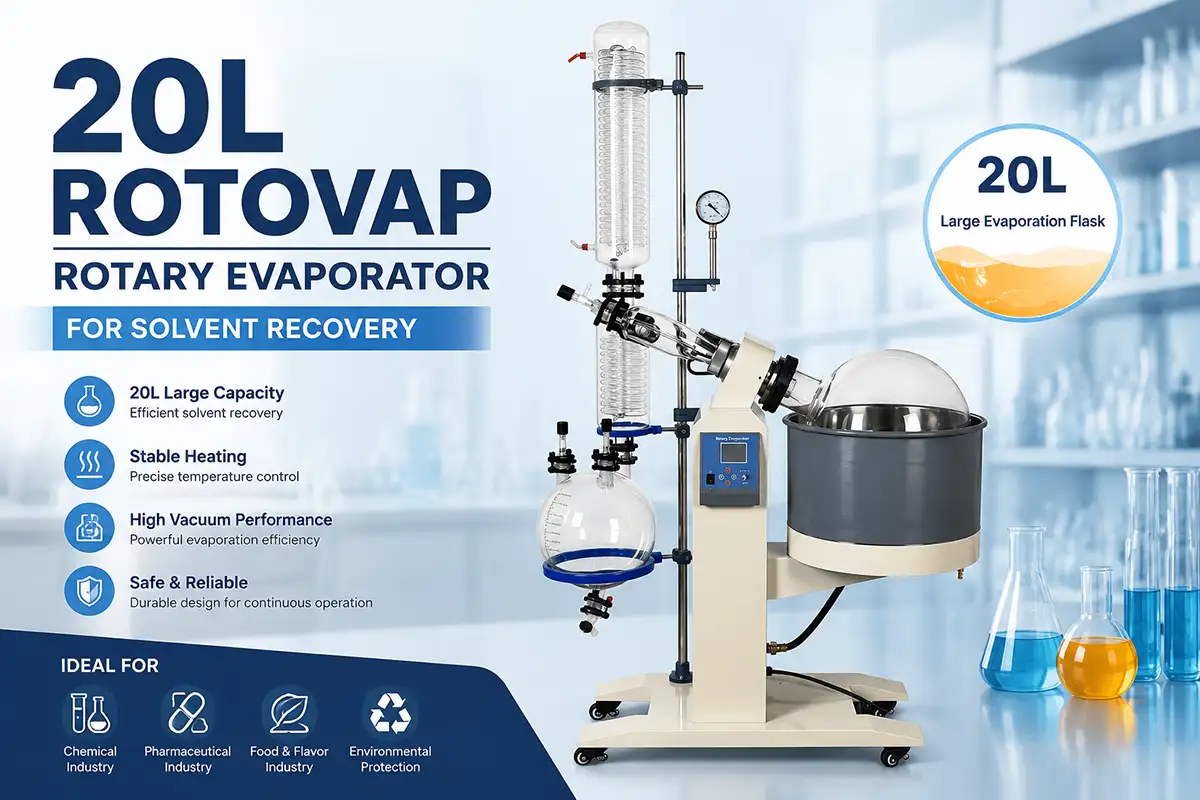
A 20L rotovap is one of the most practical sizes for laboratories and pilot plants that need faster solvent removal than benchtop systems, while still keeping operation flexible, safe, and economical. For ethanol recovery, botanical extraction, chemical concentration, and routine vacuum distillation, a 20 liter rotary evaporator often becomes the sweet spot between capacity and control.
Why a 20L rotovap is a popular upgrade
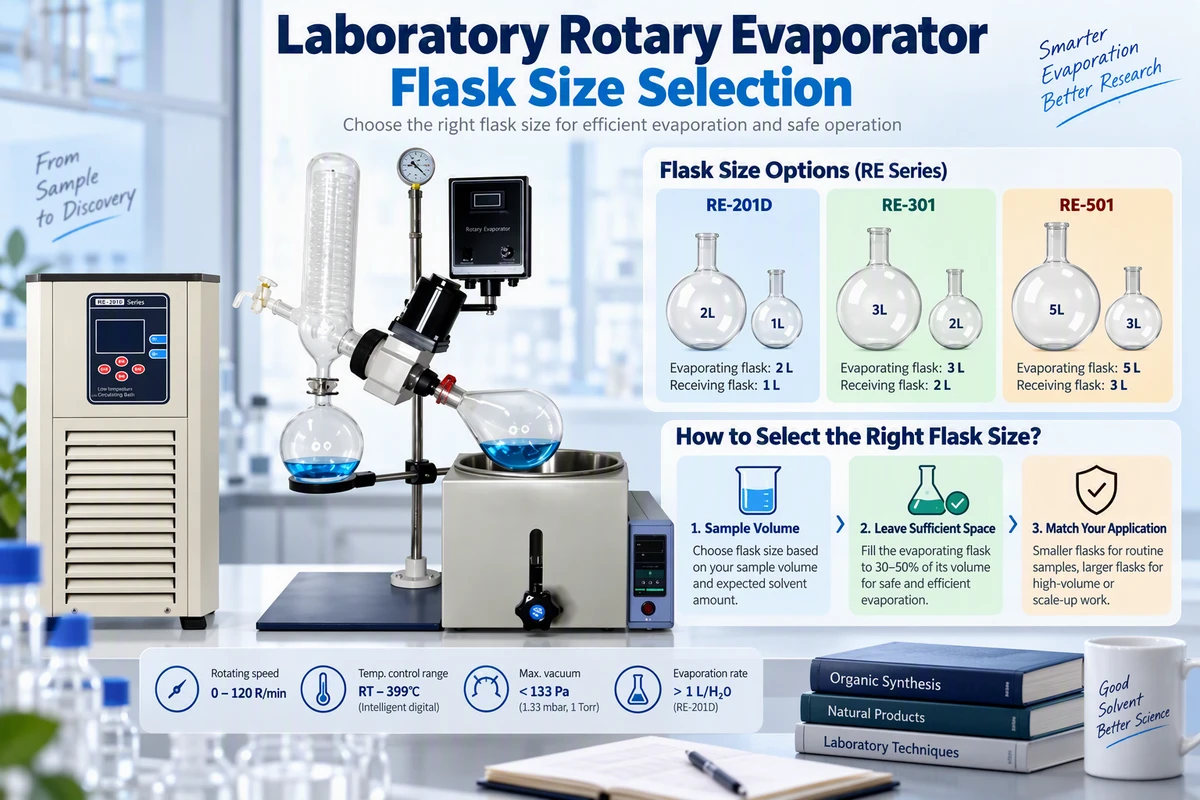
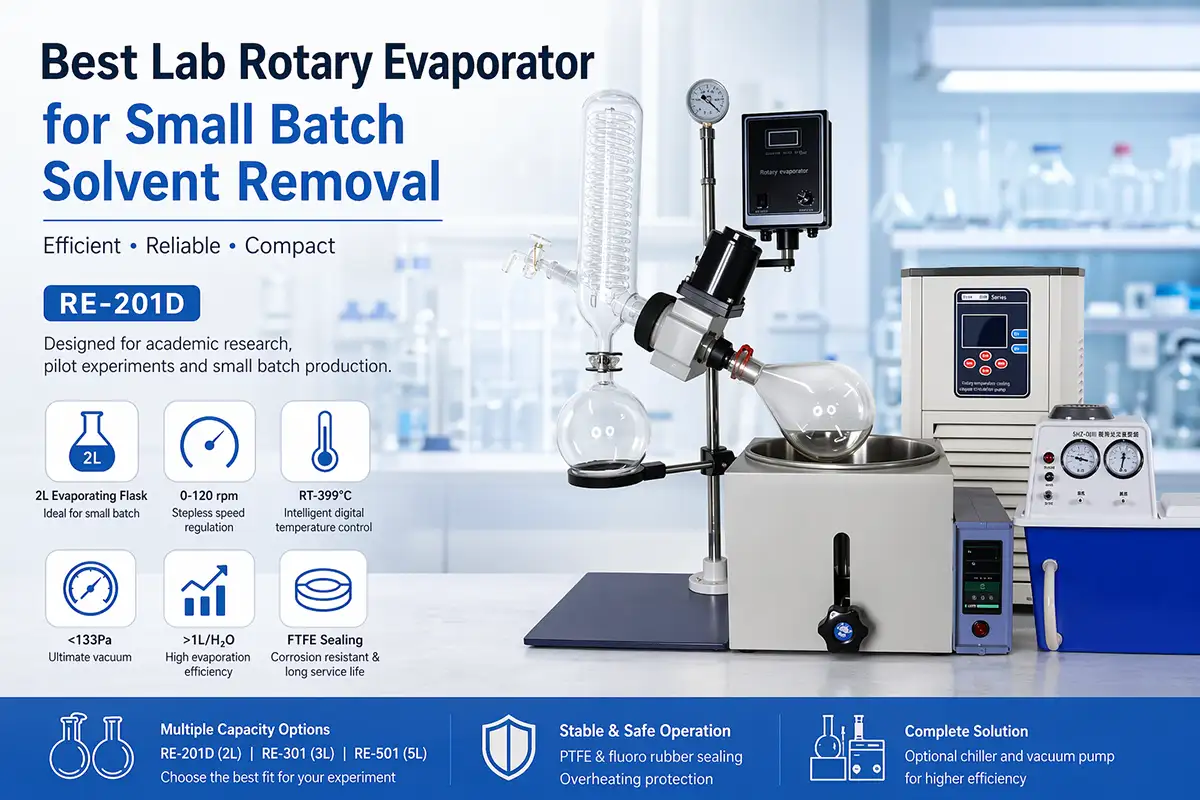
Smaller rotary evaporators are ideal for research batches, but once throughput starts increasing, solvent removal can become a bottleneck. A 20L rotovap offers noticeably larger batch volume, a stronger drive system, and a more powerful heating bath. That combination allows operators to process more material per cycle without moving immediately into very large 50L systems.
From a practical purchasing perspective, the 20L size is especially attractive because it fits many real production needs: pilot extraction labs, university scale-up work, natural product concentration, and routine recovery of common solvents. It is large enough to improve productivity, but still compact enough to install in many standard laboratory spaces.
Not necessarily. In many labs, a 20L rotary evaporator is the ideal middle-ground size. It provides pilot-scale performance while remaining easier to place, clean, and operate than a 50L unit.
Core technical specifications to expect from a 20L rotary evaporator
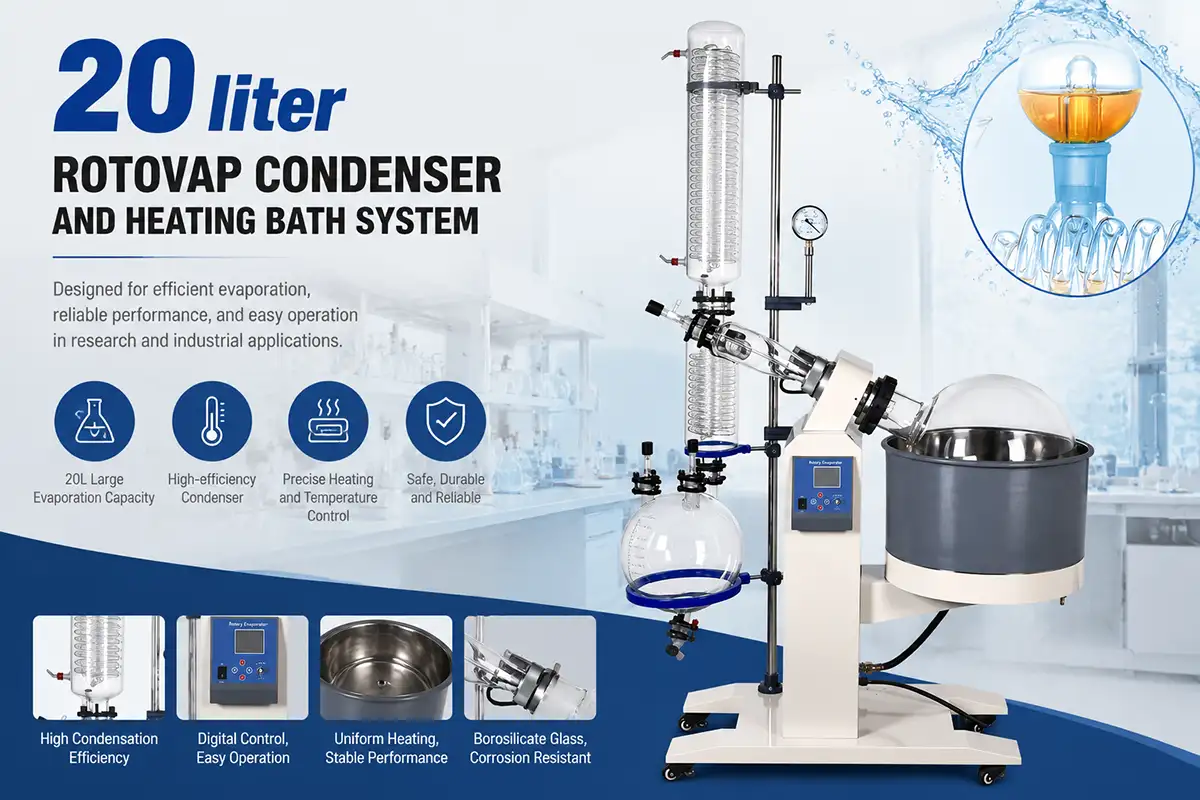
Based on the supplied equipment parameters, the 20L class model is represented by both the RE-2002 series and the R1020 series. These two formats help buyers understand what matters most in a modern 20L rotovap: motor power, speed range, bath power, condenser efficiency, lifting design, and overall dimensions.
Capacity
Evaporating flask: 20L
Receiving flask: commonly 10L
Drive and rotation
Motor power: about 250W on larger-frame systems
Rotating speed: typically 0-90 rpm or 20-120 rpm depending on model design
Heating performance
Bath power: around 5000W
Temperature range: from room temperature up to 99°C or higher depending on bath medium and model configuration
Evaporation rate
Water evaporation rate: greater than 5L/h for the RE-2002 class
Vacuum and sealing
Sealing: PTFE and fluoro rubber sealing
Vacuum level: suitable for reduced-pressure evaporation and solvent recovery work
Condenser system
Condenser: vertical double condenser or high-efficiency reflux condenser for improved recovery
| Model | Evaporating Flask | Receiving Flask | Motor Power | Rotation Speed | Bath Power | Evaporation Rate | Lifting |
|---|---|---|---|---|---|---|---|
| RE-2002 | 20L | 10L | 250W | 0-90 rpm | 5000W | >5L/h (H₂O) | Manual bath lifting, 0-220 mm |
| R1020 | 20L | 10L | Brushless 250W | 20-120 rpm | 4.0 kW total power | Designed for efficient reflux condensation | Electric + hand lift, 0-190 mm |
For many buyers, the most important difference is not simply flask volume. It is the overall balance between condenser efficiency, bath power, and lifting convenience.
What makes a good 20L rotovap perform well?
A 20L rotovap does not deliver strong results through size alone. Reliable evaporation depends on how well several parts work together.
Stable rotation: Smooth, consistent rotation improves film formation and speeds evaporation.
High bath power: A powerful water or oil bath shortens heating time and supports larger batch throughput.
Efficient condensation: A vertical double condenser or coil-based condenser helps recover more solvent and reduce vapor losses.
Strong sealing materials: PTFE and fluoro rubber seals improve chemical resistance and vacuum stability.
Convenient lifting: Electric lift or electric-plus-manual lift designs make handling safer, especially with heavier flasks.
Buyers comparing equipment should also consider whether the system will be used mainly for ethanol, acetone, methanol, hexane, botanical extracts, or other solvents. Solvent type affects the best bath temperature, vacuum strategy, and condenser load.
Only when the rest of the system is matched correctly. A strong bath helps, but condenser efficiency, vacuum stability, and correct rotation speed are equally important. Balanced system design always outperforms single-parameter thinking.
Typical applications for a 20L rotovap
The commercial strength of a 20L rotovap comes from its versatility. It is one of the most searched rotary evaporator sizes because it supports both routine laboratory workflows and pilot-scale production tasks.
Ethanol recovery
One of the most common uses is ethanol evaporation after extraction. For readers interested in this application, see this ethanol rotary evaporator guide.
Botanical and natural product concentration
A 20L rotary evaporator is often used to gently remove solvent while preserving heat-sensitive compounds in herbal and plant extracts.
Chemical synthesis and solvent exchange
In chemistry labs, a 20L rotovap is useful for concentration, purification support, and solvent replacement after reaction steps. A broader chemistry overview is available in rotary evaporator chemistry explained.
Vacuum distillation training and education
Its visible glass design makes it suitable for demonstration, pilot training, and process development.
For buyers who also want practical operating context, this rotovap distillation guide provides useful background on setup and workflow.
20L rotovap price: what should be expected?
Using the provided product price sheet and the instruction to select the middle cheaper price when a product has multiple prices, a realistic benchmark can be taken from the item “20L Laboratory Pilot Plant Test Rotary Evaporators”, listed at US$1,480.
This figure is a useful reference point for a base 20L rotovap offer. However, actual pricing can vary depending on:
Explosion-proof configuration
Condenser type and glass configuration
Whether a chiller and vacuum pump are included
Motorized versus manual lifting
Export packaging, voltage customization, and regional stock availability
| Reference Product | Indicative Price | What It Suggests |
|---|---|---|
| 20L Laboratory Pilot Plant Test Rotary Evaporators | US$1,480 | Competitive entry point for a 20L pilot-scale rotary evaporator |
| Re-2002 20L Large Rotary Evaporator Crystallizer | US$2,061 | Higher-spec or broader package configurations can move above base pricing |
| 20L Lab Vacuum Distillation Rotary Evaporator with Vacuum Pump | US$2,667 | Bundled systems with support equipment are typically priced higher |
Because one quote may cover only the main evaporator, while another includes a low-temperature chiller, vacuum pump, upgraded condenser, or explosion-proof options. The package scope matters as much as the flask size.
How to compare 20L rotovap models before buying
When comparing a 20L rotary evaporator, it helps to ask practical process questions instead of focusing only on brochure values.
1. What solvent will be used most often?
Different solvents place different demands on vacuum level, condenser cooling, and bath temperature. Ethanol recovery usually needs a robust condenser and dependable vacuum support.
2. How many batches need to be processed each day?
If throughput targets are growing, stronger bath power and efficient condensation will make a major difference in daily productivity.
3. Is operator convenience important?
For frequent use, electric lift and easy-to-clean glass assemblies can reduce fatigue and improve safety.
4. Will future scale-up be needed?
Some buyers start with a 20L rotovap because it fits current pilot work, then move to 50L after process validation. In that case, consistency in supplier design and accessories becomes valuable.
Recommended support equipment for a 20L rotovap
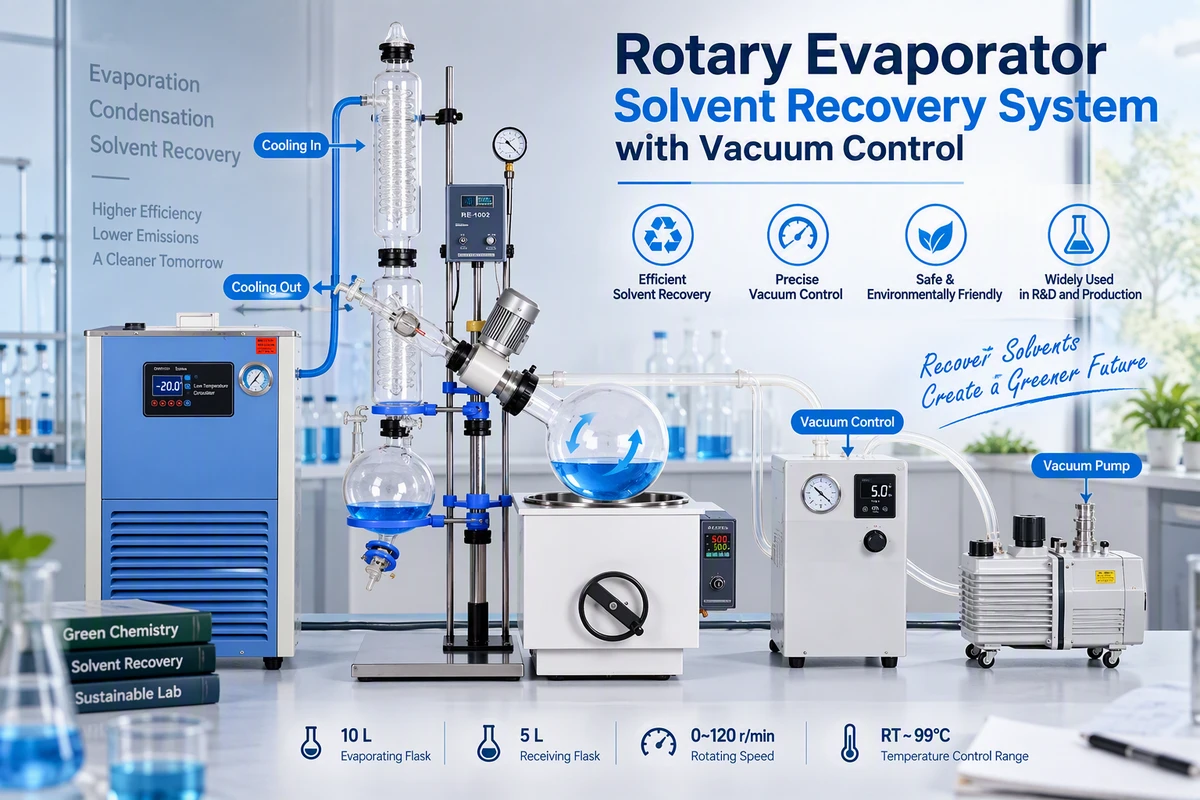
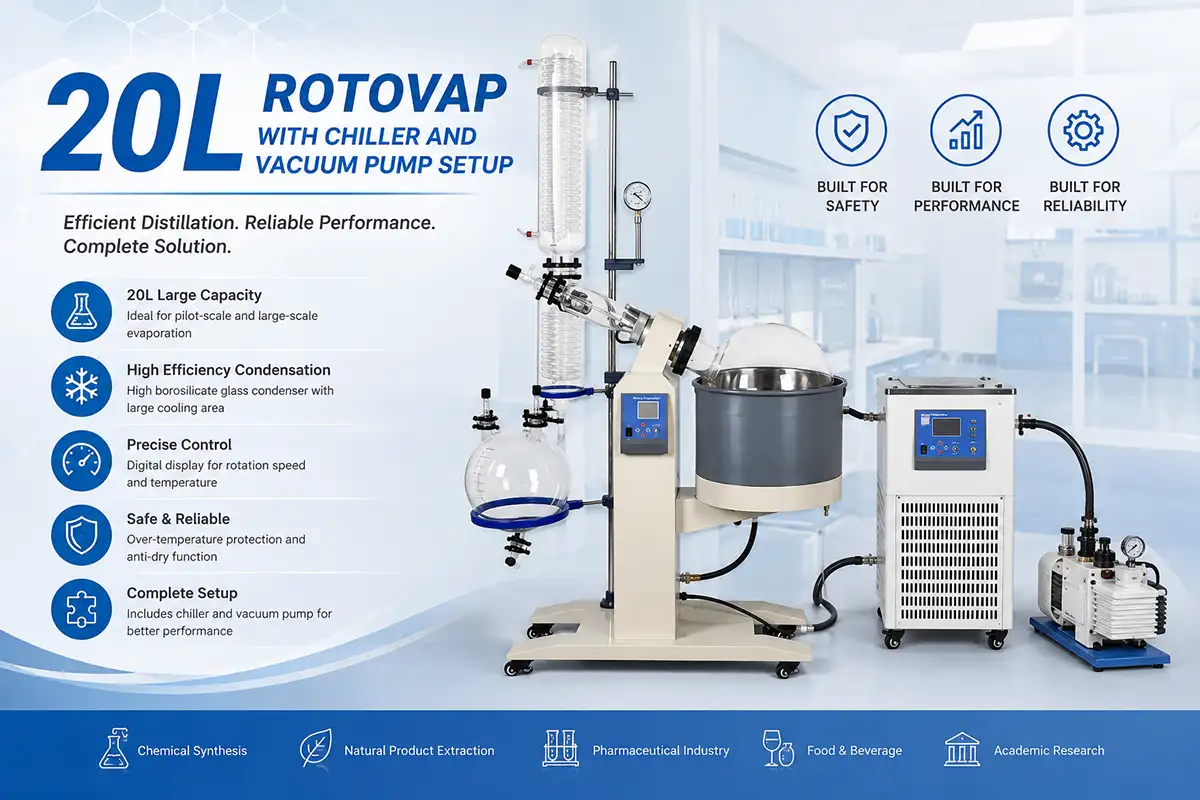
A rotary evaporator performs best as part of a matched system. In real-world use, the following accessories are often essential:
Recirculating chiller: improves condenser performance and solvent recovery.
Vacuum pump: supports lower boiling points and faster evaporation.
Vacuum controller: helps fine-tune pressure for sensitive or foaming solvents.
Cold trap or receiving protection: useful for protecting the pump and improving recovery cleanliness.
For a 20L unit, accessory matching should never be treated as an afterthought. A weak chiller or under-sized pump can limit performance even when the main rotovap itself is well designed.
Final thoughts on choosing a 20L rotovap
A 20L rotovap is one of the most balanced choices for labs and pilot facilities that need higher throughput, dependable solvent recovery, and manageable installation requirements. From the supplied technical data, the 20L class offers strong advantages in evaporation rate, bath power, and condenser performance. From the supplied price data, an indicative starting point of US$1,480 provides a practical benchmark for entry-level purchasing evaluation.
For buyers comparing options, the best decision usually comes from looking at the complete system: main unit, condenser design, lifting method, vacuum compatibility, cooling support, and package scope. When these parts are matched correctly, a 20L rotary evaporator can become a highly efficient solution for chemistry, extraction, and solvent recovery workflows.
© KD Rotary Evaporators. Technical and pricing references in this page are organized from the supplied product parameter sheets and price list for 20L-class evaluation.