Best Small Rotary Evaporator for Teaching or Research Labs
A clear comparison of 2L, 3L and 5L rotovap systems—with practical specifications, realistic price references and a direct recommendation for each type of laboratory.
Which Small Rotary Evaporator Is the Best Choice?
A small rotary evaporator removes solvent by combining flask rotation, controlled heating, condensation and reduced pressure. Rotation spreads the liquid into a thin film, while vacuum lowers the solvent’s boiling temperature. That makes rotary evaporation useful for concentrating samples, recovering solvent and preparing materials without exposing them to excessive heat.
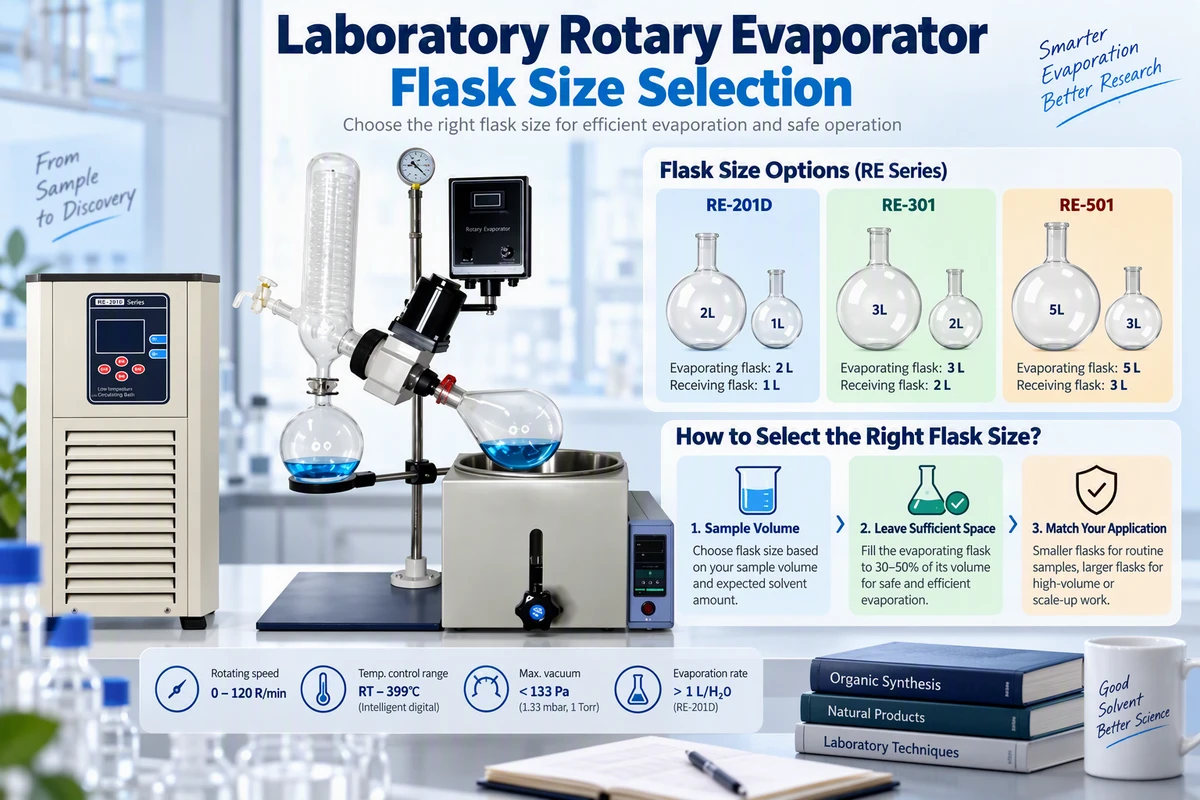
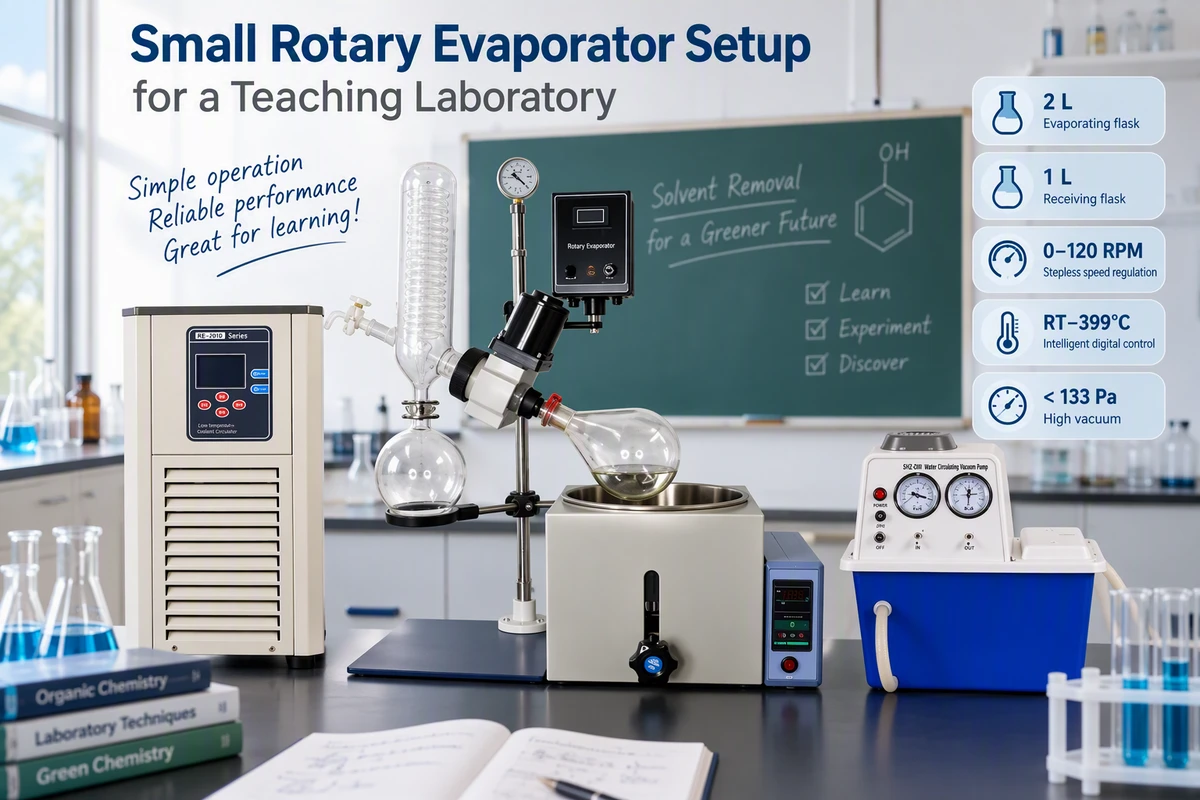
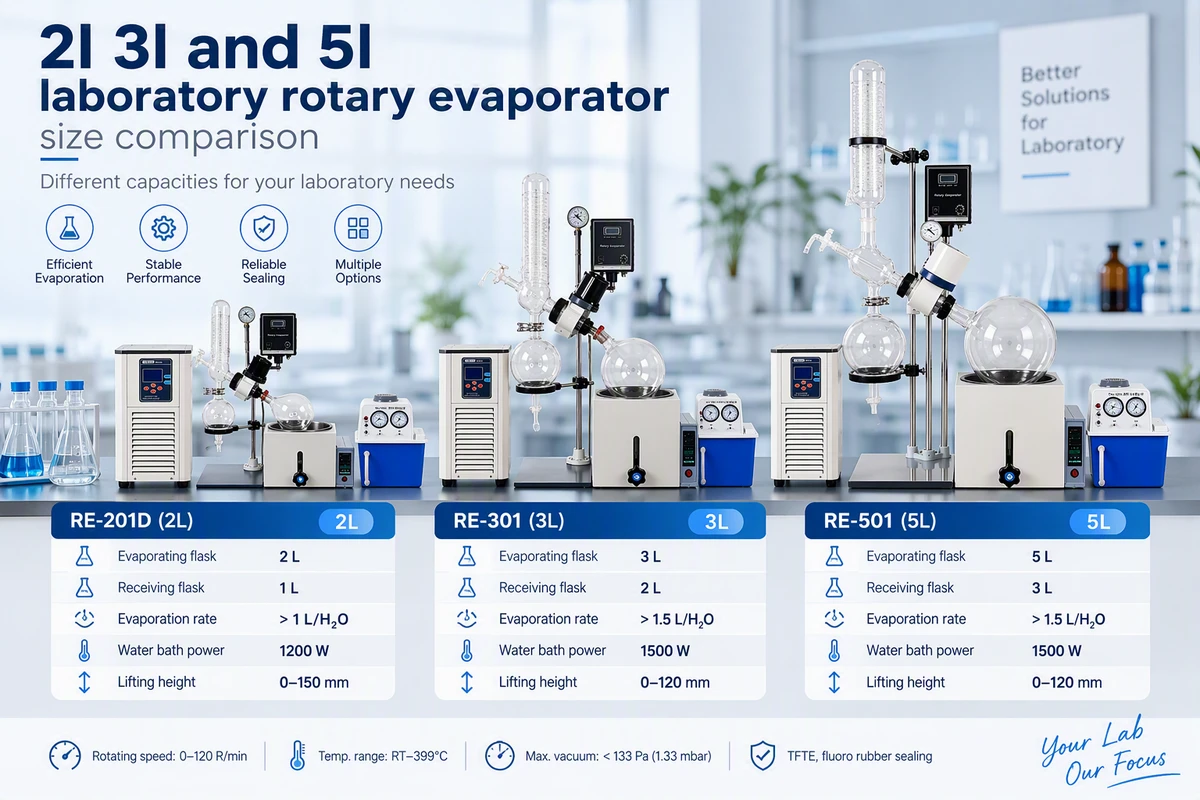
For education, the best machine is not simply the model with the highest capacity. It should have controls that students can understand, glassware that instructors can inspect easily and enough lifting travel to remove the flask quickly. The RE-201D meets those needs with a 2L evaporating flask, 1L receiving flask, 0–120 rpm stepless rotation, 1,200W bath and 0–150 mm lift.
Is a 2L rotary evaporator large enough for a teaching laboratory?
Author’s answer: Yes. A 2L model is usually the most practical teaching size because demonstration batches remain manageable, glassware is easier to handle and several student groups can complete short exercises without wasting large volumes of solvent.
Research work changes the calculation. If experiments regularly begin with more solution, a 5L flask reduces repeated runs. The RE-501 keeps the same 0–120 rpm operating range while increasing the receiving flask to 3L and bath power to 1,500W. Its specified water evaporation rate is above 1.5L/h, compared with above 1L/h for the RE-201D. Actual solvent removal depends on solvent properties, vacuum stability, bath temperature, condenser temperature and flask loading.
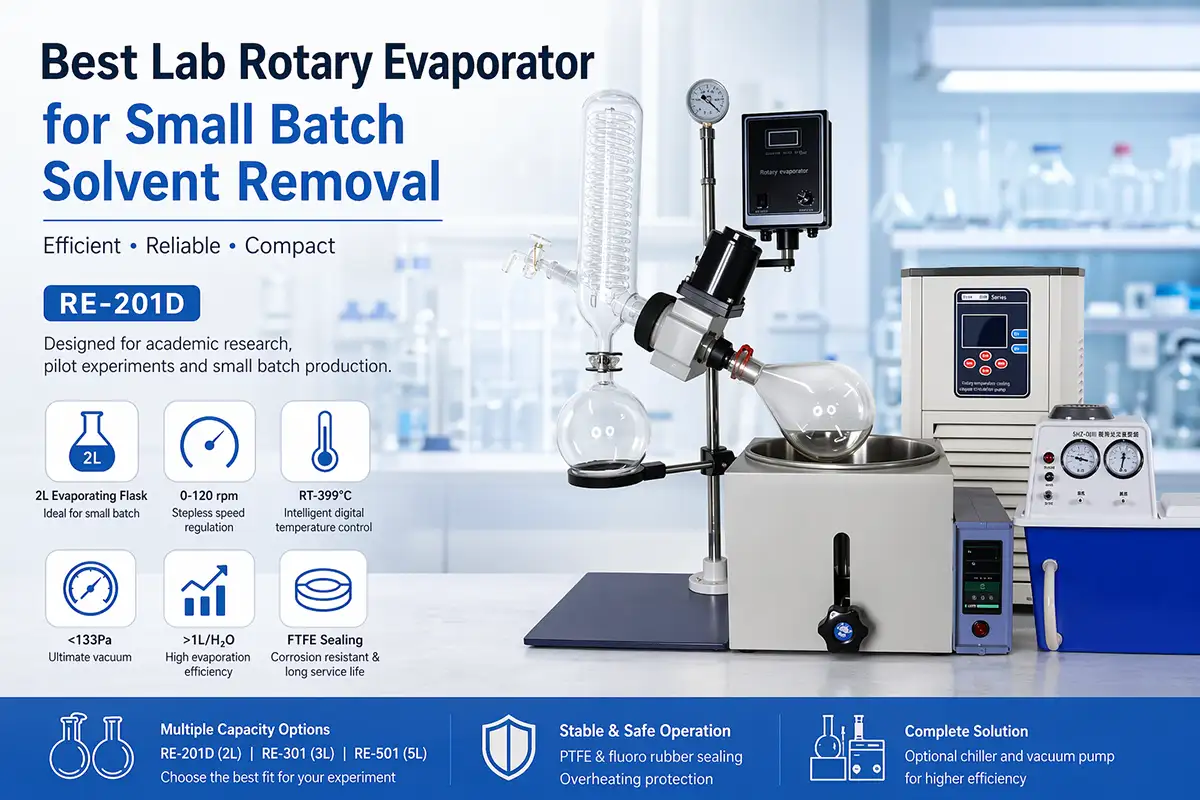
For more general selection criteria, the related guide to the best lab rotary evaporator for small-batch solvent removal explains how workload influences equipment size.
RE-201D vs RE-301 vs RE-501: Small Rotovap Comparison
| Specification | RE-201D | RE-301 | RE-501 |
|---|---|---|---|
| Best fit | Teaching & micro-batch work | Mixed teaching/research | Higher-throughput research |
| Evaporating flask | 2L | 3L | 5L |
| Receiving flask | 1L | 2L | 3L |
| Rotating motor | 40W, stepless speed regulation | ||
| Rotating speed | 0–120 rpm | ||
| Bath power | 1,200W | 1,500W | 1,500W |
| Temperature range | Room temperature to 399°C; intelligent digital control | ||
| Temperature resolution | ±2°C | ||
| Water evaporation rate | >1L/h | >1.5L/h | >1.5L/h |
| Maximum vacuum | <133Pa (1.33mbar, 1Torr) | ||
| Lifting height | 0–150mm | 0–120mm | 0–120mm |
| Reference price | About $595 | About $800 | About $920 |
Prices are representative entries selected from the supplied price sheet and may exclude the vacuum pump, chiller, freight, tax or optional glassware. Confirm the final system configuration before ordering.
What Should a Lab Check Before Buying?
Batch volume
Choose a flask that leaves headspace. Overfilling increases bumping and can carry sample into the condenser.
Vacuum control
Stable, adjustable vacuum is more useful than maximum vacuum alone, especially when students change solvents.
Cooling capacity
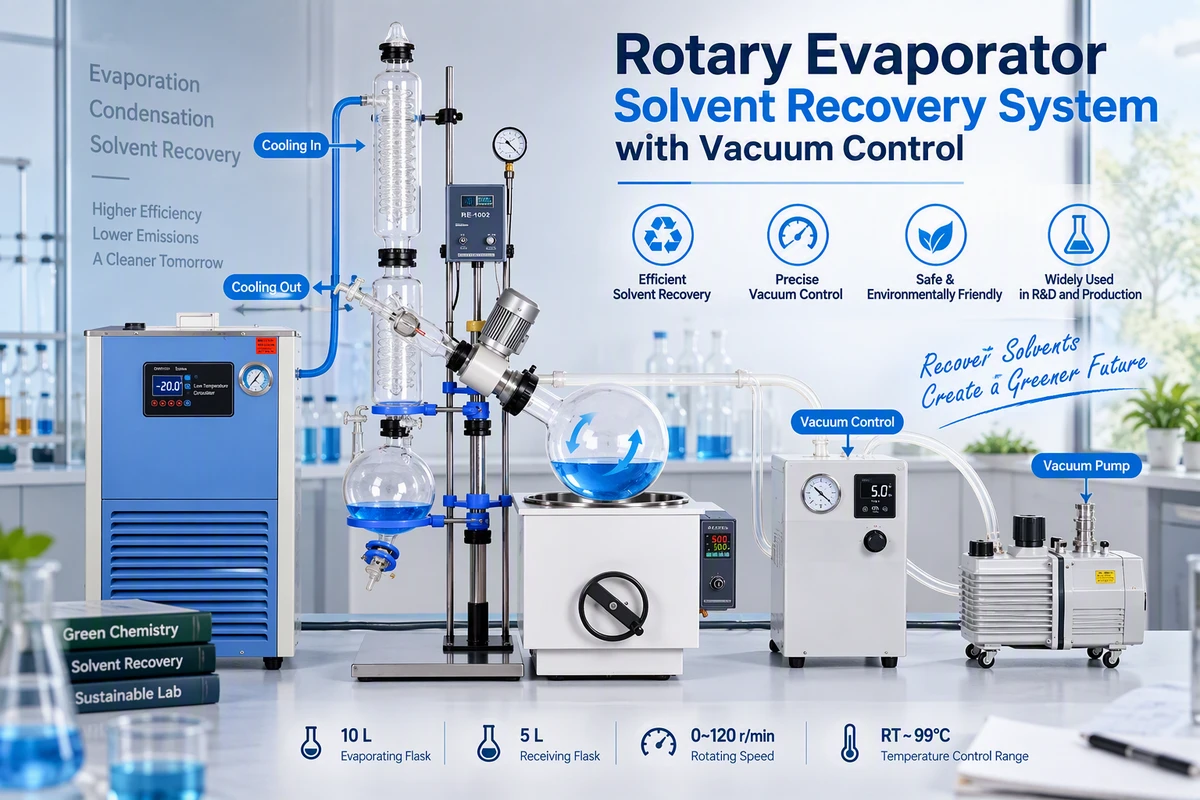
The chiller must condense vapor fast enough to protect the pump and improve solvent recovery.
Serviceability
Check seals, clamps, flasks and vapor ducts for availability before selecting a model.
Does the lowest rotary evaporator price represent the lowest total cost?
Author’s answer: Not always. A low equipment price can omit the vacuum pump, recirculating chiller, tubing and spare seals. Comparing complete configurations—and replacement-part availability—gives a more accurate laboratory budget.
Glassware availability deserves special attention in a shared lab because vapor ducts, receiving flasks and seals are wear or breakage items. A visual overview of rotary evaporator parts and essential components can help purchasing teams create a sensible spare-parts kit.
Safe Operation in Teaching and Research Labs
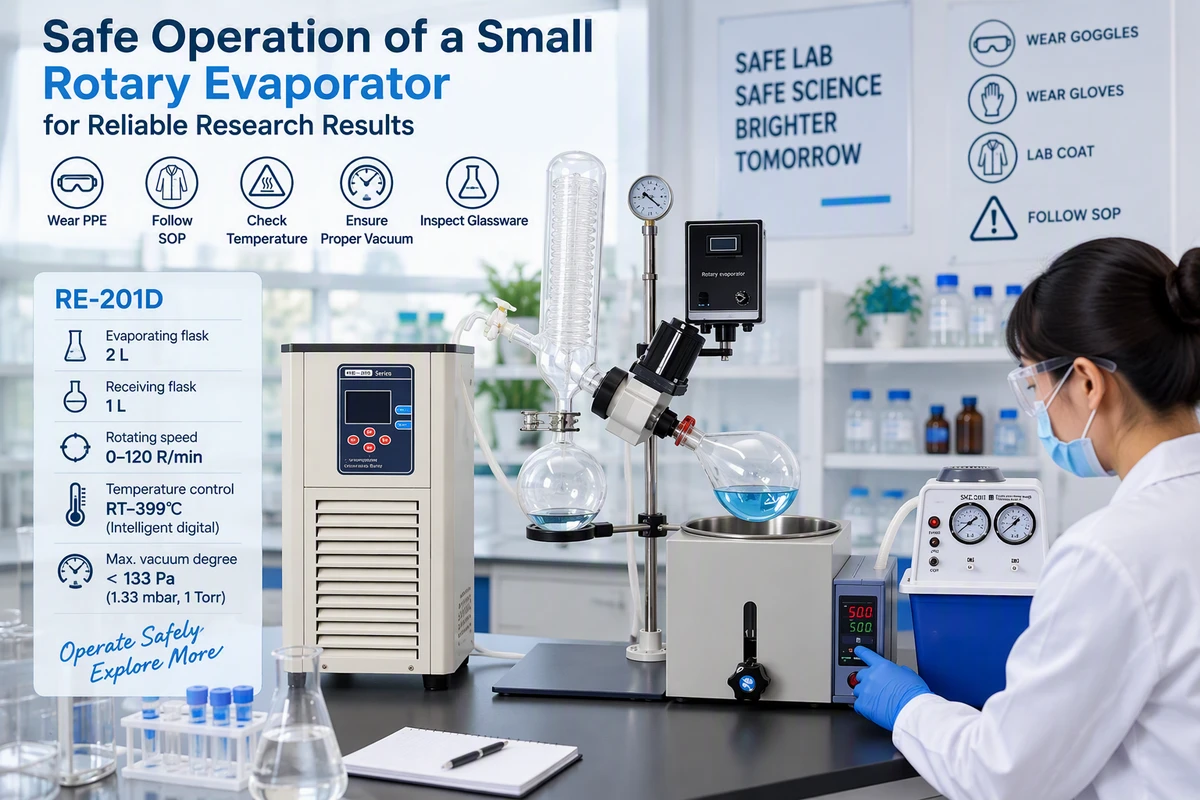
A rotovap works with heated liquids, vacuum and glass under stress, so the equipment must be treated as a complete system. The American Chemical Society’s laboratory safety guidance emphasizes evaluating hazards before work begins and using engineering controls such as a fume hood where appropriate. For rotary evaporation, that means identifying solvent flammability and toxicity, checking glassware and planning how vacuum will be released before removing a flask.
Inspect flasks, joints and the vapor duct for chips, scratches or star cracks before applying vacuum.
Secure glassware with the correct clips and never exceed the manufacturer’s recommended loading.
Begin rotation before applying strong vacuum, then reduce pressure gradually to control bumping.
Set bath and condenser temperatures for the specific solvent; a high maximum temperature rating is not a target operating temperature.
Vent the system fully before stopping rotation or attempting to remove the evaporating flask.
Which feature matters most for inexperienced operators?
Author’s answer: Predictable control matters most. Smooth speed adjustment, gradual vacuum regulation and an accessible lift let the operator respond quickly to foaming or bumping. Capacity is secondary to control and clear training.
A written standard operating procedure should cover setup, solvent-specific settings, shutdown and emergency response. New operators can also follow this practical guide on how to use a rotovap safely and efficiently.
Final Recommendation
The RE-201D 2L is the best small rotary evaporator for most teaching labs and low-volume research. It provides the essential functions in a compact format, offers more lift travel than the compared 3L and 5L models, and has an accessible reference price near $595. It is well suited to demonstrations, undergraduate organic chemistry and small sample concentration.
Choose the RE-301 3L when one instrument must support both teaching and moderate research batches. Choose the RE-501 5L when repeated 2L runs are slowing research and the laboratory has adequate bench space, cooling power and vacuum capacity. In every case, request a complete quotation that states included glassware, pump specifications, chiller capacity, electrical requirements, warranty and spare-part lead times.