Compact Mini Rotary Evaporator for Small Batch Distillation
A compact mini rotary evaporator gives a lab the control of vacuum distillation without taking over the bench. For small batches, daily solvent removal, sample concentration, and method development, the right 2L, 3L, or 5L rotovap can shorten evaporation time while protecting temperature-sensitive materials.
Why a Compact Mini Rotary Evaporator Fits Small Batch Distillation
Small batch distillation rarely needs an oversized industrial system. A compact mini rotary evaporator is built for controlled evaporation in shorter runs: removing ethanol or ethyl acetate after extraction, concentrating reaction fractions, recovering solvent from natural product samples, or preparing small batches before analysis.
The rotary motion forms a thin liquid film inside the evaporating flask. Under vacuum, that film exposes more surface area and lowers the boiling point of the solvent, so the sample can evaporate faster at a gentler bath temperature. For a deeper process explanation, the guide on what is rotary evaporation gives useful chemistry background for lab teams comparing evaporation methods.
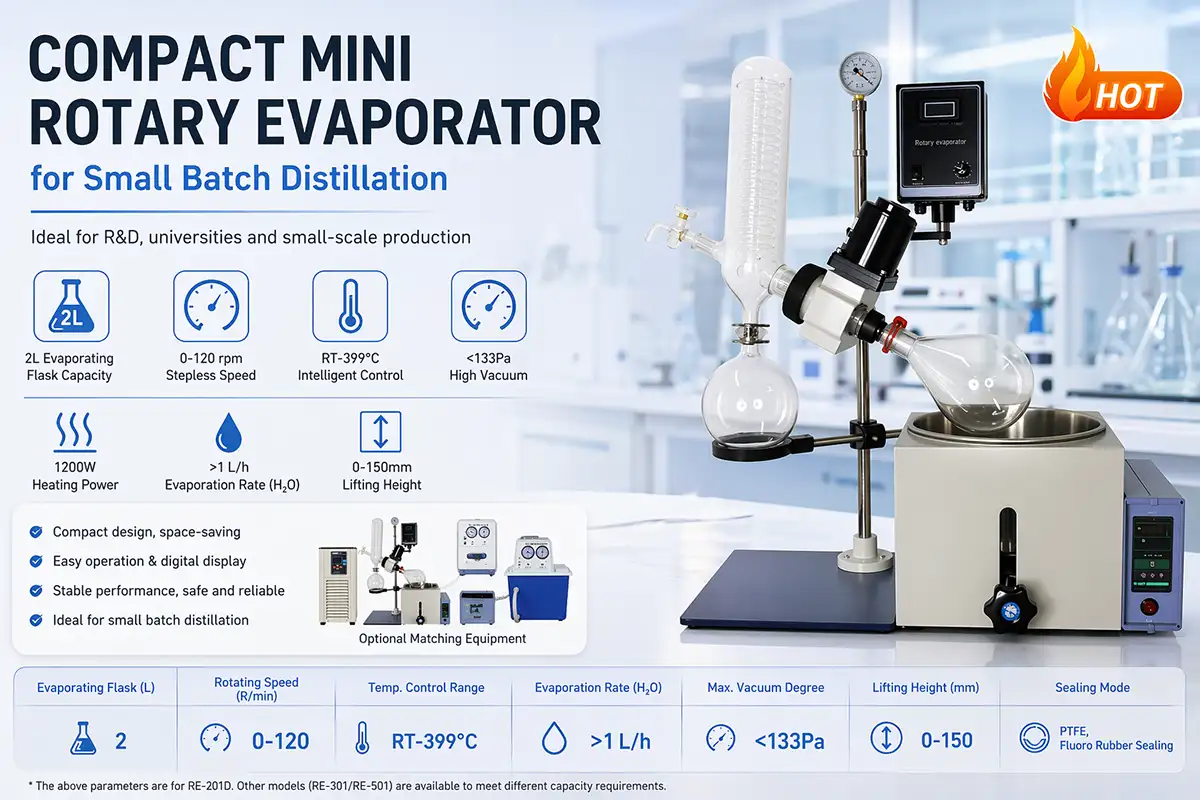
Compact mini rotary evaporator configured for solvent recovery and laboratory distillation.
Better use of bench space: 2L, 3L, and 5L systems are easier to place near a vacuum pump, recirculating chiller, and fume hood connection.
Gentler concentration: reduced pressure allows lower bath temperatures for samples that may darken, foam, or degrade under direct heat.
Faster method development: small batches can be processed, adjusted, and repeated without waiting for large glassware to stabilize.
Practical solvent recovery: a matched receiving flask captures condensed solvent for disposal, reuse, or process accounting.
Recommended Compact Models: RE-201D, RE-301, and RE-501
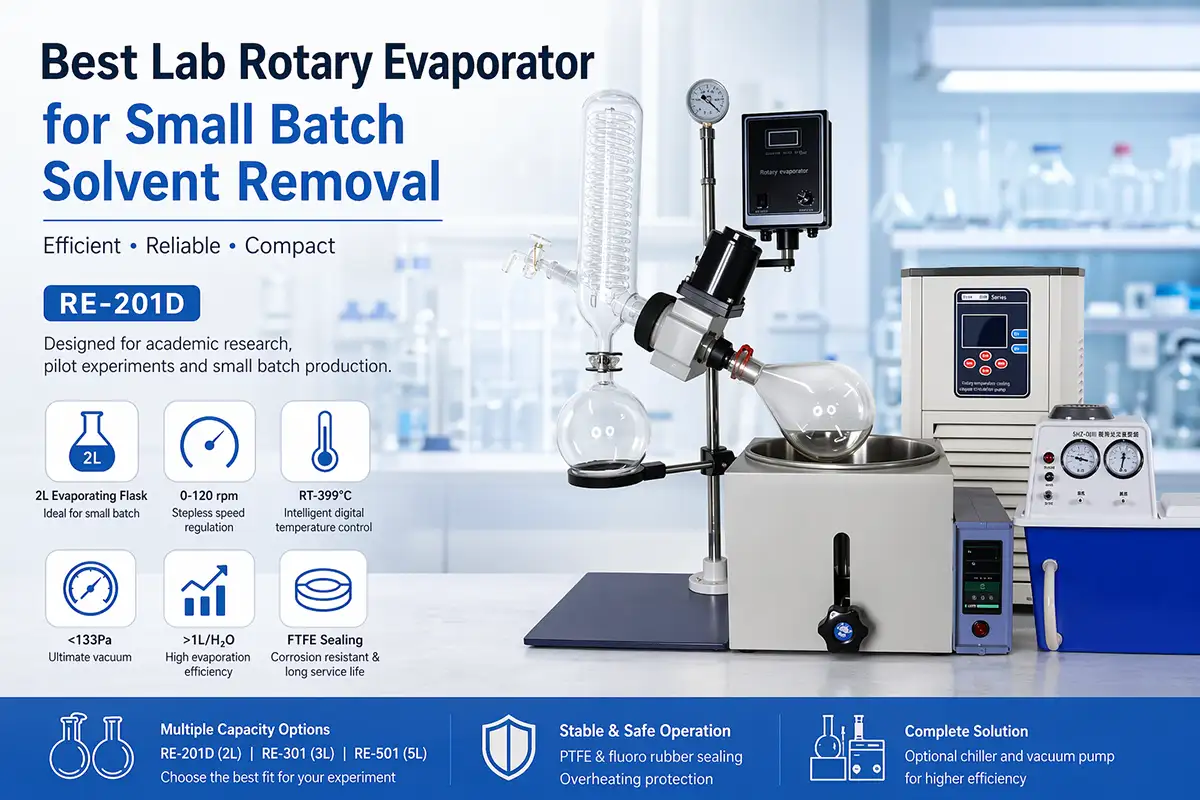
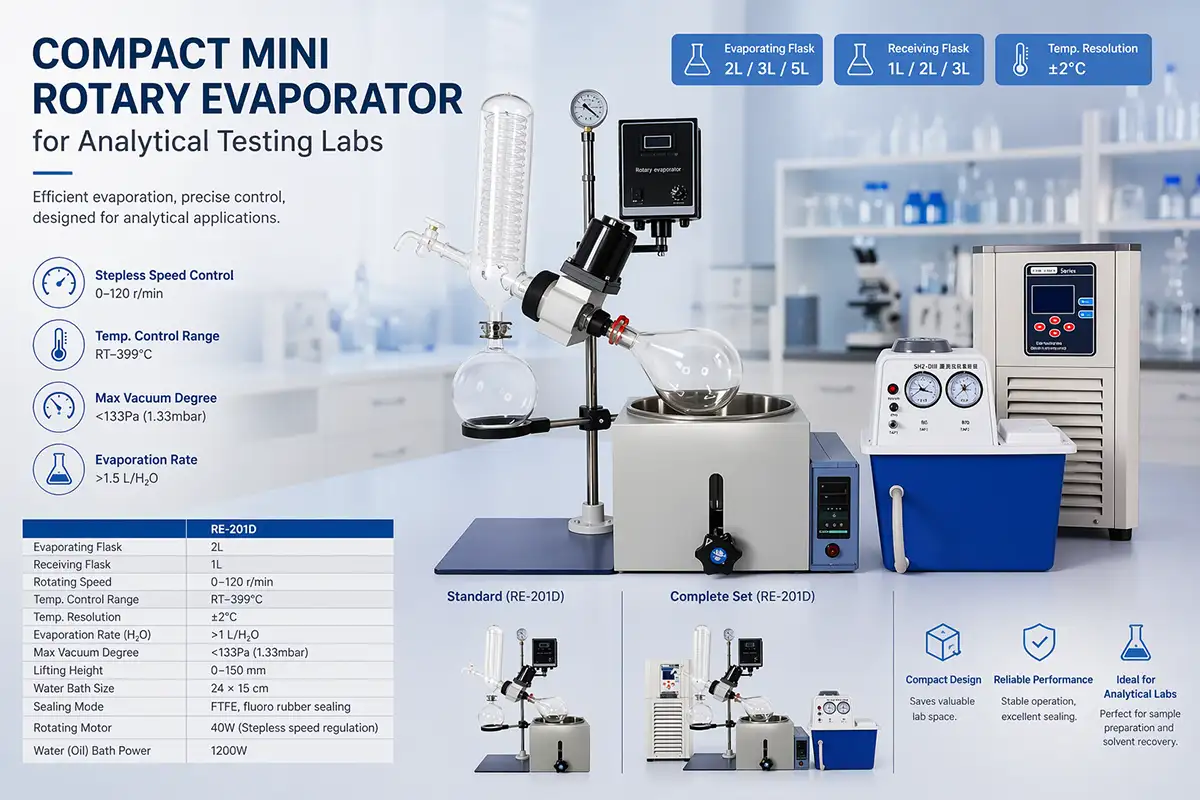
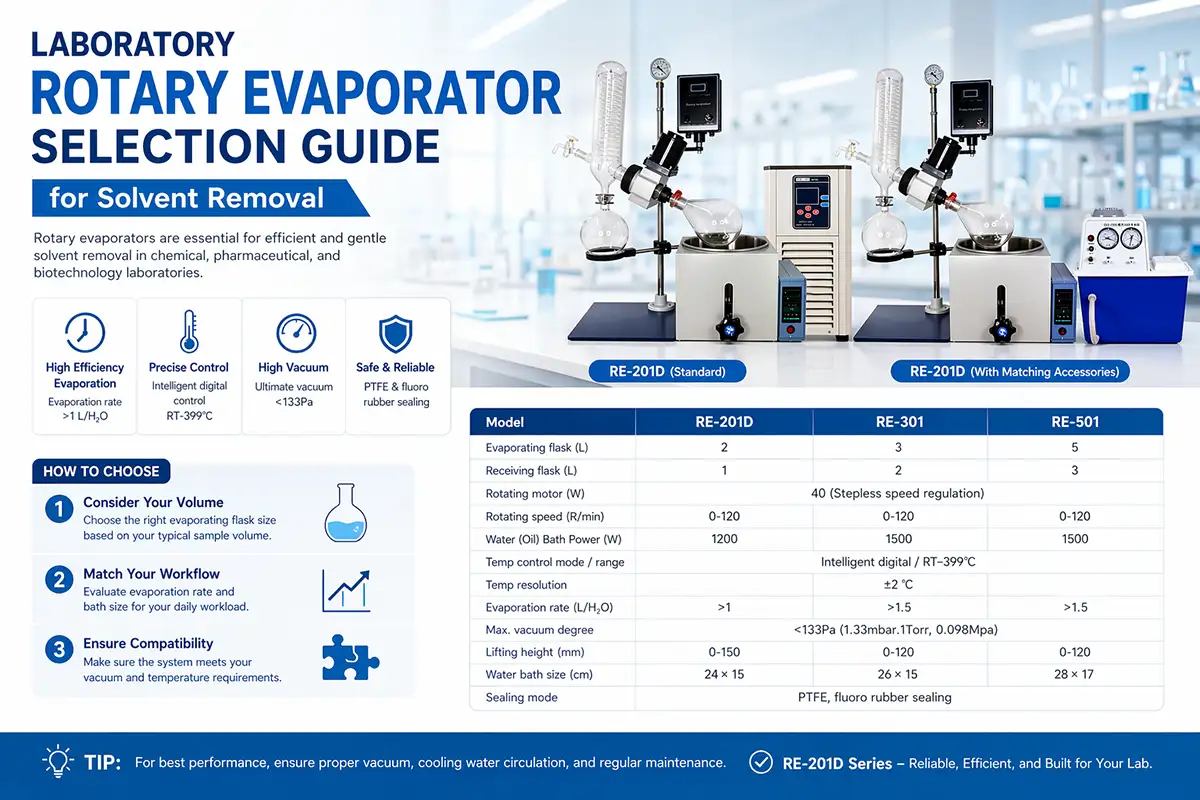
For a laboratory that handles small batch distillation every day, model size should be selected by real working volume rather than only flask capacity. The RE-201D, RE-301, and RE-501 cover the most common compact range: 2L, 3L, and 5L evaporating flasks with matching receiving flasks and steady 0-120 r/min rotation.
| Model | Evaporating Flask | Receiving Flask | Rotation | Bath Power | Evaporation Rate | Reference Price |
|---|---|---|---|---|---|---|
| RE-201D | 2L | 1L | 0-120 r/min | 1200W | >1 L/H2O | $595 |
| RE-301 | 3L | 2L | 0-120 r/min | 1500W | >1.5 L/H2O | $800 |
| RE-501 | 5L | 3L | 0-120 r/min | 1500W | >1.5 L/H2O | $920 |
Reference prices are selected from current compact-model listings. Where multiple prices were available for the same product family, a conservative mid-low value was used instead of the absolute lowest listing.
Is a 2L rotary evaporator enough for routine sample concentration?
For analytical samples, teaching labs, and small extraction batches, RE-201D is often the most economical starting point. The 2L evaporating flask and 1L receiving flask keep glassware light, while the 1200W bath is sufficient for common solvent removal work.
How to Choose the Right Mini Rotary Evaporator Capacity
The most reliable way to size a compact rotary evaporator is to begin with actual liquid loading. A rotary evaporator flask is not normally filled to its full nameplate capacity; leaving headspace improves film formation, helps control bumping, and gives foam room to rise. For many solvents, practical liquid loading is often around one-third to one-half of flask volume, depending on viscosity and foaming behavior.
RE-201D 2L Mini Rotary Evaporator
Choose RE-201D when the work is mainly sample concentration, small solvent recovery, teaching demonstrations, or early method development. Its compact size makes it easy to pair with a small diaphragm vacuum pump and compact recirculating chiller.
RE-301 3L Rotary Evaporator
Choose RE-301 when sample sizes are growing but a full 5L flask still feels oversized. It offers a 3L evaporating flask, 2L receiving flask, 1500W bath power, and the same 0-120 r/min rotation range used in the compact RE line.
RE-501 5L Rotary Evaporator
Choose RE-501 for larger small-batch distillation, botanical extraction concentration, and labs that need more receiving capacity. The 5L evaporating flask and 3L receiving flask reduce glassware changes during longer solvent recovery runs.
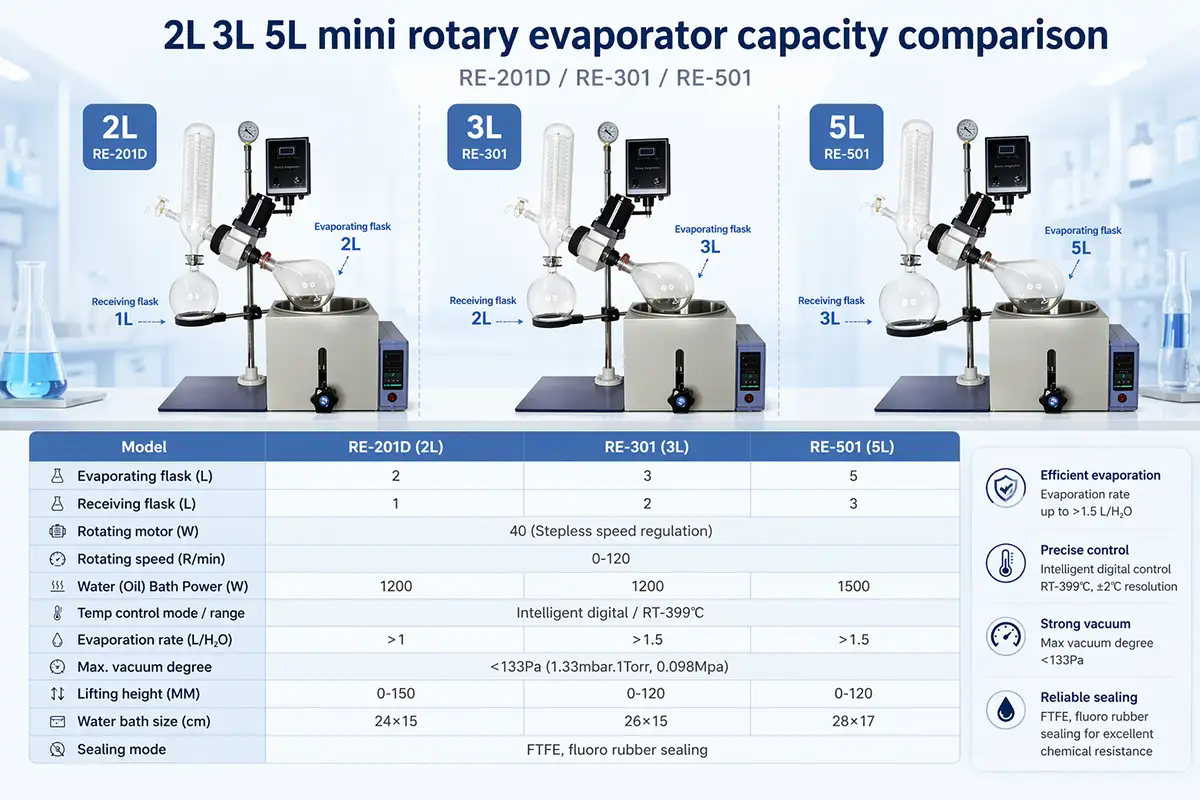
2L, 3L, and 5L compact rotary evaporator glassware capacity comparison.
When should a lab move from 2L to 5L?
A move to 5L makes sense when batches repeatedly require several 2L flask changes or when solvent recovery time becomes the bottleneck. RE-501 keeps the footprint compact while giving more working volume for routine evaporation.
What a Compact Mini Rotovap System Needs Around It
A mini rotary evaporator performs best as a system. The evaporator controls rotation and bath temperature, but vacuum stability and cooling capacity determine how cleanly the solvent boils and condenses. A practical bench setup includes the evaporator, a chemically compatible vacuum pump, a chiller or condenser cooling source, suitable tubing, receiving glassware, and a bump trap when samples foam easily.
The compact RE models use PTFE and fluoro rubber sealing, intelligent digital bath temperature control, and a maximum vacuum degree below 133 Pa. These details matter because poor sealing or unstable cooling can turn a capable evaporator into a slow solvent removal station. For operating technique, the step-by-step guide on how to use a rotovap is a useful companion for setting rotation speed, bath temperature, and vacuum ramping.
| Setup Area | Recommended Practice | Why It Matters |
|---|---|---|
| Vacuum control | Use a compatible pump and avoid pulling full vacuum too abruptly. | Controlled vacuum reduces bumping and improves repeatability. |
| Condenser cooling | Match coolant temperature to solvent volatility and vapor load. | Strong condensation protects the pump and improves solvent recovery. |
| Bath temperature | Use the lowest effective bath temperature for the solvent and sample. | Gentler heating helps preserve heat-sensitive materials. |
| Flask loading | Keep adequate headspace, especially with foaming samples. | Headspace supports stable film formation and safer evaporation. |
Small Footprint, Real Laboratory Performance
The compact RE series is not only smaller glassware on a stand. The key specifications show why it fits solvent removal workflows that need repeatability: a 40W stepless rotation motor, 0-120 r/min speed control, intelligent digital water or oil bath temperature control, and a vacuum specification suitable for low-pressure evaporation.
For teams planning future scale-up, the same selection logic can continue into larger systems. RE-1002, RE-2002, and RE-5002 support 10L, 20L, and 50L evaporating flasks with vertical double condensers and higher evaporation rates. A lab can start compact, prove the process, then compare larger systems such as a 50 liter rotary evaporator when batch volume justifies the move.
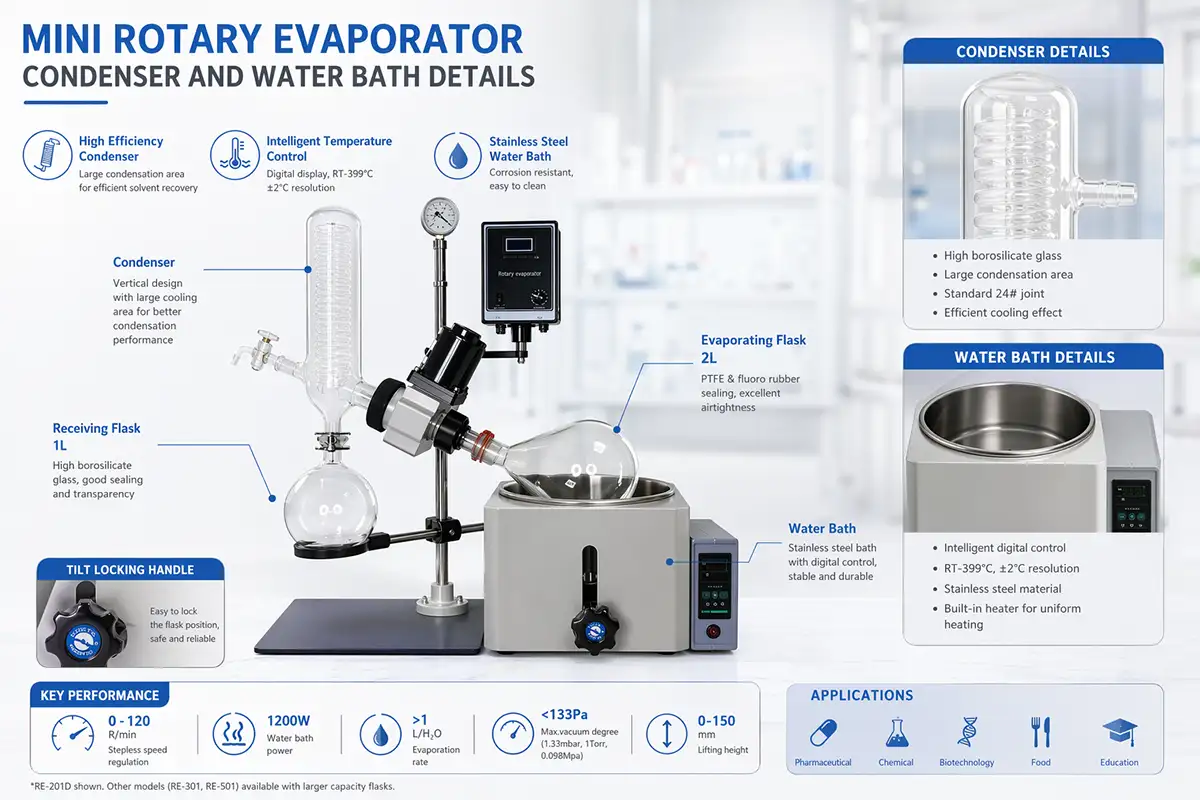
Condenser, sealing system, and digital heating bath details on a compact mini rotovap.
What to Check Before Buying a Compact Mini Rotary Evaporator
A low purchase price is helpful, but stable distillation depends on the full configuration. Before buying, confirm the glassware volume, condenser style, receiving flask size, bath power, sealing materials, available voltage, and the accessory package. A compact system should be easy to clean, easy to lift, and simple for operators to repeat from batch to batch.
Match the model to the real batch: RE-201D is economical for small sample work, RE-301 adds daily-use flexibility, and RE-501 gives the strongest compact capacity.
Confirm vacuum compatibility: solvent type, pump material, tubing, and cold-trap needs should be reviewed together.
Check condenser performance: volatile solvents need enough cooling to prevent vapor loss and pump contamination.
Plan for glassware handling: lighter 2L glassware is easier for frequent changes, while 5L glassware lowers changeover frequency.
Is the lowest mini rotovap price always the best choice?
Not usually. The better value is the configuration that includes suitable glassware, sealing, bath control, and after-sales support. A slightly higher compact rotary evaporator price can be more economical if it avoids poor vacuum stability, weak condensation, or accessory mismatch.
Compact Mini Rotary Evaporator FAQ
What solvents can be handled in small batch distillation?
Common laboratory solvents such as ethanol, methanol, acetone, ethyl acetate, and other volatile organic solvents are frequently processed by rotary evaporation. The exact settings depend on solvent boiling point, vacuum level, condenser temperature, and sample behavior.
How much sample should go into the flask?
The flask should normally have enough empty space for rotation, vapor movement, and foam control. In many routine applications, filling around one-third to one-half of the flask capacity is a practical starting range.
Does a mini rotary evaporator need a chiller?
A chiller is strongly recommended when solvent recovery rate and vapor capture matter. Tap water may be acceptable for some demonstrations, but controlled coolant temperature gives more reliable condensation and better pump protection.
Compact Rotary Evaporation Starts With the Right Flask Size
For small batch distillation, the RE-201D, RE-301, and RE-501 give a practical path from 2L sample concentration to 5L solvent recovery. Select the model by working volume, solvent behavior, and expected daily throughput, then match it with the right vacuum and cooling accessories for stable operation.
Explore KD Rotary Evaporators