How to Choose the Right Rotary Evaporator?
Choosing a rotary evaporator is not only a matter of flask size. The right decision balances solvent load, evaporation rate, condenser efficiency, bath power, vacuum stability, lifting method, glassware capacity, and the way the equipment will be used every day in the lab.
Capacity from 2L to 50L
Vacuum solvent removal
Water or oil bath heating
Lab and pilot scale options
Quick Answer: Start With Solvent Volume and Workflow
A good rotary evaporator should match the real batch size instead of the largest possible flask. A 2L or 3L unit is usually enough for teaching labs, analytical work, small extraction trials, and routine sample concentration. A 5L unit gives more room for daily lab solvent recovery. A 10L or 20L rotary evaporator is better for repeated botanical extraction, process development, and small pilot production. A 50L rotary evaporator belongs in high-throughput solvent recovery or pre-production work.
For a deeper foundation on the operating principle, the related guide what is a rotary evaporator explains how reduced pressure, rotation, heat transfer, and condensation work together during evaporation.
A well chosen rotary evaporator keeps flask size, bath power, condenser area, and vacuum performance in balance.
1. Choose the Evaporating Flask Capacity First
The evaporating flask is the first sizing point because it controls practical batch volume. In routine operation, the flask should not be filled to the top. Leaving enough headspace helps create a stable thin film, reduces bumping risk, and gives vapor room to travel into the condenser. For many solvents, a practical working charge is often well below the nominal flask volume.
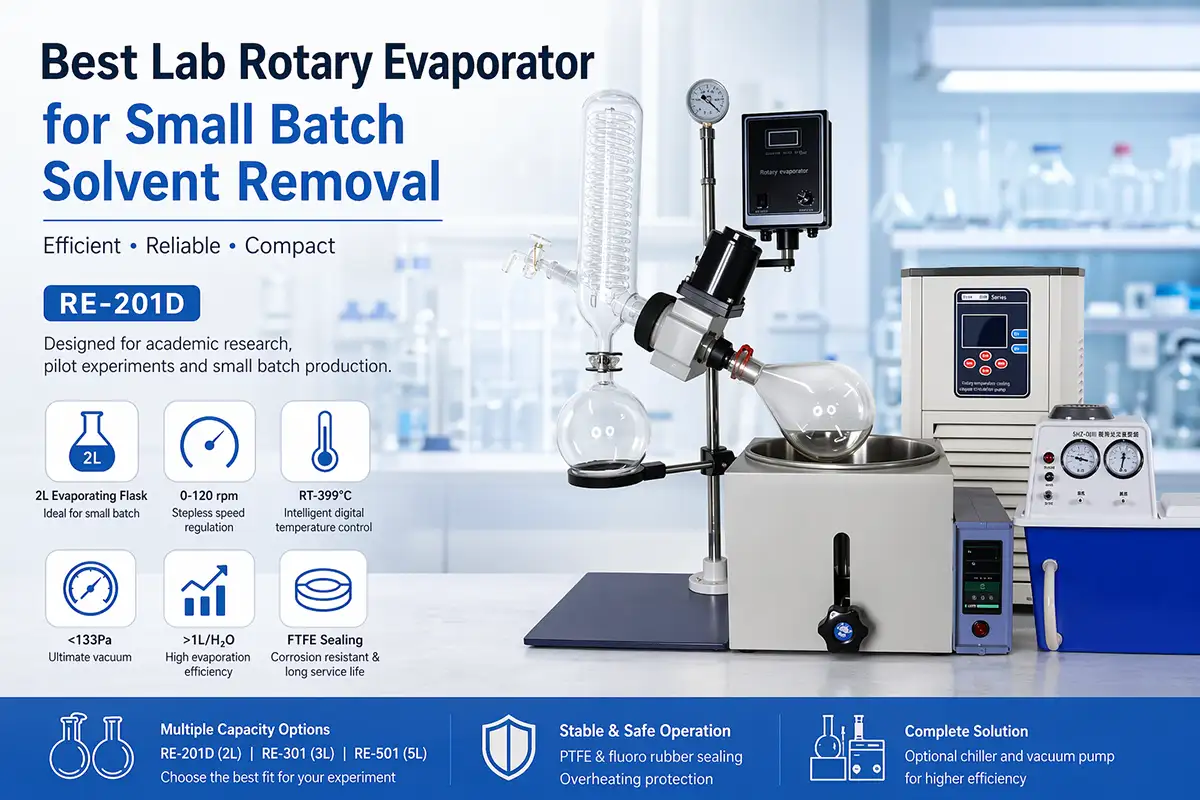
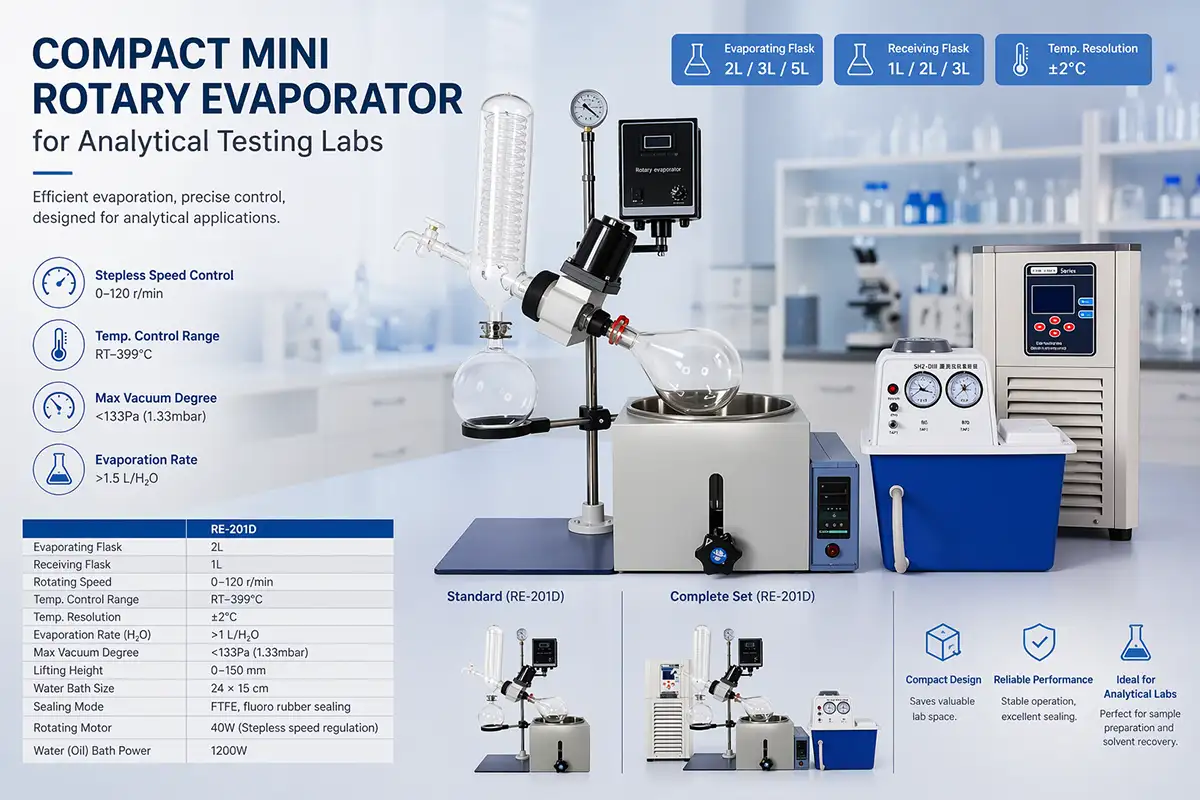
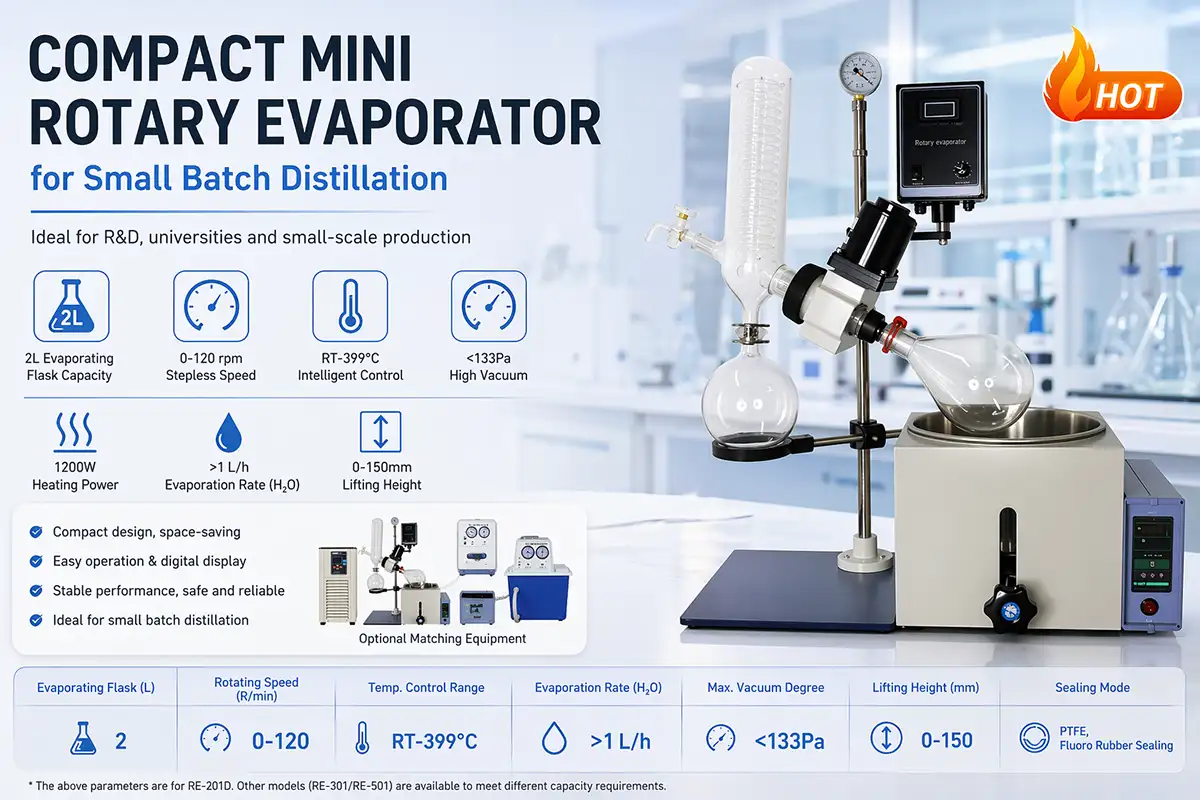
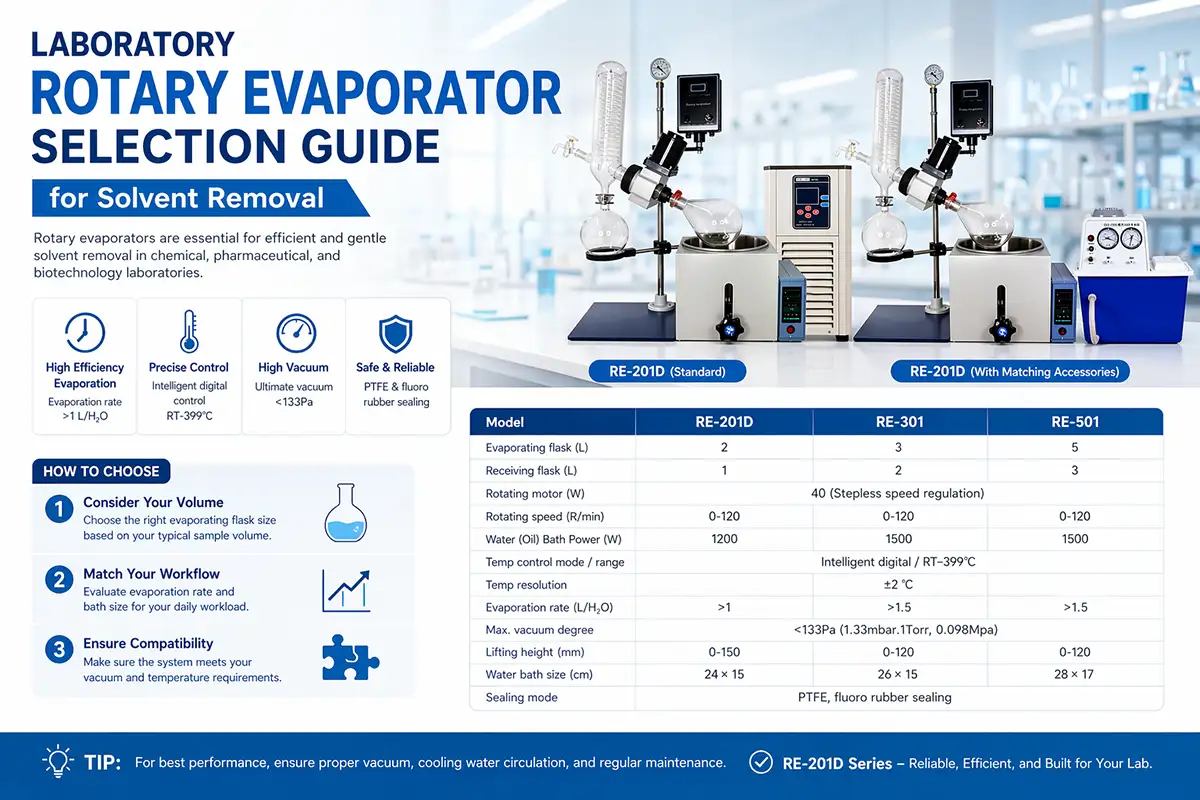
Small benchtop models such as RE-201D, RE-301, and RE-501 cover 2L, 3L, and 5L flasks. They are compact, simple to operate, and suitable for small batch solvent removal. Larger RE-1002, RE-2002, and RE-5002 units step up to 10L, 20L, and 50L evaporating flasks for higher daily solvent loads.
Is a 2L rotary evaporator enough for daily solvent removal?
For small sample concentration, method development, and light recovery work, a 2L model can be the right choice. For repeated batches, viscous extracts, or larger solvent volumes, the selection should move toward 5L or 10L to avoid constant flask changes and slow throughput.
| Model | Evaporating Flask | Receiving Flask | Rotating Speed | Best Fit | Reference Price |
|---|---|---|---|---|---|
| RE-201D | 2L | 1L | 0-120 rpm | Teaching labs, small sample concentration, light solvent recovery | $600 |
| RE-301 | 3L | 2L | 0-120 rpm | Small batch evaporation with more receiving capacity | $800 |
| RE-501 | 5L | 3L | 0-120 rpm | Routine lab solvent removal and small production trials | $780 |
| RE-1002 | 10L | 5L | 0-120 rpm | Frequent solvent recovery, extraction labs, process testing | $1,818 |
| RE-2002 | 20L | 10L | 0-120 rpm | Pilot batches and higher daily evaporation demand | $2,061 |
| RE-5002 | 50L | 20L | 0-90 rpm | Large solvent recovery and pre-production scale evaporation | $2,545 |
2. Match Vacuum and Condenser Capacity to the Solvent
A rotary evaporator removes solvent efficiently because vacuum lowers the boiling point while the rotating flask spreads liquid into a thin film. That is why vacuum stability matters as much as bath temperature. A unit rated below 133 Pa, or about 1.33 mbar, gives strong evaporation support for common laboratory solvents when paired with a suitable vacuum pump and cold source.
The condenser should be selected according to vapor load. Compact units use vertical condenser glassware for everyday evaporation. Larger 10L, 20L, and 50L models use vertical double condensers to increase condensation area. For volatile solvents, high vapor volumes, or continuous repeated batches, condenser efficiency becomes one of the most important performance factors.
Operating technique also affects the result. The practical guide how to use a rotovap is useful when setting bath temperature, vacuum depth, rotation speed, and condenser cooling in a safe sequence.
Should vacuum strength or heating power be prioritized?
Vacuum control should usually be prioritized first. Raising bath temperature can force evaporation, but stable vacuum lowers the boiling point more gently and helps protect heat-sensitive samples. Heating power should then be matched to flask size so the bath can recover temperature during active evaporation.
3. Check Bath Power, Temperature Range, and Heat Transfer
The water or oil bath supplies the energy needed for evaporation. Small RE-201D, RE-301, and RE-501 systems use 1200W to 1500W bath power, which is suitable for compact glassware. The RE-1002 increases bath power to 3000W, the RE-2002 to 5000W, and the RE-5002 to 7000W or 9000W depending on configuration. This scaling is important because larger solvent batches remove heat from the bath faster.
Temperature range should be chosen around the solvent, sample sensitivity, and desired evaporation speed. Digital temperature control and stable bath fluctuation help make repeated runs more consistent. For water bath work, room temperature to 99°C is common. Oil bath configurations can extend higher when the application requires it.
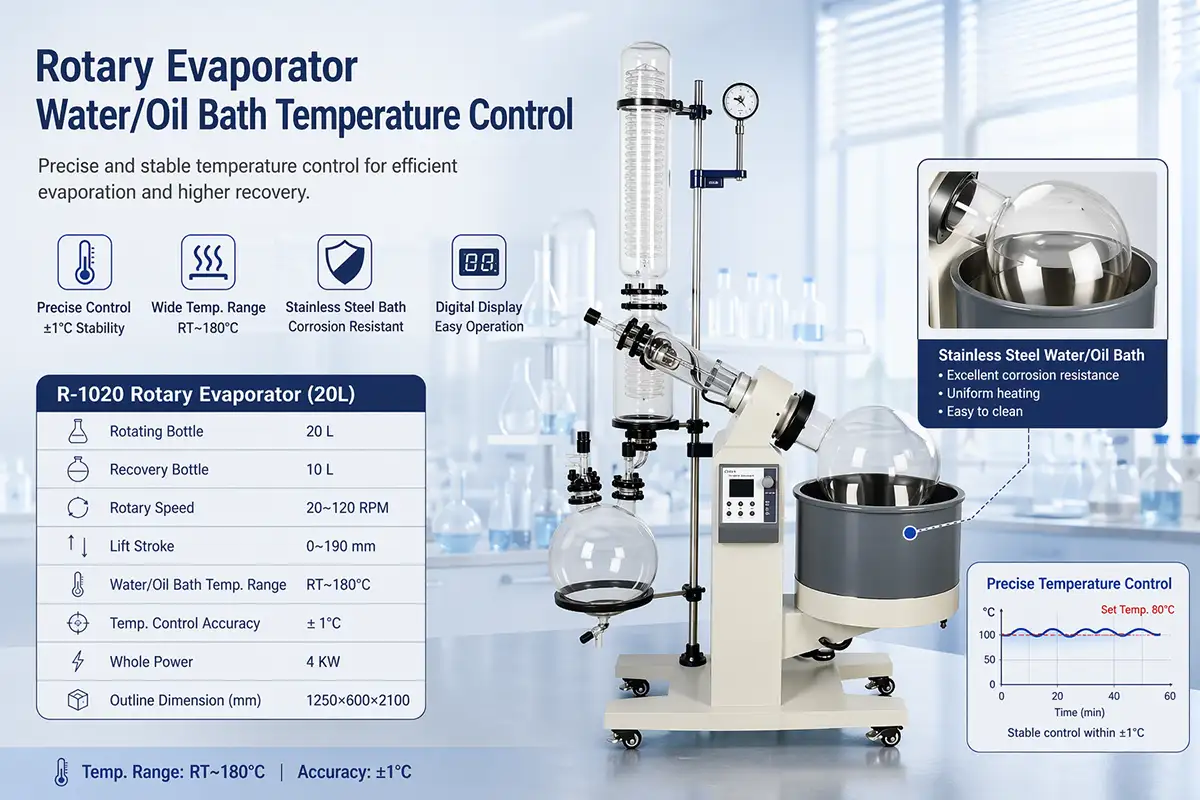
Bath power should rise with flask volume so evaporation remains stable during heavier solvent loads.
4. Evaluate Lifting Method, Sealing, and Daily Safety
Rotary evaporators are handled repeatedly during a normal workday, so mechanical comfort matters. Smaller systems may use manual or compact lifting designs. Larger R series units can include electric lift or electric plus hand lift, which makes 10L, 20L, and 50L glassware easier to position. Lift height should provide enough clearance for flask installation, bath movement, and safe removal after the run.
Sealing materials are also important. PTFE and fluoro rubber sealing are commonly used because they support chemical resistance and vacuum integrity. A poor seal reduces evaporation speed, causes pressure instability, and can make solvent recovery inconsistent.
For frequent flask changes: choose an electric lift or a smooth manual lift with enough vertical travel.
For corrosive or mixed solvents: check seal material, glass quality, and compatibility before purchase.
For heavier flasks: confirm the stand, bath, and clamp design feel stable at the selected volume.
5. Compare Small Lab, Mid Scale, and Large Scale Rotary Evaporators
The best rotary evaporator is the one that removes solvent at the required pace without making the lab overpay for capacity that will not be used. A compact 2L or 3L model saves bench space and is easier for training. A 5L model is a balanced daily lab machine. A 10L or 20L model supports process development and small production. A 50L model is chosen when solvent recovery volume becomes a major part of the workflow.
When evaluating a large unit, read the glassware capacity together with motor power, bath wattage, condenser type, voltage, and installation space. The related KD page for a 50 liter rotary evaporator is a relevant reference for labs comparing high-capacity solvent removal equipment.
| Scale | Typical Models | Capacity Range | Main Advantage | Watch Point |
|---|---|---|---|---|
| Small lab | RE-201D, RE-301 | 2L to 3L | Compact, economical, easy for routine sample work | Limited throughput for repeated solvent recovery |
| General lab | RE-501, R1005 | 5L | Useful balance of capacity, footprint, and cost | Condenser and pump must match solvent volatility |
| Pilot scale | RE-1002, RE-2002, R1010, R1020 | 10L to 20L | Higher recovery rate for extraction and process testing | Needs stronger bath power, chiller capacity, and floor space |
| Large scale | RE-5002, R1050 | 50L | Large volume solvent removal and recovery | Voltage, cooling, handling safety, and installation planning |
6. Do Not Choose the Rotavap Alone
A rotary evaporator works as a system. The main unit, vacuum pump, recirculating chiller, glassware, bath, tubing, and solvent receiving setup should be selected together. A strong evaporator with an undersized chiller will still lose performance because vapor cannot condense fast enough. A good condenser with poor vacuum control can also slow the entire process.
Can a rotary evaporator be selected by price alone?
Price should be treated as a filter, not the final decision. A lower purchase price is attractive, but the better value comes from matching capacity, condenser efficiency, seal quality, lift design, and accessory sizing to the real solvent removal job.
7. Rotary Evaporator Buying Checklist
Before purchasing, compare each candidate against the actual daily work. The following checklist helps narrow the choice quickly without ignoring details that affect long-term performance.
Batch size: choose 2L, 3L, 5L, 10L, 20L, or 50L according to normal solvent volume, not only maximum possible volume.
Receiving capacity: make sure the receiving flask can hold recovered solvent without constant interruptions.
Speed range: 0-120 rpm covers many lab applications, while 50L systems may use a lower 0-90 rpm range for large glassware stability.
Condenser design: select a vertical double condenser for larger vapor loads and more demanding solvent recovery.
Bath power: use higher wattage for larger flasks so evaporation does not slow when solvent load increases.
Vacuum and sealing: confirm pump compatibility and PTFE or fluoro rubber sealing for stable vacuum performance.
Space and voltage: check footprint, height, power supply, and installation environment before buying a 20L or 50L system.
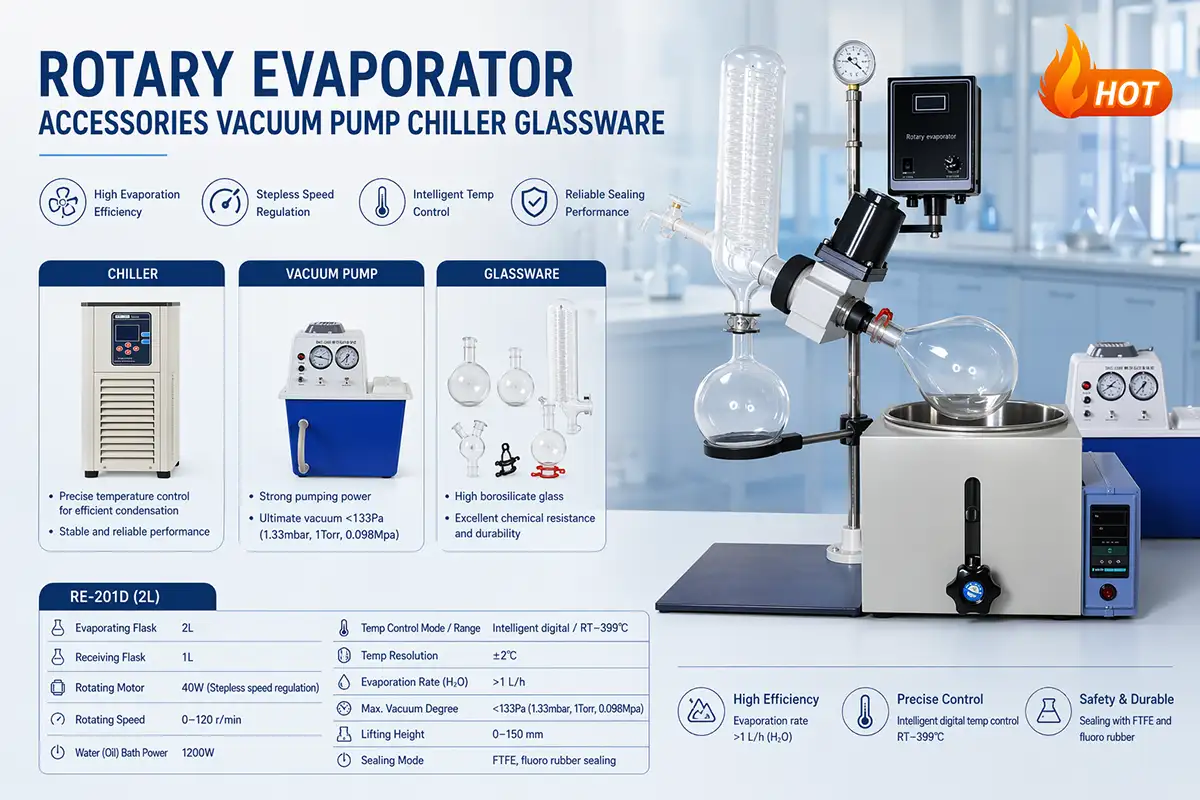
The evaporator, vacuum pump, and chiller should be sized as one solvent removal system.
Recommended Selection Path
For small batches, start with RE-201D or RE-301. For a general purpose laboratory rotary evaporator, RE-501 gives a practical 5L capacity. For repeated extraction and solvent recovery, RE-1002 or RE-2002 provides better throughput. For large volume recovery, RE-5002 or R1050 should be considered with proper cooling, vacuum, voltage, and installation planning.
The right rotary evaporator should feel balanced: the flask is large enough, the receiving bottle is not constantly full, the condenser can capture vapor, the bath can hold temperature, and the lift makes glassware handling safe. When all of these points fit the workflow, solvent removal becomes faster, cleaner, and easier to repeat.
Build the Selection Around the Real Batch
A rotary evaporator is a long term lab tool. Start with the normal solvent volume, then confirm condenser area, bath power, vacuum stability, lifting method, and accessory sizing. This approach leads to a machine that is efficient on day one and still practical as the workload grows.