Rotovap Price Guide: What Affects Cost and How to Choose the Right Rotary Evaporator
Rotovap price is one of the first things buyers compare, but the smartest decision usually comes from matching price with evaporation rate, vacuum performance, condenser efficiency, flask size, and long-term operating value. A lower upfront cost can be attractive, yet the right rotary evaporator often saves more through faster solvent recovery, safer operation, and better process stability.
Quick Navigation
Why Does Rotovap Price Vary So Much?
The biggest reason is capacity. A 2L or 5L benchtop unit is built for research, small-batch formulation, and teaching laboratories, while 10L, 20L, and 50L systems are designed for higher throughput, pilot processes, solvent recovery, and extraction workflows. As capacity increases, the frame becomes stronger, the bath becomes more powerful, the condenser usually becomes larger, and the lifting structure must handle more load safely.
Another major factor is configuration. Two rotary evaporators may look similar in pictures but perform differently in real use. A better condenser design improves vapor recovery, an electric lift improves convenience, a stronger bath shortens warm-up time, and higher evaporation capacity reduces total processing time. Buyers comparing only the headline number often miss the value hidden in these details.
For buyers who are still reviewing the basics of rotary evaporation, it can be helpful to read what is a rotary evaporator before comparing price tiers. A clearer understanding of function usually leads to a more accurate purchasing decision.
Typical Rotovap Price Range by Capacity
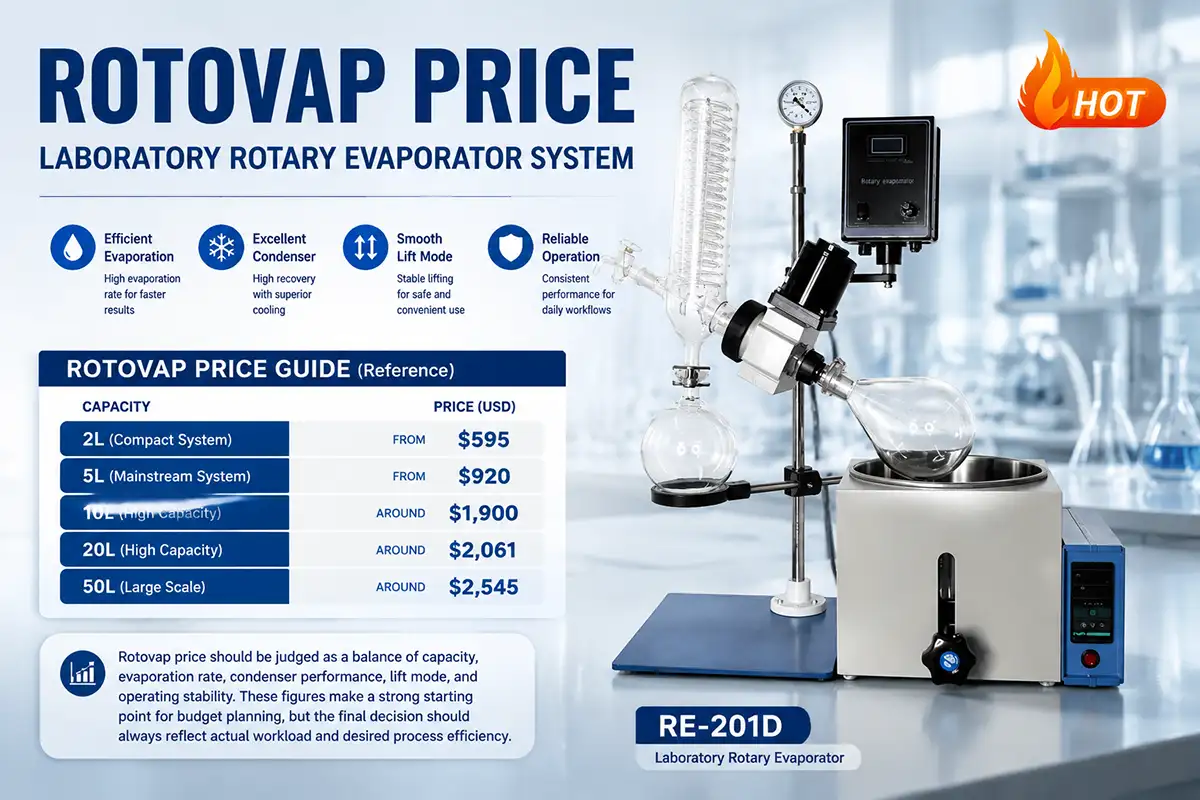
Based on the provided product pricing information and matching rotary evaporator listings, the market can be viewed in practical working bands rather than a single fixed number. Smaller systems are usually the most economical entry point, while larger systems climb in price because of structural design, bath power, condenser scale, and throughput capability.
2L Class
Compact bench models are commonly used for routine laboratory concentration and teaching use.
Around $5955L Class
A very popular lab size with broader use in R&D, natural product extraction, and solvent recovery.
Around $92010L Class
Suitable for labs needing more throughput and stronger process continuity.
Around $1,90020L Class
Often selected for pilot runs, extraction workflows, and larger solvent recovery tasks.
Around $2,06150L Class
Used for pilot-scale processing where larger batch volume and stronger recovery performance are essential.
Around $2,545Bundle Systems
Complete packages with chiller and vacuum pump can raise total system investment but improve installation readiness.
Varies by packageBuyers focused on larger pilot-scale equipment may also want to review our 50 liter rotary evaporator page for a closer look at large-capacity system applications.
Technical Parameters That Influence Value
A meaningful rotovap price comparison should always include technical parameters. The provided model data shows several patterns that matter during purchasing.
1. Flask Volume
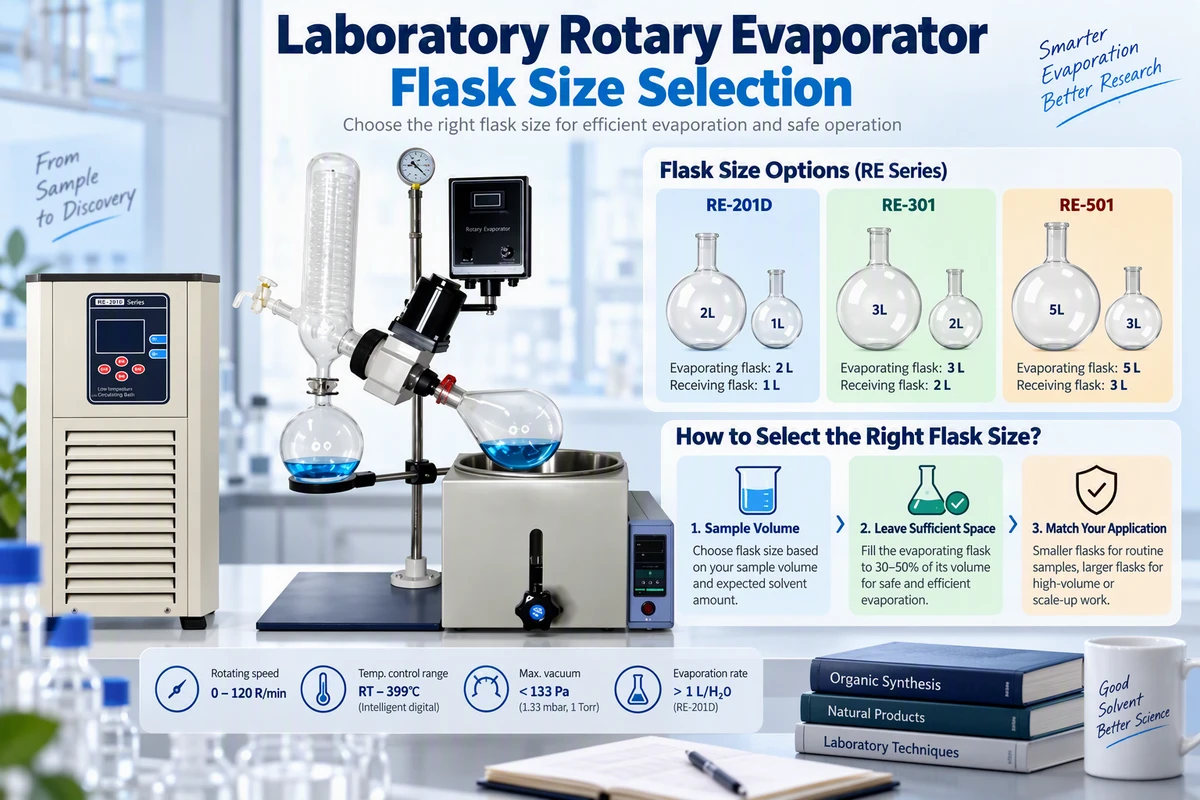
Models in the supplied data cover 2L, 3L, 5L, 10L, 20L, and 50L rotating flasks. Receiving flask volume also increases accordingly, which supports longer uninterrupted collection and smoother process continuity.
2. Rotating Speed
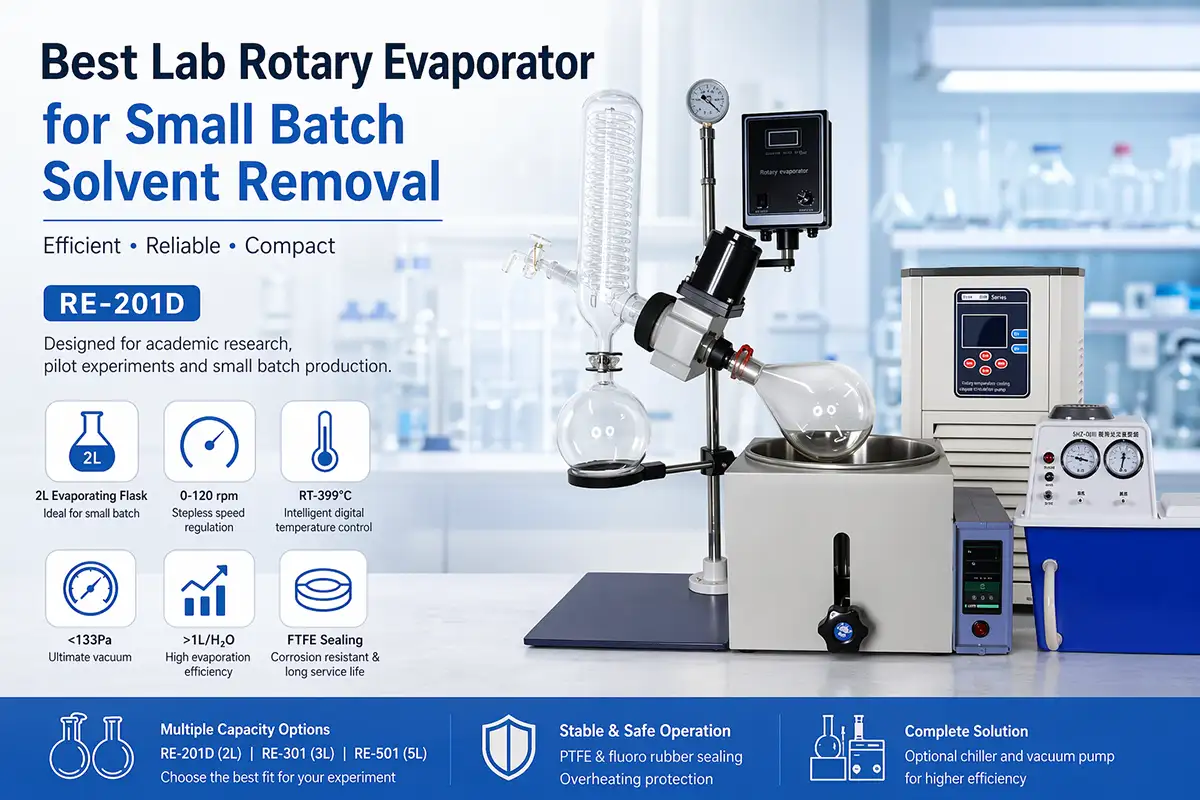
Smaller RE-201D, RE-301, and RE-501 models run at 0-120 rpm. R1005 reaches 10-140 rpm, while larger systems such as R1010, R1020, and R1050 run in the 20-120 rpm class. Speed range matters because stable film formation directly affects evaporation efficiency.
3. Bath Power and Temperature Control
Smaller bath power starts around 1200W to 1500W, while large models rise to 3000W, 5000W, and even 7000W/9000W. In practical terms, stronger bath power helps maintain process stability during larger solvent loads. The listed temperature control range up to 399℃ on some compact models and RT-99(250)℃ on larger RE-1002/2002/5002 systems shows flexibility for water bath and oil bath work.
4. Evaporation Rate
This is one of the clearest performance indicators. The supplied specifications show >1 L/h, >1.5 L/h, >3 L/h, >5 L/h, and >9 L/h water evaporation rates depending on size. Faster evaporation can justify a higher purchase price because it reduces batch time and labor exposure.
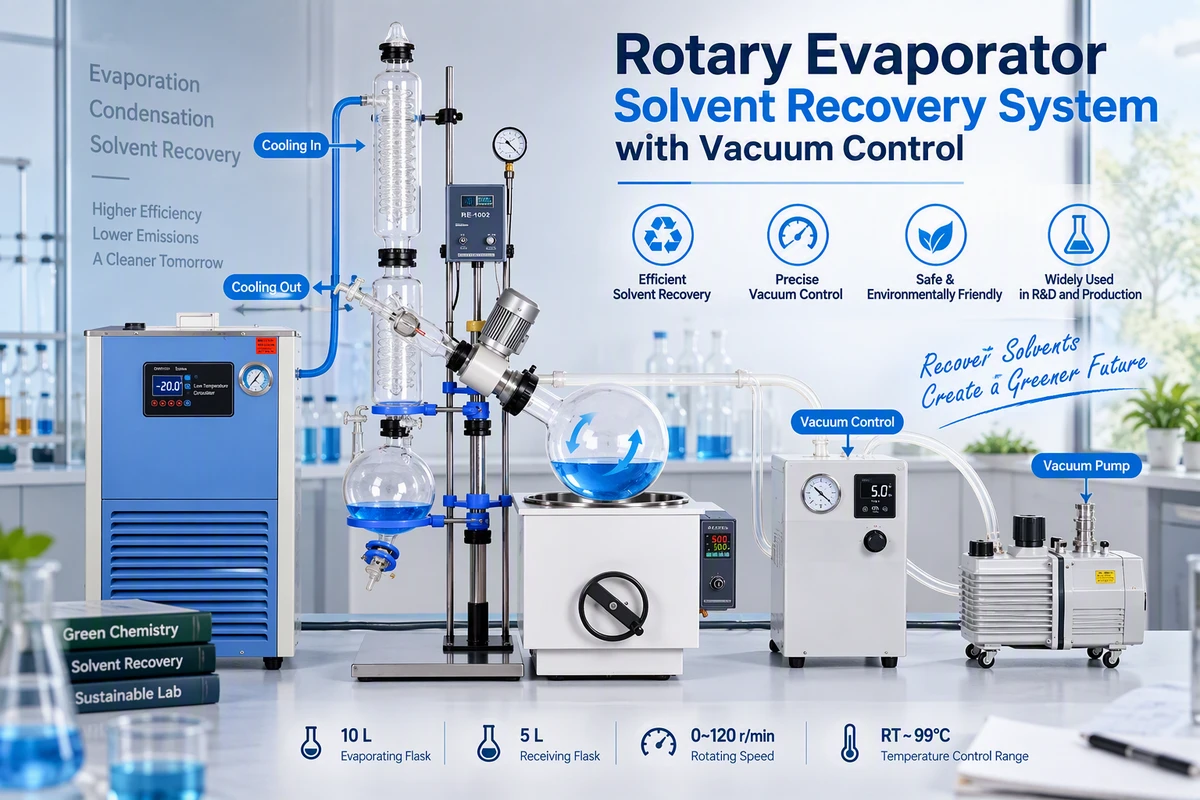
Process-oriented users can also explore how rotary evaporators work to better connect these parameters with real operating performance.
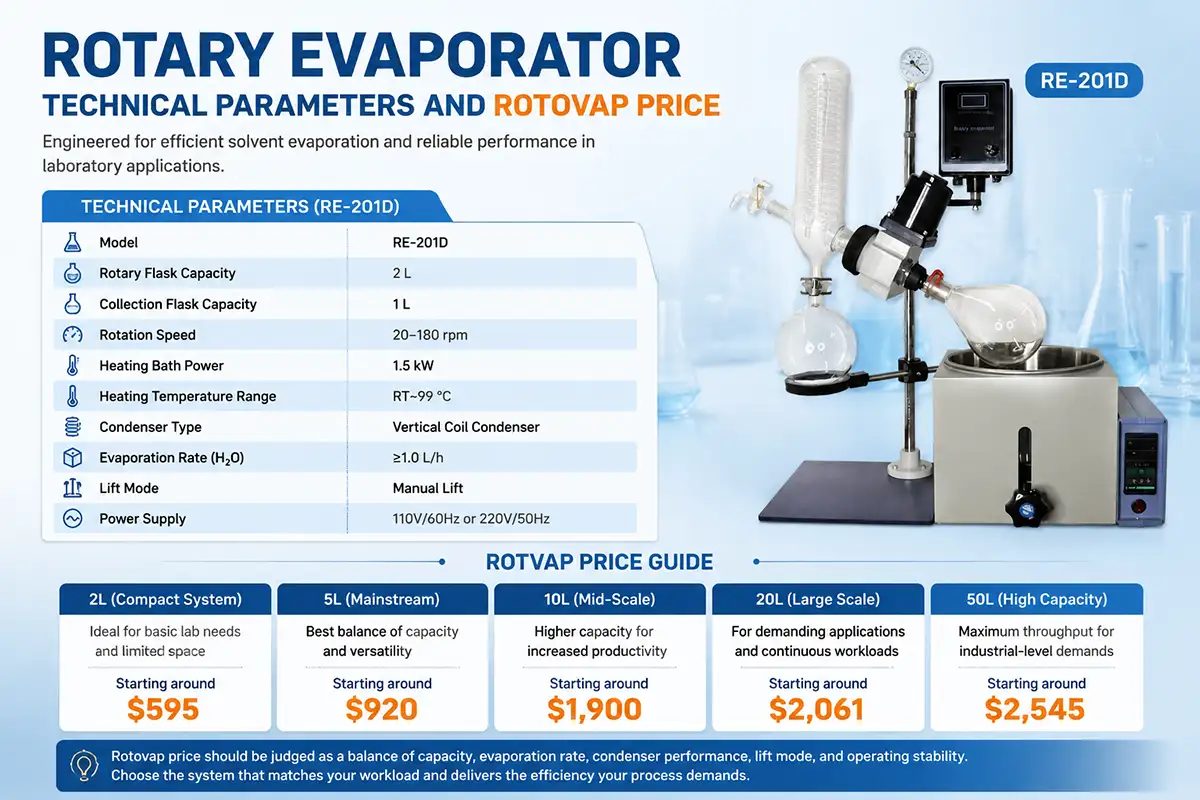
Rotary Evaporator Model Comparison
| Model | Evaporating Flask | Receiving Flask | Motor / Speed | Bath Power | Evaporation Rate | Lift | Reference Price |
|---|---|---|---|---|---|---|---|
| RE-201D | 2L | 1L | 40W / 0-120 rpm | 1200W | >1 L/h | 0-150 mm | About $595 |
| RE-501 | 5L | 3L | 40W / 0-120 rpm | 1500W | >1.5 L/h | 0-120 mm | About $920 |
| RE-1002 | 10L | 5L | 180W / 0-120 rpm | 3000W | >3 L/h | 0-220 mm | About $1,900 |
| RE-2002 | 20L | 10L | 180W / 0-120 rpm | 5000W | >5 L/h | 0-220 mm | About $2,061 |
| RE-5002 | 50L | 20L | 250W / 0-90 rpm | 7000W/9000W | >9 L/h | 0-220 mm | About $2,545 |
| R1005 | 5L | 3L | 40W / 10-140 rpm | Total power 2KW | — | Electric 0-150 mm | 5L market range around $920+ |
| R1010 | 10L | 5L | Brushless 250W / 20-120 rpm | Total power 3KW | — | Electric + hand, 0-160 mm | 10L market range around $1,900+ |
| R1050 | 50L | 20L | Brushless 250W / 20-120 rpm | Total power 4KW | — | Electric + hand, 0-180 mm | 50L market range around $2,545+ |
How to Choose the Right Rotovap for the Budget
A practical buying strategy starts with batch size. If the application is standard lab concentration, a 2L or 5L system may be enough. If the target is daily solvent recovery, pilot extraction, or scale-up validation, 10L to 50L systems often provide much better long-term value.
Next, think about the full process line. A rotary evaporator is rarely working alone. Vacuum pump compatibility, condenser cooling support, and temperature control all affect final performance. In many real laboratories, the actual cost of ownership depends as much on the matching accessories as on the evaporator itself.
It is also important to evaluate the process itself. For example, ethanol concentration and botanical extraction applications often benefit from larger baths, efficient condensers, and stronger vacuum support. For more process background, our page on ethanol rotary evaporator applications gives added context for solvent-heavy workflows.
Final Thoughts on Rotovap Price
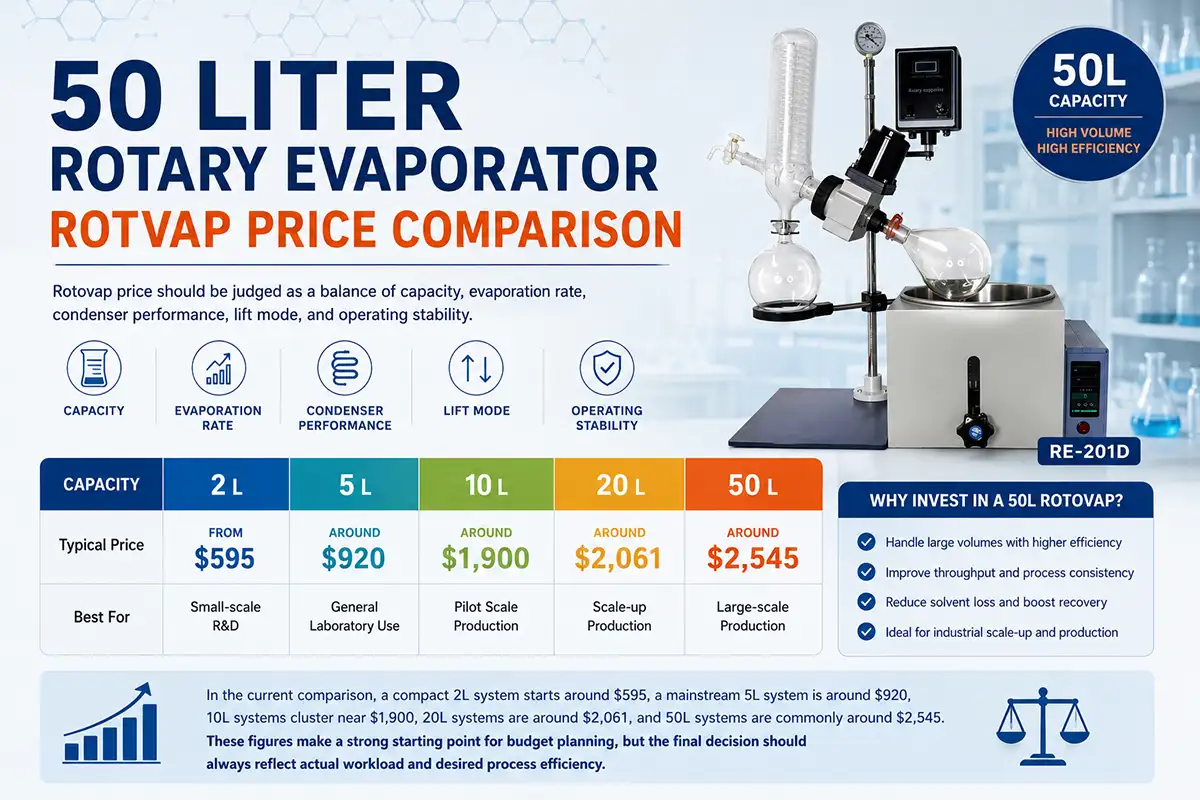
Rotovap price should be judged as a balance of capacity, evaporation rate, condenser performance, lift mode, and operating stability. In the current comparison, a compact 2L system starts around $595, a mainstream 5L system is around $920, 10L systems cluster near $1,900, 20L systems are around $2,061, and 50L systems are commonly around $2,545. These figures make a strong starting point for budget planning, but the final decision should always reflect actual workload and desired process efficiency.
If the goal is dependable solvent removal, smoother scale-up, and better long-term equipment value, the best purchasing decision is usually not the lowest quote, but the model with the most appropriate specifications for the application.