What is the Best Mini Rotary Evaporator for Labs?
The best mini rotary evaporator for most labs is the model that removes solvent reliably without taking more bench space, bath power, or budget than the application needs. For very small samples, the RE-201D is the most economical compact choice. For daily lab work, the RE-301 gives a useful capacity step up. For the widest small-batch flexibility, the RE-501 5L rotary evaporator is usually the strongest mini lab option.
Quick Answer: The Best Mini Rotary Evaporator Depends on Batch Size
A mini rotary evaporator should be judged by working volume first, then by vacuum control, condenser performance, rotation stability, bath power, seal quality, and lifting ergonomics. A low price is useful only when the instrument can recover solvent cleanly and repeatably.
For a lab that handles small samples, method development, teaching demonstrations, essential oil trials, synthetic chemistry cleanup, or light ethanol recovery, the best starting point is usually a 2L to 5L rotary evaporator. That range keeps the footprint manageable while still providing enough evaporation area for practical solvent removal.
For a deeper look at the operating principle behind solvent evaporation under vacuum, the KD guide to how a rotovap works is a useful companion resource.
Recommended Mini Rotary Evaporator Models
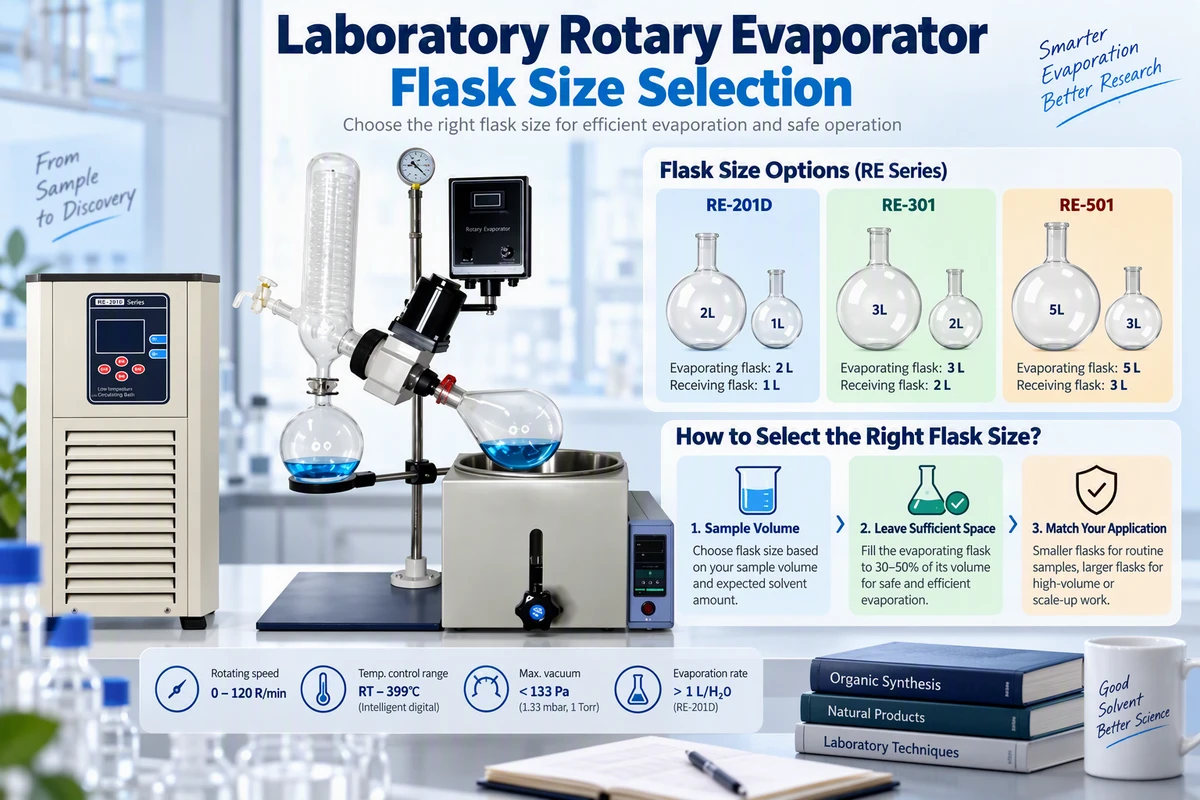
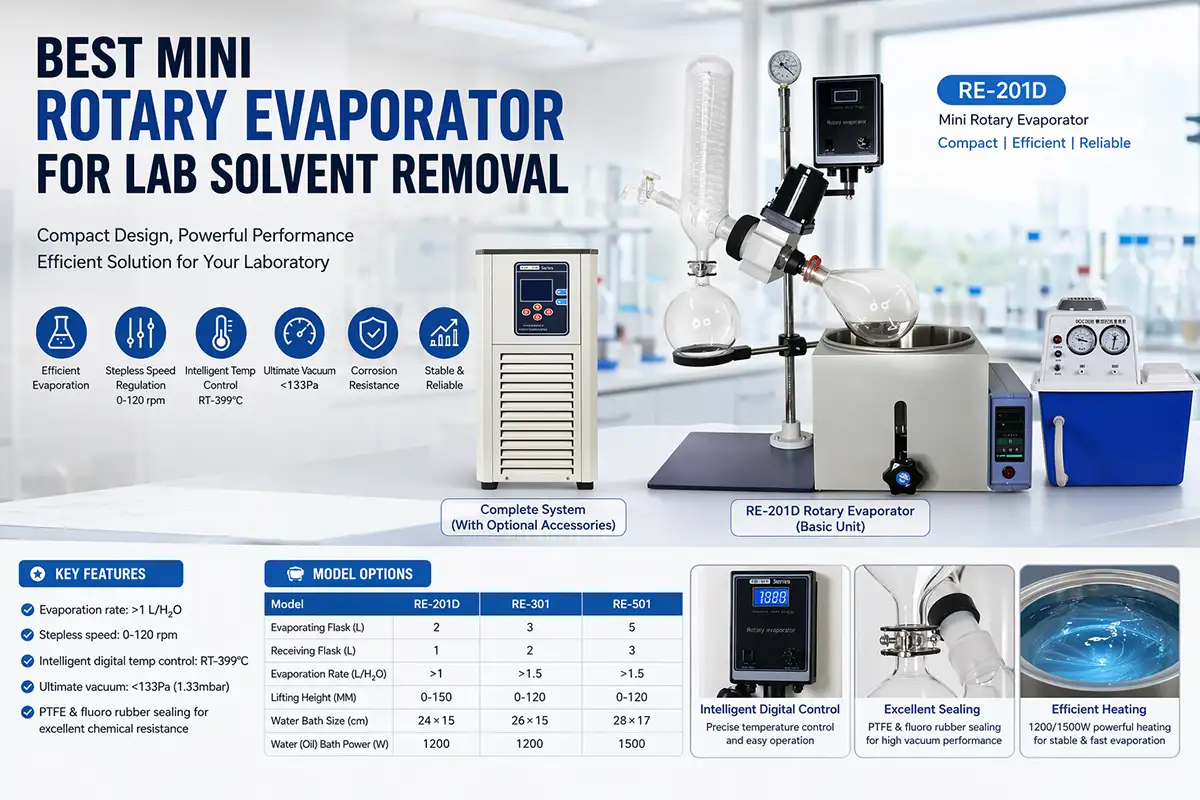
The KD small lab range can be grouped into three practical choices. The RE-201D fits laboratories that need a low-cost mini rotovap for small samples. The RE-301 is a middle option for routine testing and more comfortable receiving volume. The RE-501 is the best mini rotary evaporator when a lab wants compact size but does not want to outgrow the machine quickly.
| Model | Best Fit | Evaporating Flask | Receiving Flask | Speed | Reference Price |
|---|---|---|---|---|---|
| RE-201D | Budget mini lab rotary evaporator for small samples | 2 L | 1 L | 0-120 r/min | $595 |
| RE-301 | Routine lab solvent removal with more working room | 3 L | 2 L | 0-120 r/min | $800 |
| RE-501 | Best overall mini choice for flexible small batches | 5 L | 3 L | 0-120 r/min | $920 |
Reference prices are selected from the supplied KD rotary evaporator price sheet. Where repeated product pricing appears, a practical mid-low value is used rather than the highest listing.
Why the RE-501 is Often the Best Mini Rotary Evaporator for Labs
The RE-501 earns the strongest recommendation because a 5L evaporating flask gives small laboratories more usable capacity without jumping into a large pilot-plant system. It remains practical for daily bench work, but it can handle larger solvent loads than 2L and 3L units.
More batch flexibility: A 5L evaporating flask and 3L receiving flask reduce interruptions during solvent recovery and sample concentration.
Stable rotation range: The 0-120 r/min speed range supports controlled thin-film formation for common lab solvents.
Higher throughput than 2L: The published evaporation rate is greater than 1.5 L/h for water, giving better daily productivity for repeated runs.
Lab-friendly control: Intelligent digital bath control helps maintain repeatable heating conditions for solvent removal.
Reliable sealing design: PTFE and fluoro rubber sealing support stable vacuum performance for routine chemistry use.
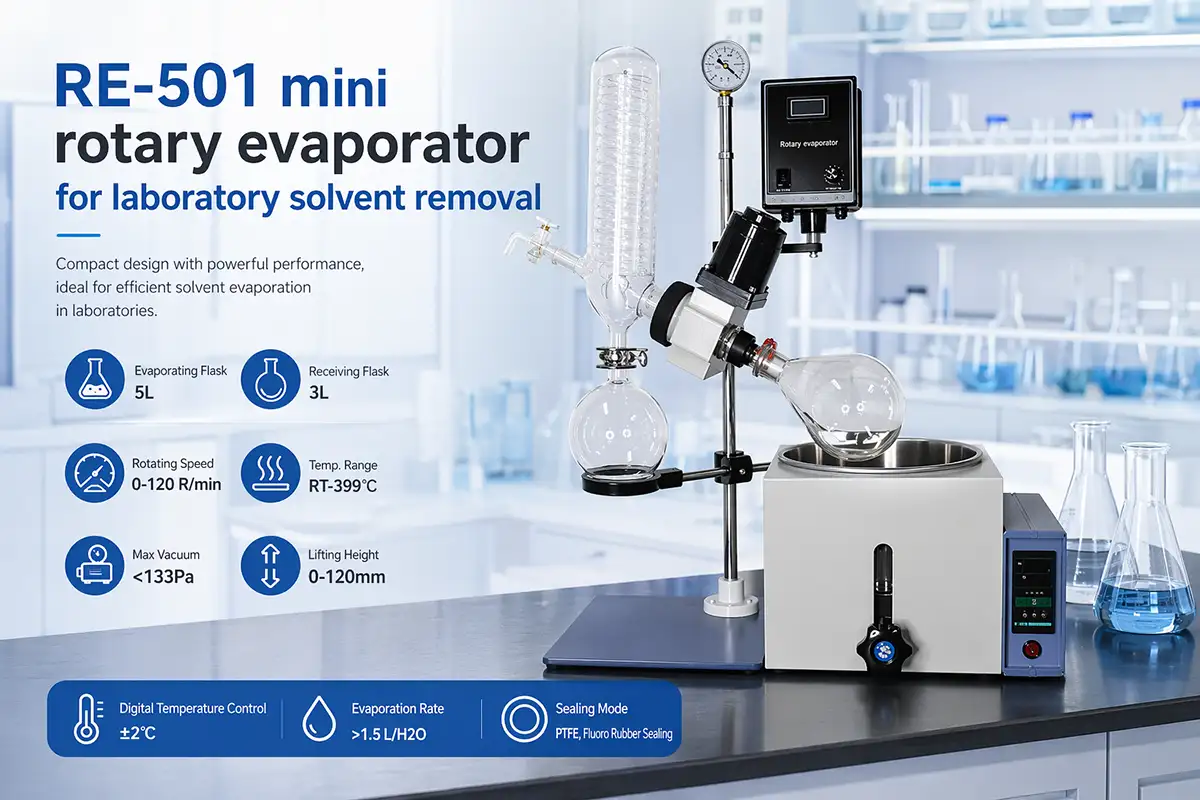
A 5L mini lab rotary evaporator is a strong fit when compact size and practical batch capacity are both important.
Detailed Specifications for Compact Lab Models
Specifications should be read as a system, not as isolated numbers. Flask size affects batch volume, but vacuum level, bath power, condenser capacity, and lifting height decide how stable the process feels during real solvent removal.
| Specification | RE-201D | RE-301 | RE-501 |
|---|---|---|---|
| Evaporating flask | 2 L | 3 L | 5 L |
| Receiving flask | 1 L | 2 L | 3 L |
| Rotating motor | 40 W, stepless regulation | 40 W, stepless regulation | 40 W, stepless regulation |
| Rotating speed | 0-120 r/min | 0-120 r/min | 0-120 r/min |
| Water or oil bath power | 1200 W | 1500 W | 1500 W |
| Temperature control | Intelligent digital control | Intelligent digital control | Intelligent digital control |
| Evaporation rate, water | >1 L/h | >1.5 L/h | >1.5 L/h |
| Maximum vacuum degree | <133 Pa | <133 Pa | <133 Pa |
| Lifting height | 0-150 mm | 0-120 mm | 0-120 mm |
| Sealing mode | PTFE, fluoro rubber sealing | PTFE, fluoro rubber sealing | PTFE, fluoro rubber sealing |
The RE-201D has the smallest working volume and the lowest selected reference price. The RE-301 improves receiving capacity and daily convenience. The RE-501 offers the most room for changing sample types, solvent volume, and workflow without moving into a large 10L or 20L evaporator.
When a 2L Mini Rotary Evaporator is the Better Choice
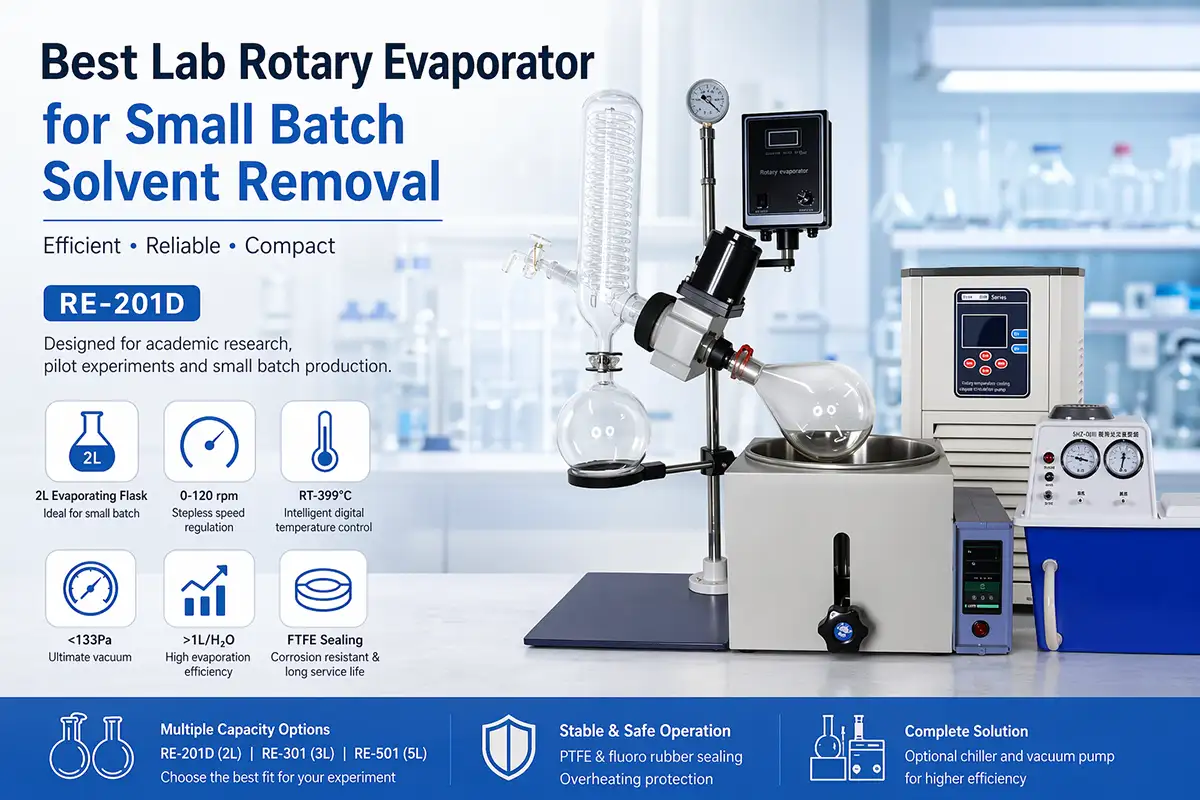
The RE-201D is the right answer when the lab needs an economical small rotovap for lighter duty work. It is especially suitable for teaching labs, small synthetic chemistry batches, quality-control testing, formulation screening, and sample concentration before analysis.
A smaller flask can also make process control easier when sample volume is low. There is less glassware weight, less bath volume to manage, and less total solvent inventory in the system. For a laboratory that handles small samples all day, that simplicity has real value.
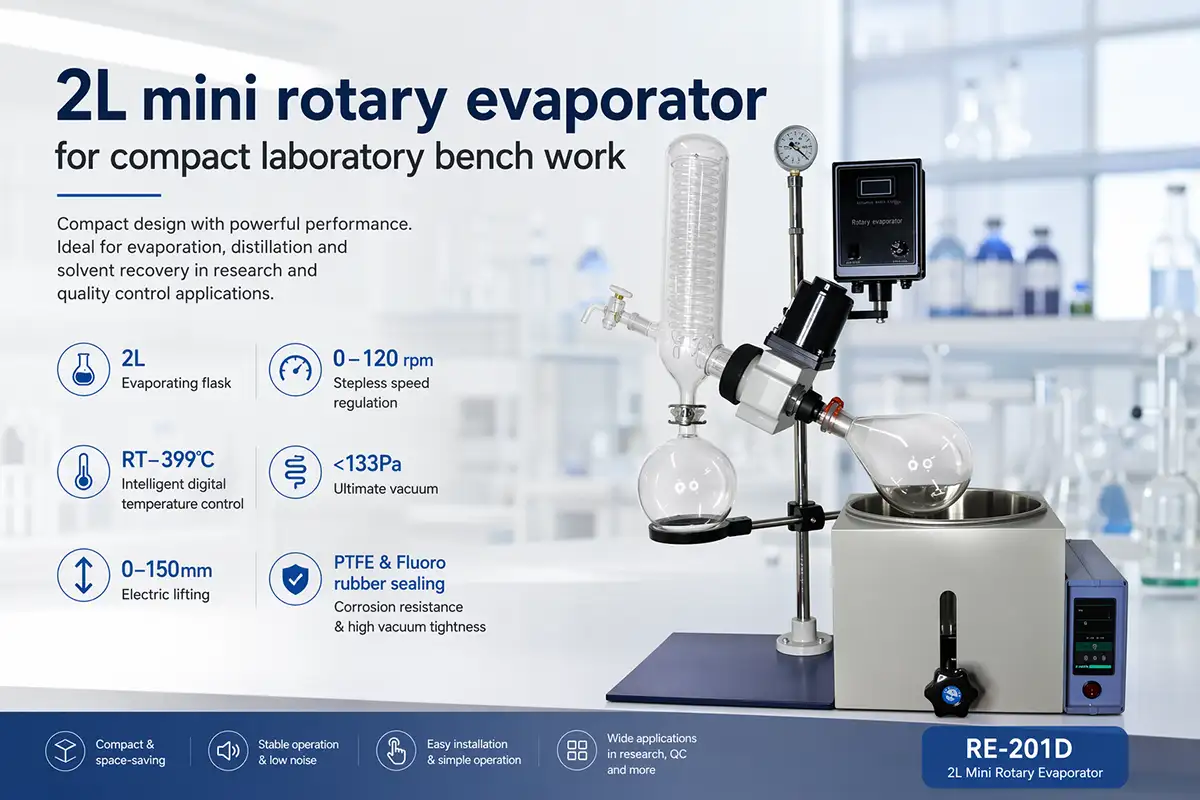
A 2L compact rotovap is a practical entry point for small sample concentration and light solvent recovery.
Selection Guide: How to Choose the Right Mini Rotovap
A good mini rotary evaporator should match the way solvent moves through the lab. The instrument is only one part of the workflow. Vacuum pump capacity, cooling circulation, solvent boiling point, bath temperature, flask loading, and anti-bumping technique all affect final performance.
Start with normal sample volume. Choose RE-201D for smaller samples, RE-301 for routine mid-small batches, and RE-501 for the broadest small-lab flexibility.
Check receiving flask capacity. A receiving flask that is too small interrupts recovery and increases handling time.
Match condenser cooling to the solvent. Lower-boiling and volatile solvents need stronger cooling support to reduce vapor loss.
Use stable vacuum control. Reliable vacuum improves evaporation speed and helps reduce bumping, especially with mixed solvents.
Think about future batches. A lab that expects larger samples soon may save money by choosing RE-501 first.
Practical buying note
The lowest-cost mini rotovap is not always the lowest-cost workflow. If a lab runs repeated solvent removal every day, the additional capacity of a 5L machine can reduce batch changes, receiving flask checks, and operator waiting time. The price gap between a small 2L unit and a flexible 5L unit can be easier to justify when daily throughput matters.
For operating procedure details, see the KD practical guide on how to use a rotovap. It covers the sequence of loading, rotating, heating, applying vacuum, and recovering solvent safely.
Mini Rotary Evaporator vs Larger Lab Systems
A mini rotary evaporator is built for compact laboratory work, not bulk production. Once routine batches become large, a 10L, 20L, or 50L system becomes more appropriate. KD larger models such as R1005, R1010, R1020, R1050, RE-1002, RE-2002, and RE-5002 provide the larger flask volumes needed for scale-up and pilot operations.
| Model Range | Flask Volume | Typical Role | Why It Matters |
|---|---|---|---|
| RE-201D / RE-301 / RE-501 | 2 L / 3 L / 5 L | Mini lab solvent removal | Compact, affordable, practical for testing and small batches |
| R1005 / R1010 | 5 L / 10 L | Higher-capacity lab and early scale-up | Electric lift and larger recovery volume support heavier use |
| RE-1002 / RE-2002 | 10 L / 20 L | Pilot solvent recovery and extraction workflows | Higher evaporation rates and larger condenser systems support bigger batches |
| R1050 / RE-5002 | 50 L | Pilot plant or production support | Large solvent loads and bulk recovery need industrial working volume |
When the application starts moving beyond mini-lab scale, the existing KD resource on 50L rotary evaporator systems gives a helpful comparison point for larger solvent recovery needs.
Best Applications for a Mini Lab Rotary Evaporator
Mini rotary evaporators are common in laboratories that need reliable solvent removal without the footprint or cost of pilot equipment. They are especially useful when sample value is high, batch size is limited, or methods change often.
Solvent recoverySample concentrationBotanical extraction trialsTeaching laboratoriesSynthetic chemistry cleanupFormulation screeningQC preparation
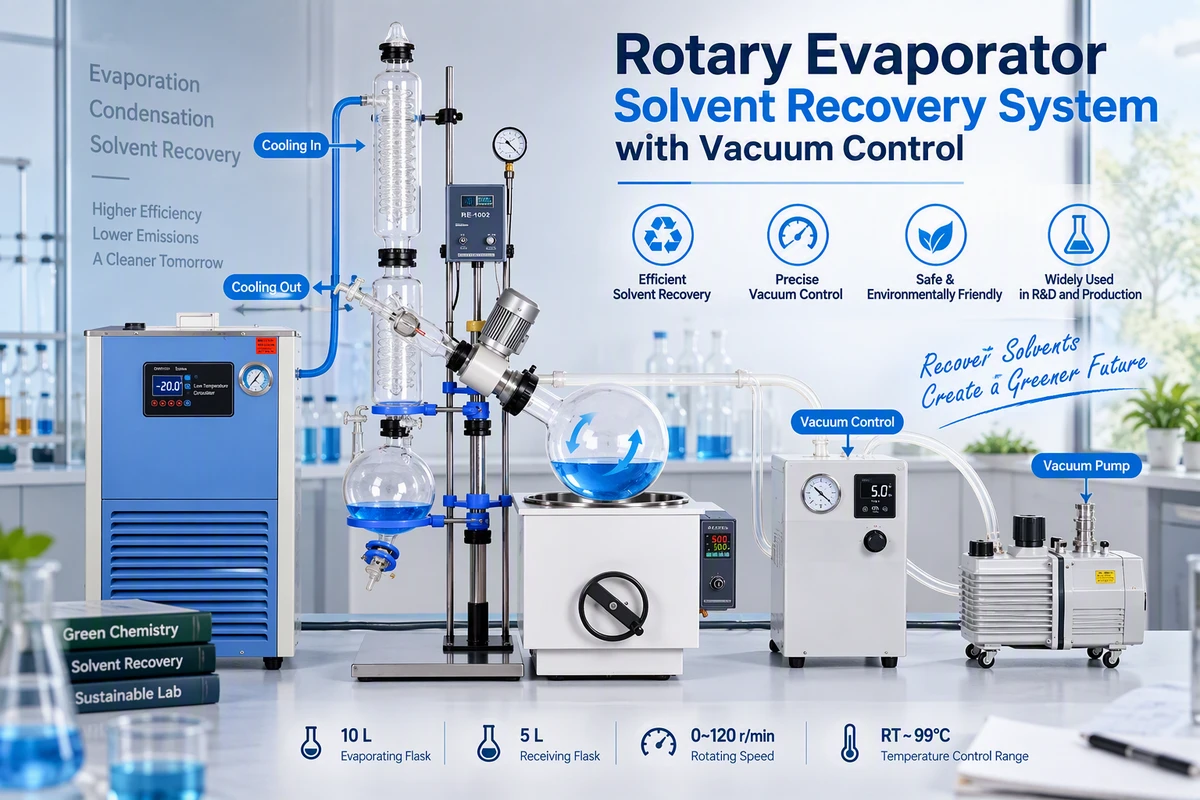
The best mini rotary evaporator works as a system: rotating flask, heated bath, condenser, receiver, vacuum pump, and cooling source must be matched. Reduced pressure allows lower-temperature solvent removal, while controlled rotation creates a thin liquid film that improves heat transfer and evaporation efficiency.
Final Recommendation
The best mini rotary evaporator for labs is the RE-501 when flexibility, small-batch productivity, and long-term usefulness matter most. Its 5L evaporating flask, 3L receiving flask, 0-120 r/min rotation range, digital bath control, and selected reference price of about $920 make it a strong compact lab investment.
The RE-201D remains the best budget mini rotary evaporator for small samples and entry-level solvent removal. The RE-301 is the balanced middle option for labs that want more capacity than 2L but do not need a 5L system. In short, choose RE-201D for compact economy, RE-301 for routine daily testing, and RE-501 for the best all-around mini lab rotovap.
Mini Rotary Evaporator FAQ
What size mini rotary evaporator is best for a small lab?
A 2L rotary evaporator is best for very small samples and tight budgets. A 3L model is better for routine daily testing. A 5L model is the best all-around choice when the lab needs compact equipment with more batch flexibility.
What price range should be expected for a mini rotary evaporator?
Based on the supplied KD price list, selected compact lab models range from about $595 for RE-201D to about $920 for RE-501. Actual configuration, accessories, pump, chiller, shipping, and voltage requirements can change the final purchase price.
Which specification matters most after flask size?
Vacuum stability, condenser capacity, bath power, sealing material, and lifting design matter most after flask size. These details influence evaporation speed, recovery efficiency, operator comfort, and long-term reliability.
Choose the Right Mini Rotary Evaporator for the Lab
KD Rotary Evaporators can support compact lab solvent removal with 2L, 3L, and 5L mini rotovap options, plus larger 10L to 50L systems for future scale-up. Match the model to sample volume, solvent type, vacuum needs, and daily throughput before ordering.