How Does Rotovap Work?
A rotovap, or rotary evaporator, removes solvents quickly and gently by combining rotation, controlled heating, vacuum, and efficient condensation. For laboratories handling organic solvents, botanical extracts, chemical synthesis, or sample concentration, this process can dramatically improve productivity while protecting temperature-sensitive materials.
What Is a Rotovap and What Does It Actually Do?
A rotary evaporator is a solvent removal system designed to evaporate liquids under reduced pressure. In practical terms, it lowers the boiling point of a solvent, spreads the liquid into a thin rotating film, and then condenses the vapor into a receiving flask for collection. This is why rotary evaporation is widely used for ethanol recovery, concentration of reaction mixtures, purification workflows, and post-extraction solvent removal.
If a broader chemistry explanation is useful, see rotary evaporator chemistry explained. For a beginner-oriented overview, another helpful resource is what is a rotary evaporator.
How Does Rotovap Work Step by Step?
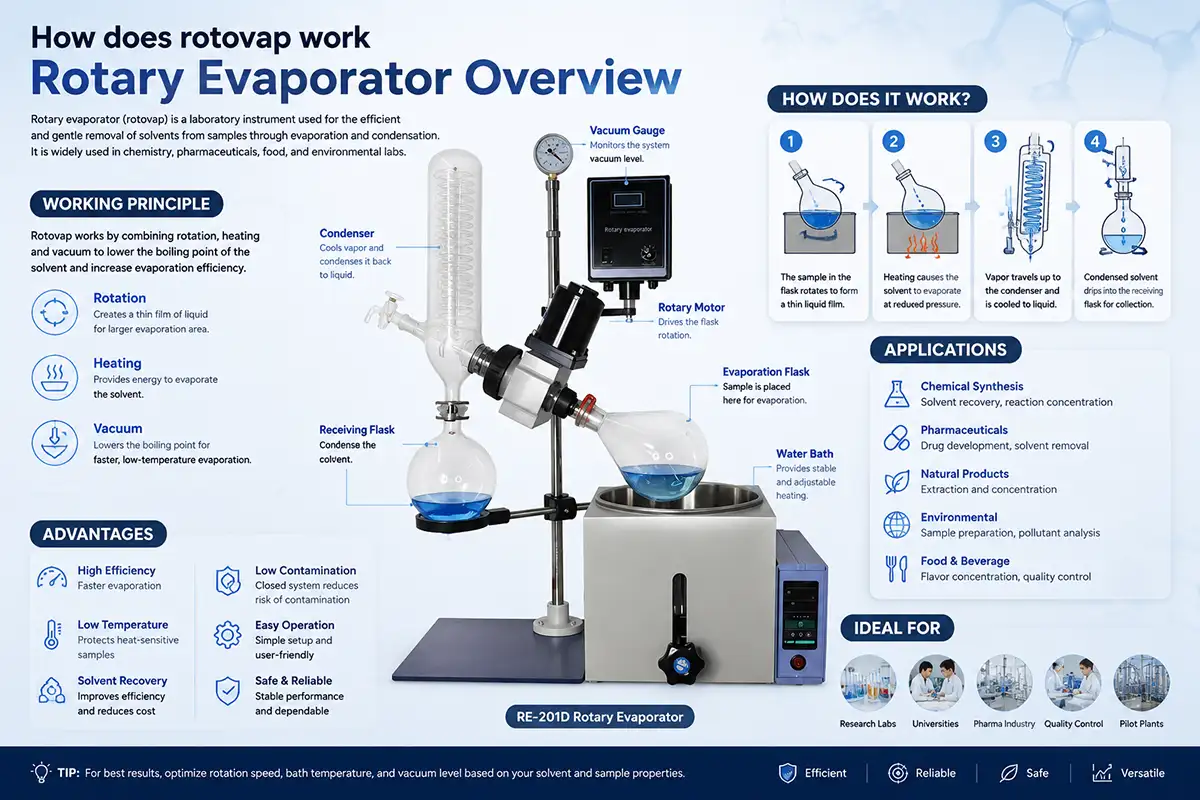
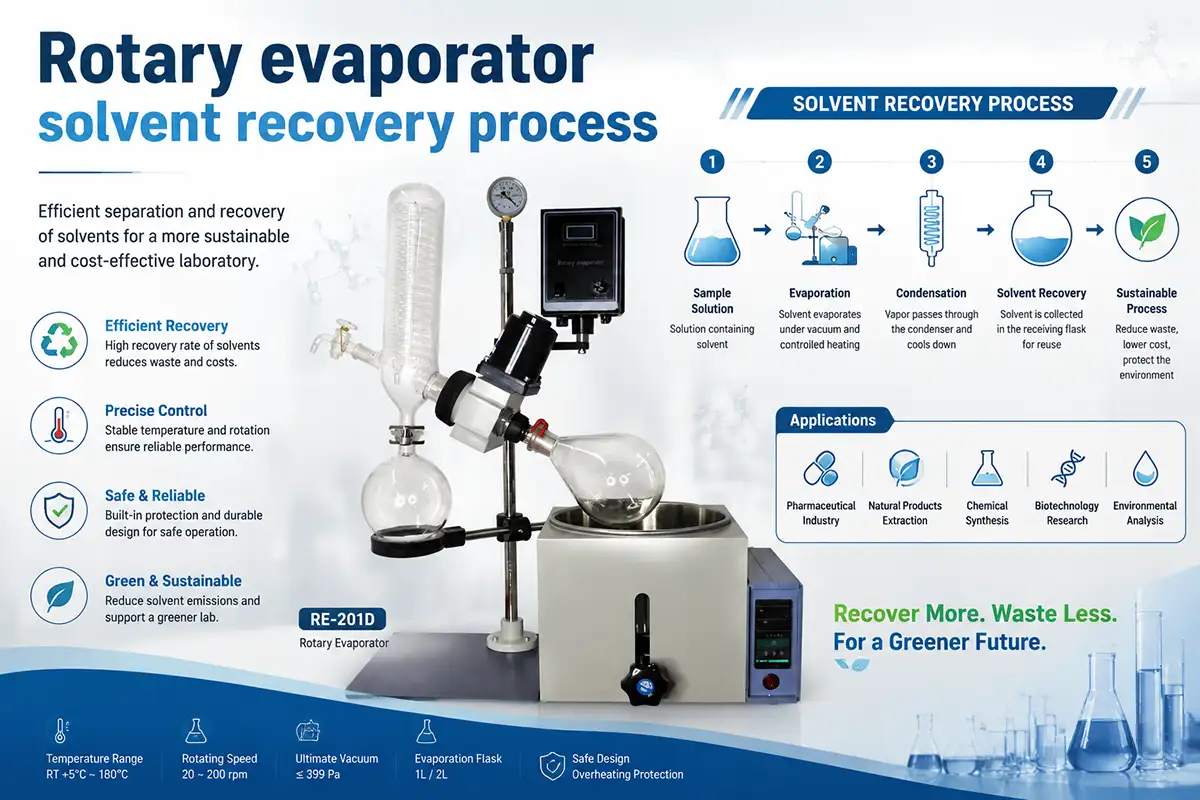
1. Vacuum lowers the boiling point
By reducing pressure inside the system, a solvent can boil at a much lower temperature than it would under atmospheric pressure. This is the key reason a rotovap is ideal for heat-sensitive compounds.
2. Rotation forms a thin film
The evaporating flask rotates continuously, spreading the sample into a thin film over the inner flask wall. That larger surface area accelerates evaporation and reduces bumping risk.
3. Water or oil bath provides gentle heat
The rotating flask sits partly in a heated bath. Instead of aggressive direct heating, the bath supplies stable and even thermal energy to encourage rapid solvent vaporization.
4. Condenser captures vapor
Vapor rises into the condenser, where cooling medium removes heat and converts the vapor back into liquid. The recovered solvent then flows into the receiving flask.
In short, the rotary evaporator working principle is not based on high temperature alone. It relies on the coordinated effect of vacuum, heat, rotation, and condensation. When these four elements are properly matched, the system achieves faster evaporation, better solvent recovery, and improved product quality.
Main Components That Make a Rotovap Work
Evaporating flask: holds the sample or solvent-containing mixture.
Receiving flask: collects the condensed solvent after recovery.
Rotating motor: drives the flask at a controlled speed for thin-film formation.
Bath system: heats with water or oil, depending on target temperature range.
Condenser: cools solvent vapor for efficient recovery.
Vacuum system: reduces pressure and lowers boiling point.
Lift mechanism: raises or lowers the bath or main unit for safer operation.
Seal system: PTFE or fluoro rubber sealing helps maintain vacuum integrity.
What Happens to Solvent During Rotary Evaporation?
Solvent in the flask starts to evaporate once the vacuum and bath temperature move it below its effective boiling point. The rotating motion keeps renewing the liquid surface, so the solvent leaves faster than in a static distillation setup. The vapor path then moves into the condenser, where it cools and becomes liquid again. This recovered solvent is collected separately from the concentrated sample.
This is exactly why rotovaps are favored for ethanol removal, solvent recovery after extraction, and concentration before downstream purification. Compared with open evaporation, the process is cleaner, more controlled, and far more efficient.
How to Use a Rotovap Efficiently
Efficient use depends on selecting the right bath temperature, vacuum level, condenser cooling, and flask rotation speed for the solvent involved. For example, ethanol, acetone, methanol, and hexane all behave differently under reduced pressure. In real applications, the most effective setup is usually the one that removes solvent quickly without overheating the product.
For readers comparing operation methods, this related guide may also help: how to use a rotovap.
KD Rotary Evaporator Technical Range
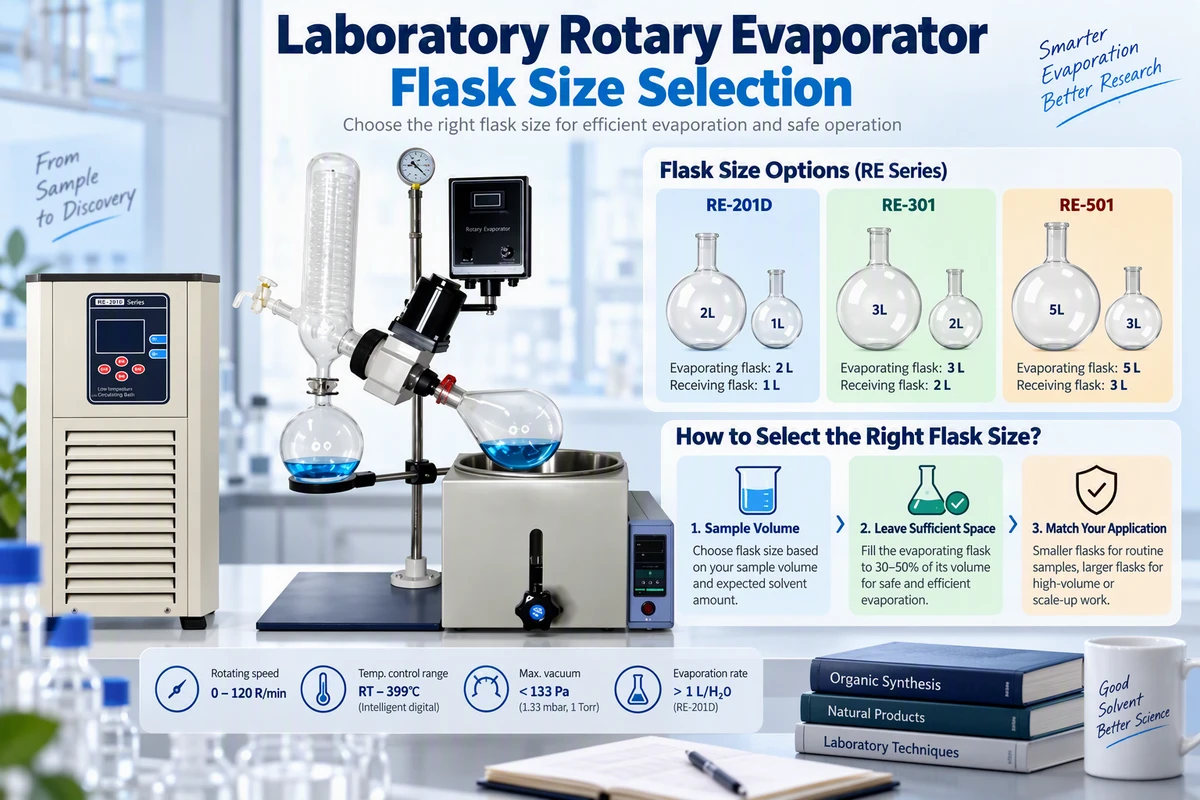
KD Rotary Evaporators covers small laboratory units, mid-scale systems, and large-capacity models. Based on the supplied technical parameters, the available range includes 2L, 3L, 5L, 10L, 20L, and 50L solutions with different lifting designs, motor outputs, and condenser structures.
| Model | Evaporating Flask | Receiving Flask | Speed Range | Bath Power | Evaporation Rate | Lifting Height | Highlights |
|---|---|---|---|---|---|---|---|
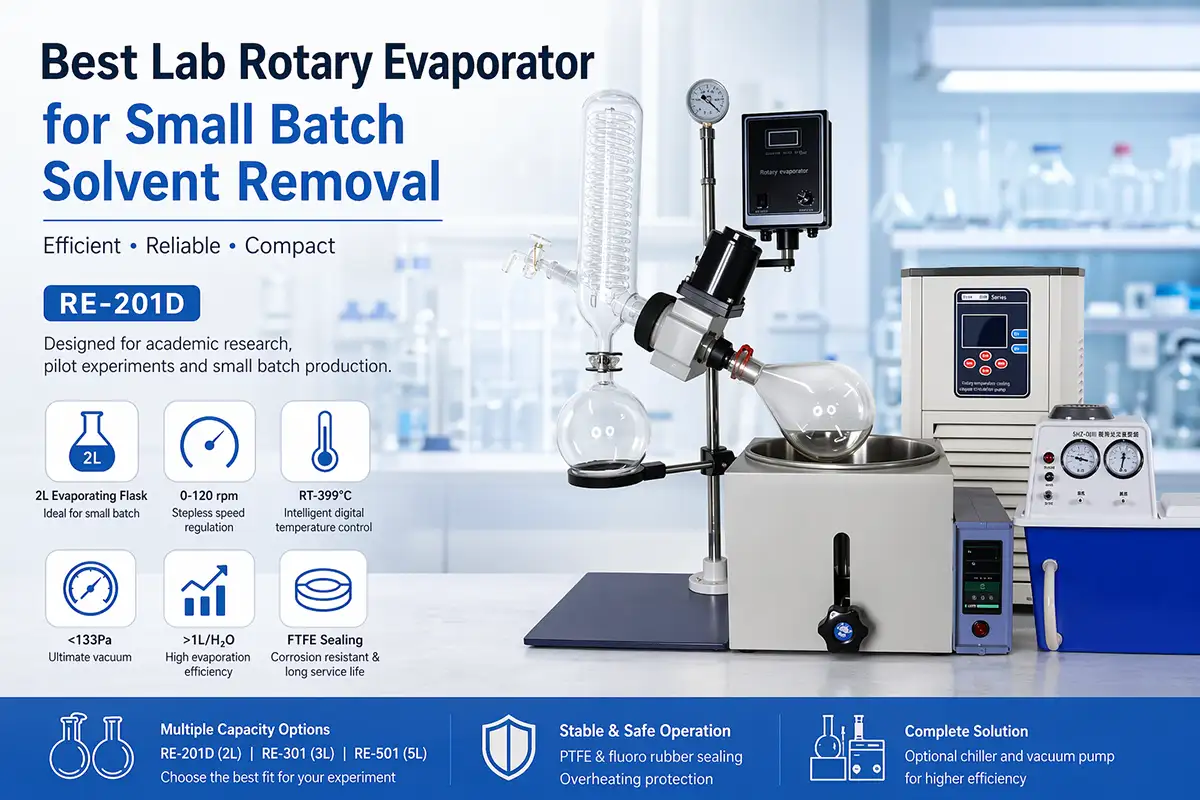
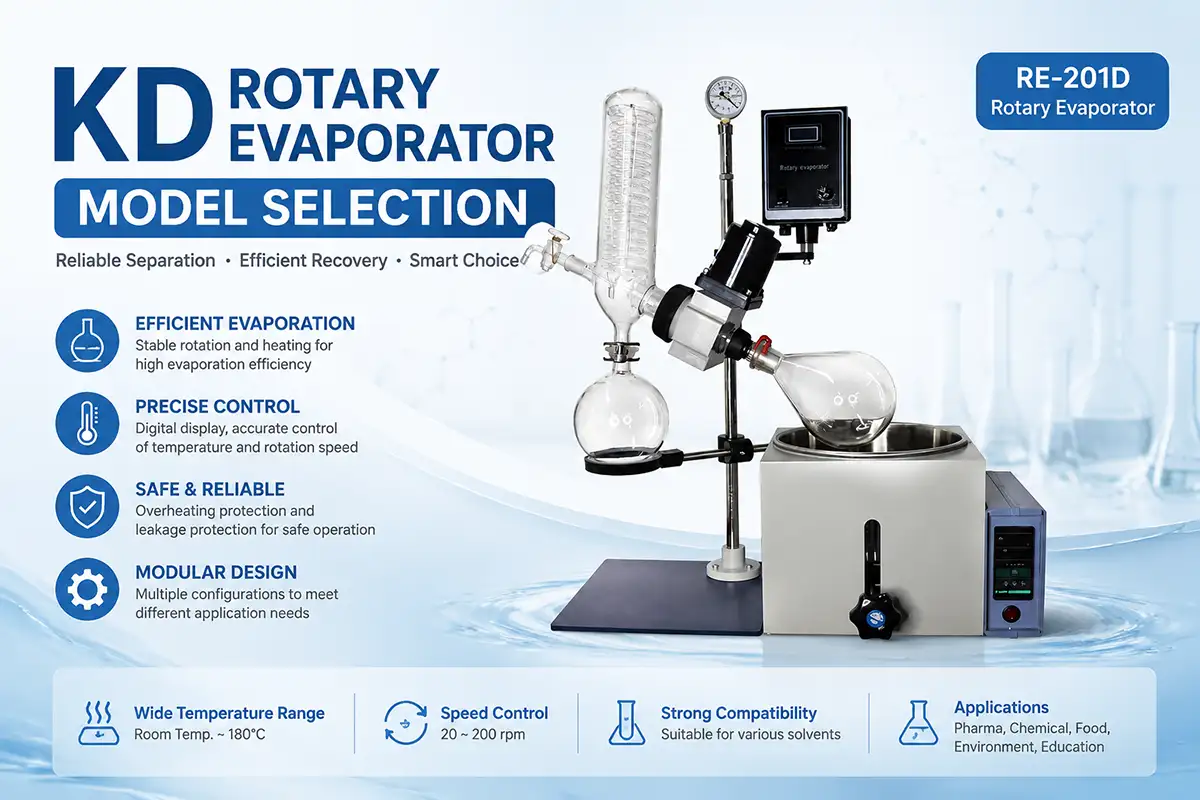
| RE-201D | 2L | 1L | 0-120 rpm | 1200W | >1 L/h (H₂O) | 0-150 mm | Compact manual-lift model for routine lab solvent removal |
| RE-301 | 3L | 2L | 0-120 rpm | 1500W | >1.5 L/h | 0-120 mm | Useful for small-batch concentration with digital bath control |
| RE-501 | 5L | 3L | 0-120 rpm | 1500W | >1.5 L/h | 0-120 mm | Popular bench-scale format with PTFE/fluoro rubber sealing |
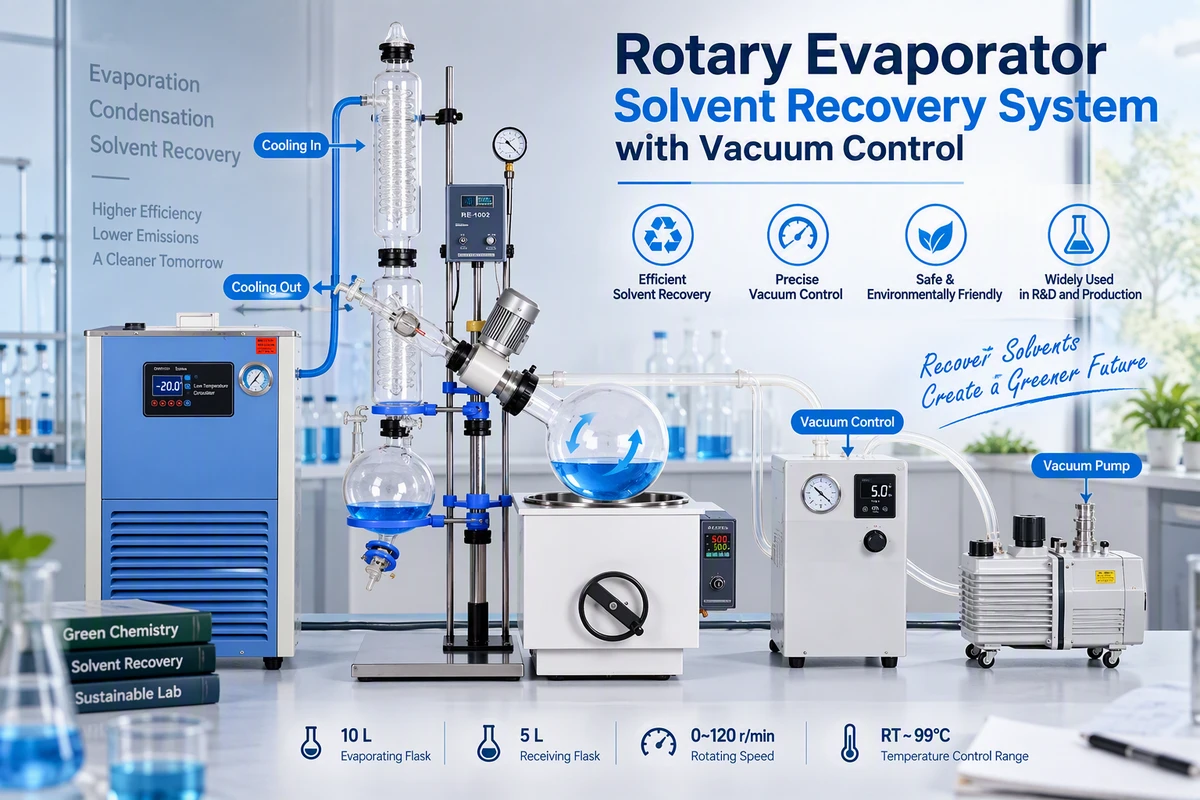
| RE-1002 / R1010 | 10L | 5L | 0-120 rpm / 20-120 rpm | 3000W | >3 L/h | 0-220 mm / 0-160 mm | Higher throughput with electric lift options and double condenser design |
| RE-2002 / R1020 | 20L | 10L | 0-90 rpm / 20-120 rpm | 5000W | >5 L/h | 0-220 mm / 0-190 mm | Strong choice for pilot solvent recovery and extraction processing |
| RE-5002 / R1050 | 50L | 20L | 0-90 rpm / 20-120 rpm | 7000W/9000W | >9 L/h | 0-220 mm / 0-180 mm | Large-scale evaporation with vertical double condenser and robust frame |
Typical Price Reference for KD Rotary Evaporators
Based on the supplied product pricing sheet, several rotary evaporator references can be used as market indicators. Where multiple prices were listed, the lower middle value was selected as requested.
| Product Reference | Approx. Price | Comment |
|---|---|---|
| Mini Lab Rotary Evaporator RE-201D | $480 | Entry-level compact solution for basic concentration tasks |
| 5L Lab Vacuum Rotary Evaporator Set | $1,699 | Balanced choice for daily laboratory use and extraction workflows |
| RE1002 Factory Price 10L Rotary Evaporator | $1,900 | Suitable for users needing more throughput than a 5L unit |
| RE-2002 20L Large Volume Rotary Evaporator | $2,100 | Common pilot-scale option for solvent recovery and concentration |
| RE-5002 50L Essential Oil Distillation Rotator Evaporator | $2,545 | Cost-effective larger-volume solution for production support |
Final pricing can vary by condenser configuration, lift type, explosion-proof requirements, bundled vacuum pump and chiller options, and shipping destination.
How to Choose the Right Rotovap Size
2L to 5L
Best for teaching labs, analytical preparation, R&D work, and low-volume solvent removal. These units are compact, economical, and easy to install.
10L to 20L
Better for pilot extraction, higher-volume synthesis, and repeated batch concentration. They offer stronger bath power and noticeably higher evaporation rates.
50L
Ideal for production support, larger solvent recovery tasks, and facilities that need higher throughput with robust condenser performance.
Accessory Matching
A rotovap performs best when paired with the correct vacuum pump and recirculating chiller. Good accessory matching improves vacuum stability and condensation efficiency.
Why Labs Choose KD Rotary Evaporators
Wide capacity range from compact lab units to 50L systems
Digital temperature control and stable rotation performance
PTFE and fluoro rubber sealing options for reliable vacuum operation
Electric lift and manual lift configurations for different workflows
Vertical double condenser and efficient reflux condenser designs
Competitive pricing for both standard laboratory and pilot applications
Final Answer: How Does Rotovap Work?
A rotovap works by lowering solvent boiling point under vacuum, rotating the sample to create a thin film, heating it gently in a bath, and condensing the solvent vapor for recovery. That combination makes rotary evaporation faster, gentler, and more efficient than many traditional evaporation methods.
For laboratories looking to improve solvent recovery, concentration efficiency, or extract processing consistency, choosing the right rotary evaporator design matters. KD Rotary Evaporators offers practical model options from 2L bench units to 50L large-capacity systems, helping users match equipment size, throughput, and budget with real process needs.
Explore KD Rotary Evaporators© KD Rotary Evaporators. Rotary evaporation solutions for laboratory and pilot-scale solvent recovery.