What Size Rotovap Is Best for Pilot Plant?
For most pilot plant solvent removal work, a 20L rotary evaporator is the best starting size. It has enough flask volume and condenser capacity to move beyond benchtop testing, but it is still easier to install, control, clean and budget than a 50L system.
The practical rule for pilot plant rotovap sizing
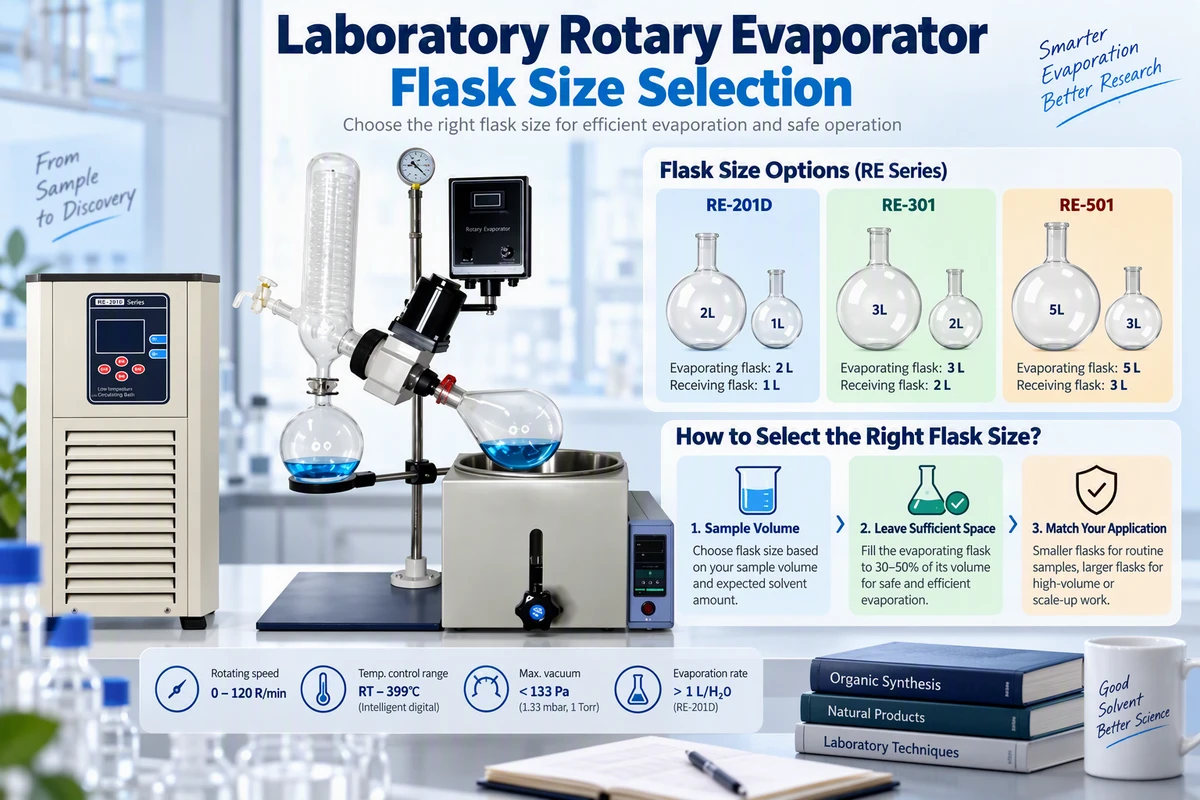
A pilot plant rotovap should be sized from the working batch, not only from the advertised flask volume. A rotating flask is normally not filled to the top. In real evaporation, a comfortable charge is often around one third to one half of the flask capacity, leaving room for foaming, bumping control and stable rotation under vacuum.
That means a 10L evaporating flask is not a true 10L working batch vessel. It is better viewed as a bridge between a laboratory rotary evaporator and a pilot scale system. A 20L unit gives more flexibility for repeated solvent removal. A 50L unit is the better choice when solvent recovery time is the main production bottleneck.
Is a 10L rotovap large enough for pilot plant work?
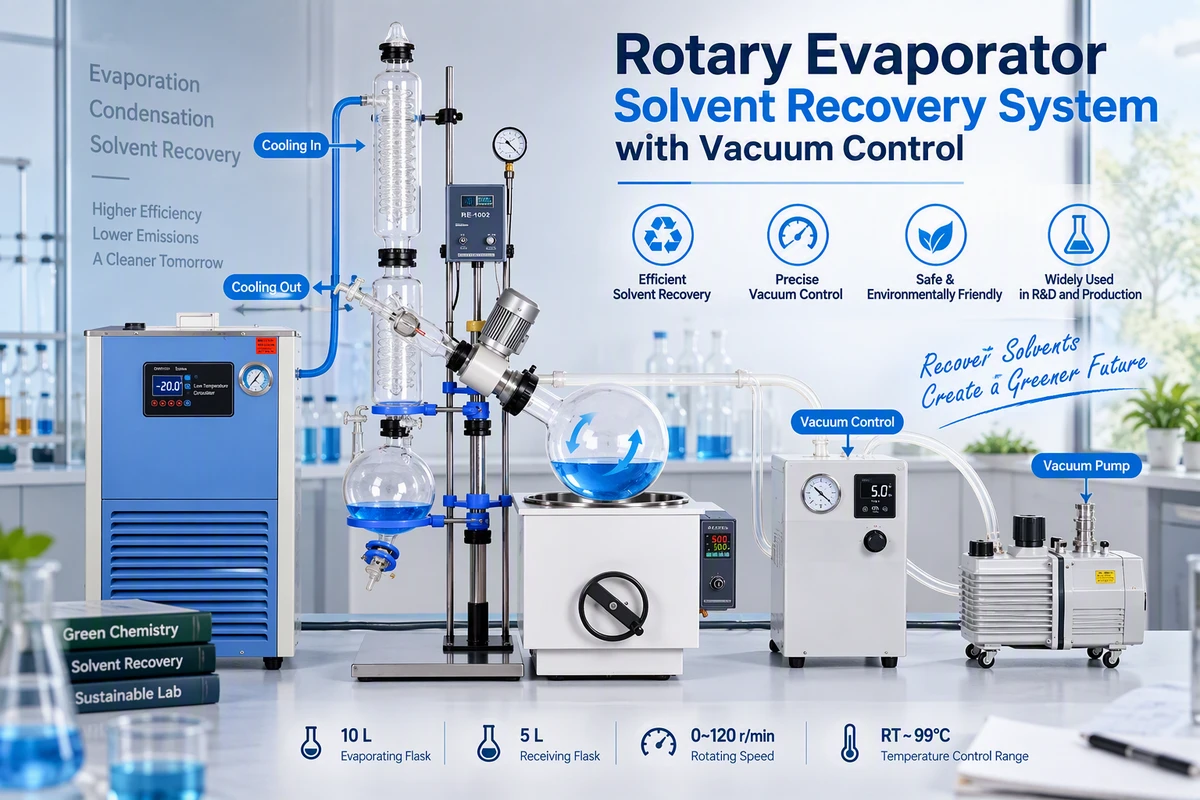
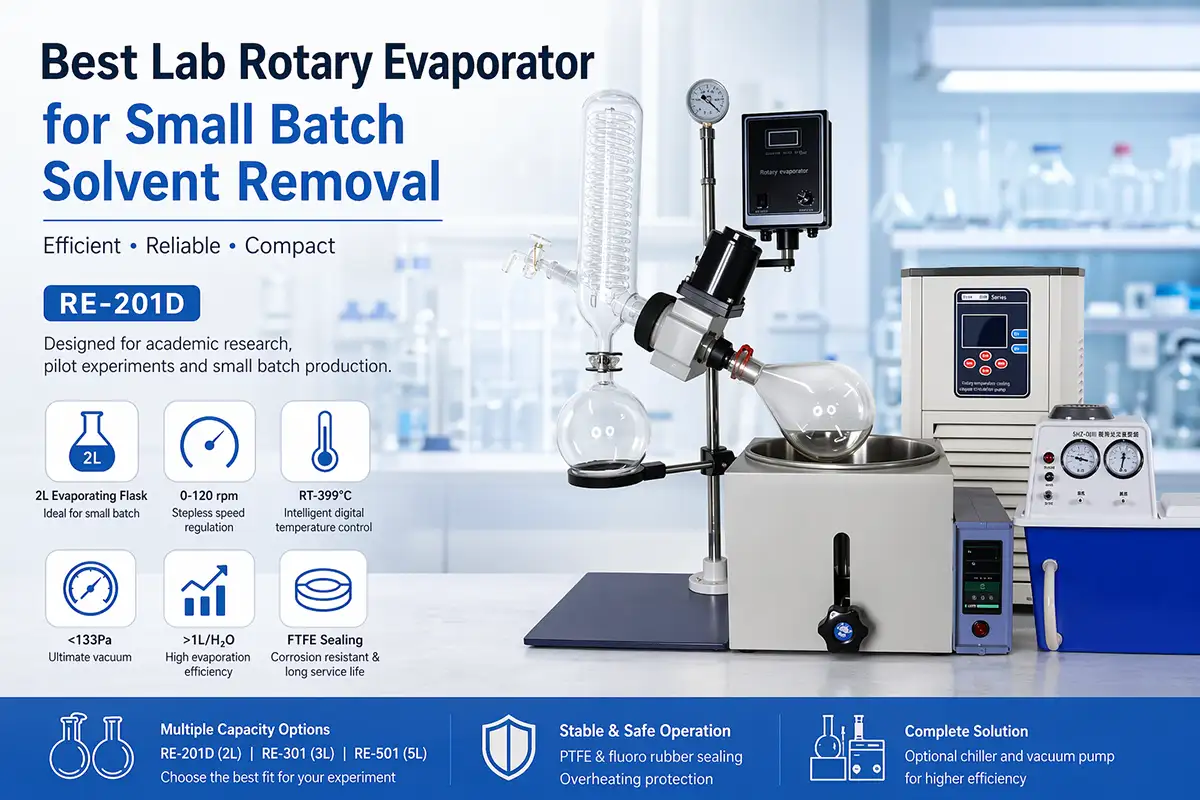
Yes, when the pilot run is still close to process development. A 10L model such as RE-1002 or R1010 is suitable for small solvent loads, recipe confirmation, extract concentration trials and labs that need a manageable upgrade from 2L or 5L equipment.
Capacity chooser
Use the quick selector below as a simple way to match pilot plant workload with a suitable rotovap size. The final decision should also consider vacuum pump capacity, chiller temperature, solvent boiling point, condenser area and available installation space.
10L is best for process trials, small pilot batches and teams moving up from benchtop rotary evaporation.
10L vs 20L vs 50L pilot plant rotary evaporators
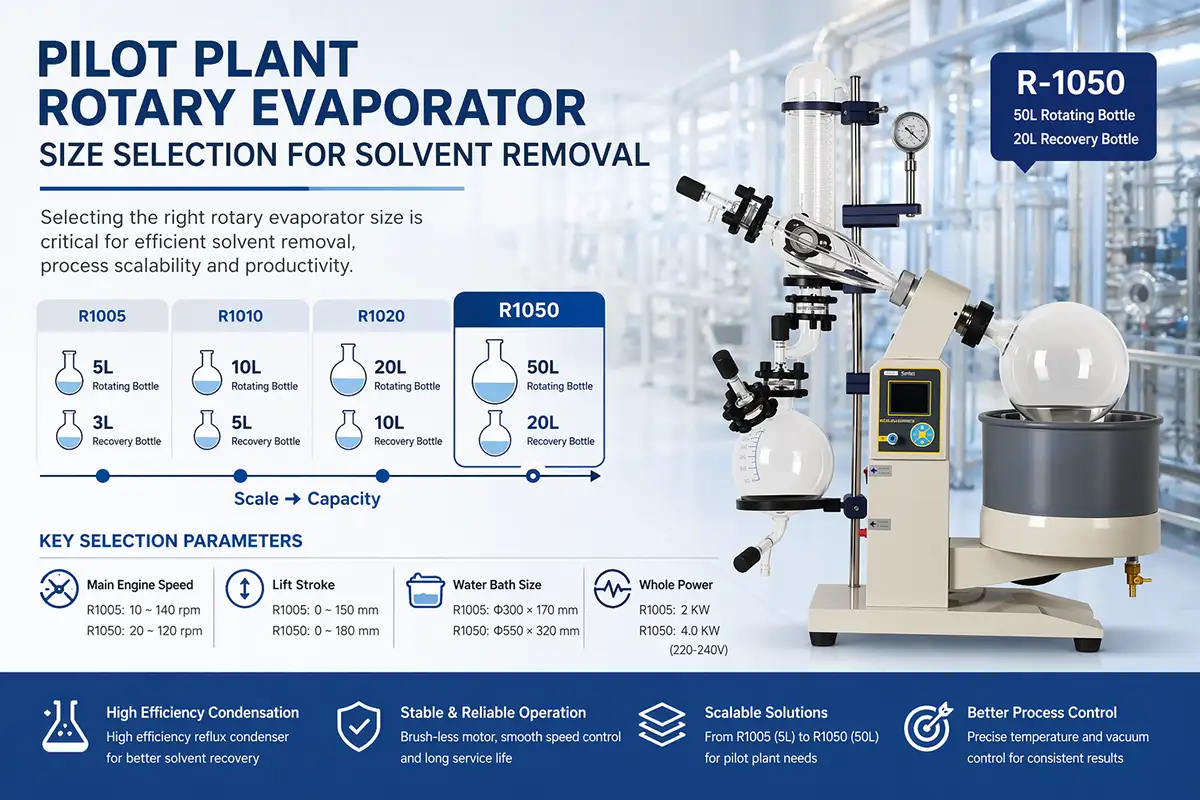
The KD rotary evaporator range covers the common pilot plant steps: 10L, 20L and 50L. The R series emphasizes electric lift and larger structural dimensions, while the RE-1002, RE-2002 and RE-5002 models provide clear evaporation-rate references for scale selection.
| Recommended size | Suitable pilot plant use | Representative models | Key supplied specifications | Price reference from supplied list |
|---|---|---|---|---|
| 10L | Small pilot batches, solvent screening, extract concentration and scale-up confirmation before committing to a larger system. | RE-1002, R1010 | 10L evaporating flask; 5L receiving flask; RE-1002 evaporation rate >3L/h for water; R1010 20-120 rpm and 3kW whole power. | RE-1002: $1,818; R1010: $2,379 |
| 20L | Best default for routine pilot plant solvent removal where throughput matters but installation should remain compact. | RE-2002, R1020 | 20L evaporating flask; 10L receiving flask; RE-2002 evaporation rate >5L/h for water; R1020 4kW whole power. | RE-2002: $2,100; 20L pilot plant listing: $1,480 |
| 50L | High solvent load, frequent recovery cycles, essential oil concentration and larger pilot production before process transfer. | RE-5002, R1050 | 50L evaporating flask; 20L receiving flask; RE-5002 evaporation rate >9L/h for water; 7000/9000W bath power. | RE-5002: $2,545; R-1050 listing: $1,818 |
For a deeper background on evaporation principles, the guide to rotary evaporator chemistry explains why temperature, vacuum and rotation speed matter as much as flask size.
Why 20L is usually the best pilot plant rotovap size
A 20L rotary evaporator is often the most balanced choice because it creates a useful pilot plant working volume without the larger utility demand of a 50L unit. The RE-2002 configuration uses a 20L evaporating flask and 10L receiving flask, with an evaporation rate listed above 5L/h for water. For many organic solvents, actual performance will depend on vacuum level, bath temperature, condenser temperature and solvent heat load, but the 20L platform gives a strong middle point for daily concentration work.
The R1020 model adds a larger structural format with electric plus hand lift, a stainless steel bath, a 20L rotating bottle, a 10L recovery bottle and a 4kW whole power rating. This is the size range that usually feels like a true pilot plant instrument rather than a larger benchtop unit.
When does a pilot plant need to move from 20L to 50L?
The move is justified when the evaporator becomes the slowest part of the process. If batches queue up, receiving flasks fill too quickly, or solvent removal runs through too much of the shift, a 50L rotovap is the more efficient selection.
When a 50L rotovap is the better pilot plant choice
A 50L rotary evaporator is best for teams that already know the process conditions and need higher solvent recovery capacity. The RE-5002 is listed with a 50L evaporating flask, 20L receiving flask and an evaporation rate above 9L/h for water. The R1050 also uses a 50L rotating bottle and 20L recovery bottle, with a vertical main condenser plus side condenser design for higher condensing demand.
The tradeoff is installation planning. A 50L system needs more bath power, more cooling capacity, more vacuum stability and more operating space. If the pilot plant handles ethanol, ethyl acetate, acetone or other volatile solvents, condenser performance and vapor safety should be reviewed before purchase.
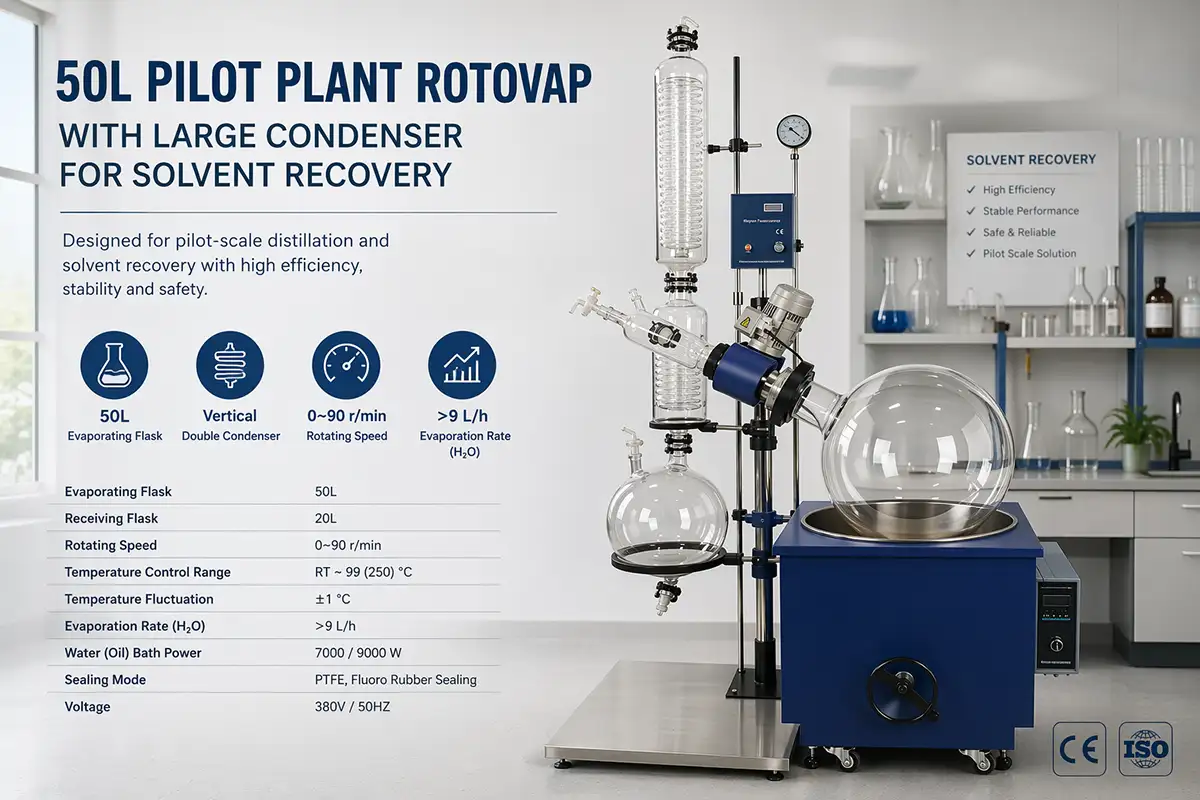
For buyers comparing this class directly, the 50 liter rotary evaporator product page is the most relevant internal reference.
Specifications that matter more than flask volume
Flask size is the starting point, but a pilot plant rotovap should be selected as a complete evaporation system. A larger flask without enough cooling or vacuum control can run slowly, flood the condenser, or increase bumping risk.
Evaporation rate RE-1002 is listed above 3L/h for water, RE-2002 above 5L/h and RE-5002 above 9L/h. These numbers help compare scale, even though solvent-specific rates will change.
Receiving flask capacity A 5L receiver on 10L systems is practical for small batches. A 10L receiver on 20L systems and 20L receiver on 50L systems reduce interruption during solvent recovery.
Bath power and temperature range Larger systems require stronger heating. The RE-5002 lists 7000/9000W bath power, while the RE-2002 lists 5000W.
Condenser design Pilot work benefits from vertical double condensers or high-efficiency reflux condenser structures, especially when volatile solvents are removed under vacuum.
Lift and handling Electric lift improves operation on larger glassware. Manual lifting can be acceptable for smaller setups, but high-capacity flasks are easier to handle with powered movement.
Can a larger rotovap solve every solvent removal bottleneck?
No. Larger glassware helps only when the supporting system is sized correctly. Vacuum pump performance, chiller capacity, condenser area, bath temperature and anti-bumping control must match the selected 20L or 50L evaporator.
How to read pilot plant rotovap prices
Price should be compared by configuration, not by capacity alone. A basic 20L rotary evaporator, a 20L package with chiller and vacuum pump, and an explosion-proof 20L system can all appear in the same size class but serve different applications. From the supplied price list, clear reference points include RE-1002 at $1,818, RE-2002 at $2,100 and RE-5002 at $2,545. Where multiple prices appeared for a model or size class, the more affordable middle reference was used rather than the highest package price.
For a pilot plant purchase, budget should include the rotary evaporator body, glassware, vacuum pump, recirculating chiller, tubing, clamps, seals, receiving flasks and spare parts. The best value is rarely the lowest line-item price; it is the system that reaches the required solvent removal rate without overloading utilities or operators.
Matching the rotovap size to common pilot plant cases
| Application | Best size | Reason | Suggested KD model range |
|---|---|---|---|
| Early process development | 10L | Enough capacity for meaningful trials while keeping cleaning, setup and solvent consumption controlled. | RE-1002 or R1010 |
| Routine pilot plant solvent removal | 20L | Best balance of batch volume, evaporation rate, equipment footprint and purchase cost. | RE-2002 or R1020 |
| High-throughput concentration | 50L | Higher receiving capacity and evaporation rate reduce repeated batch handling and idle time. | RE-5002 or R1050 |
| Training or method transfer | 10L to 20L | Smaller glassware is easier to control while the process team confirms vacuum, bath and condenser settings. | RE-1002, R1010 or RE-2002 |
After sizing the equipment, operating technique still matters. The practical guide on how to use a rotovap is a useful companion for startup sequence, vacuum control and solvent bumping prevention.
Final recommendation for pilot plant buyers
The best rotovap size for a pilot plant is usually 20L. It is large enough for real solvent removal work, affordable enough for many lab-to-pilot upgrades, and easier to support than a 50L system. Choose 10L when the work is still exploratory. Choose 50L when the process is proven and the solvent recovery schedule demands higher throughput.
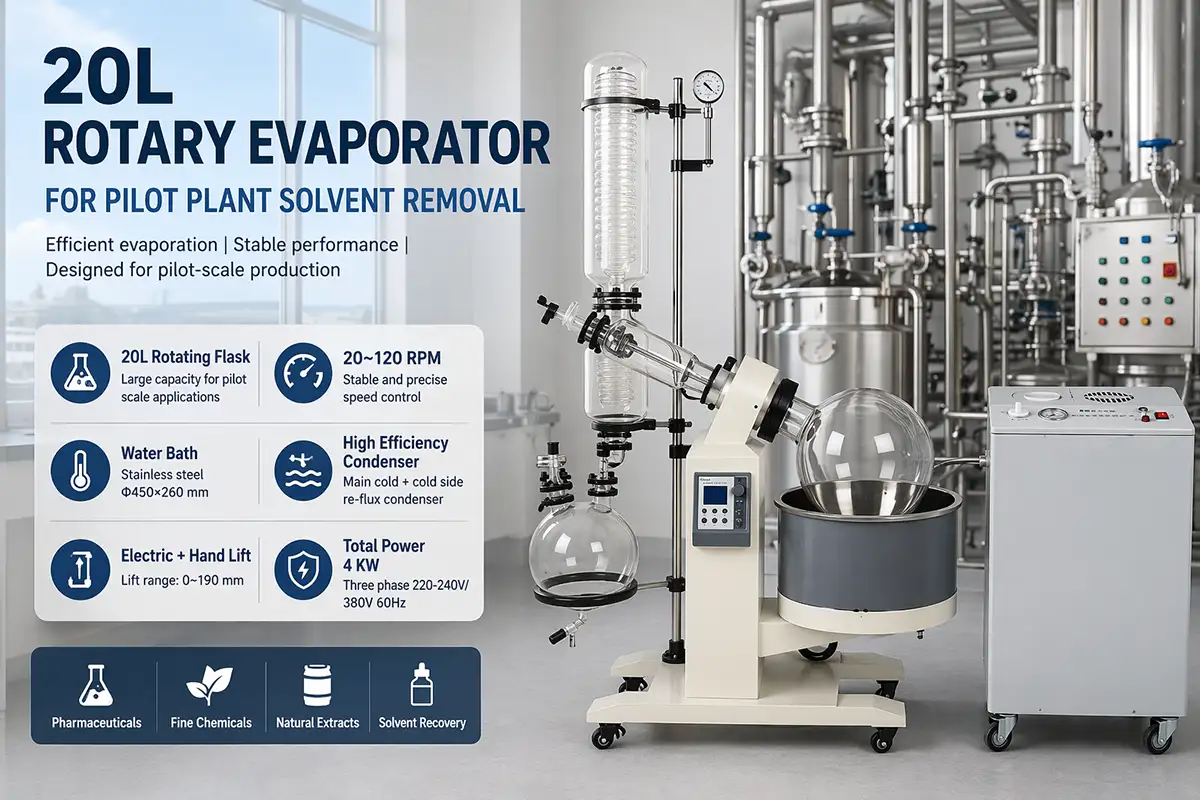
For most production-minded laboratories, the decision can be summarized clearly: 10L confirms the process, 20L runs the pilot plant, and 50L supports larger solvent recovery demand.
Best size in one sentence
A 20L rotary evaporator is the best all-around pilot plant rotovap, while 10L is the practical development size and 50L is the right upgrade when evaporation capacity becomes the main bottleneck.