Compact Mini Rotary Evaporator for Analytical Testing Labs
A compact mini rotary evaporator gives analytical testing labs a controlled way to remove solvents, concentrate samples, recover fractions, and prepare extracts without dedicating bench space to a large pilot scale system. For routine method development, QC testing, teaching labs, and small batch chemistry, the right 2L, 3L, or 5L rotary evaporator can make evaporation faster, cleaner, and easier to repeat.
Why Analytical Testing Labs Prefer a Compact Rotovap
Analytical labs usually do not need the largest rotary evaporation system on the floor. They need reliable solvent removal, stable bath temperature, repeatable rotation, and glassware that can be cleaned quickly between batches. That is why a compact mini rotary evaporator is often the practical choice for sample concentration, solvent exchange, botanical testing, environmental analysis, educational experiments, and small synthetic chemistry workflows.
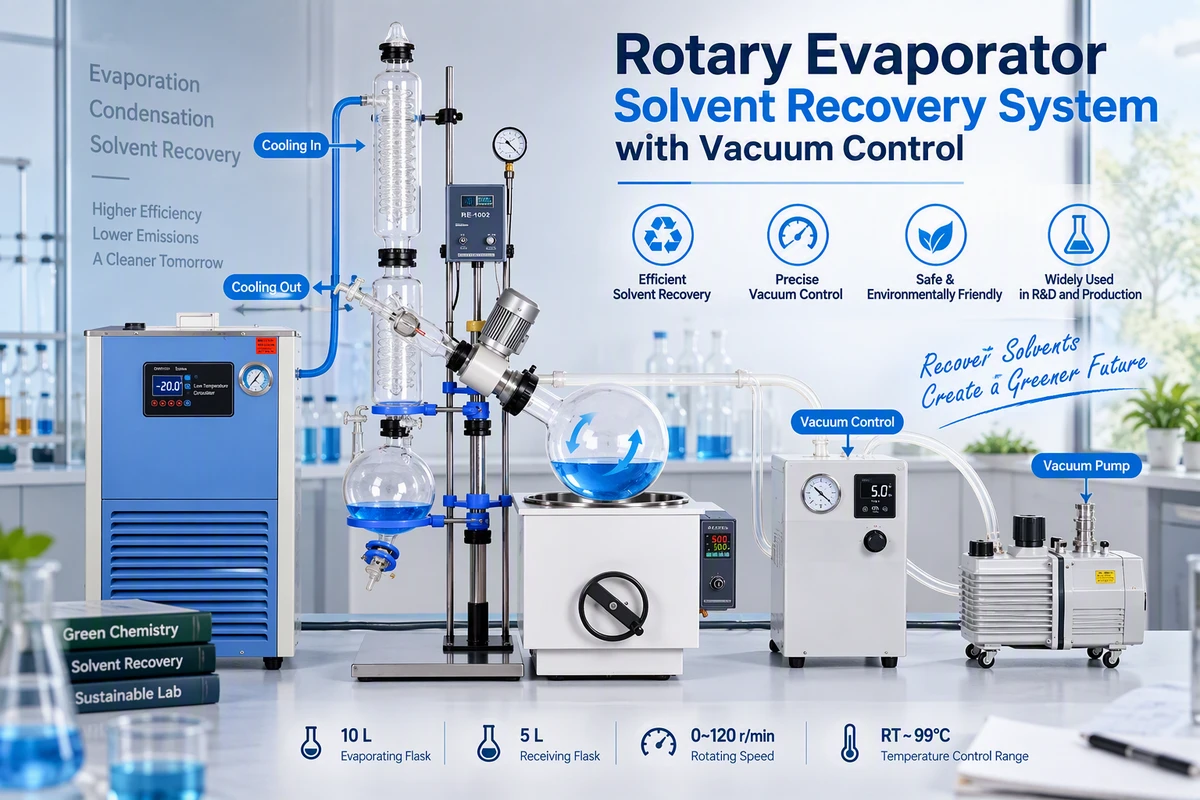
The purpose of rotary evaporation is simple: lower the boiling point under vacuum, rotate the flask to form a thin liquid film, warm the sample gently in a bath, then condense and collect the solvent vapor. For a deeper process overview, KD's guide to rotary evaporator chemistry explains how vacuum, heat, rotation, and condensation work together.
Best Capacity Range for Small Batch Solvent Removal
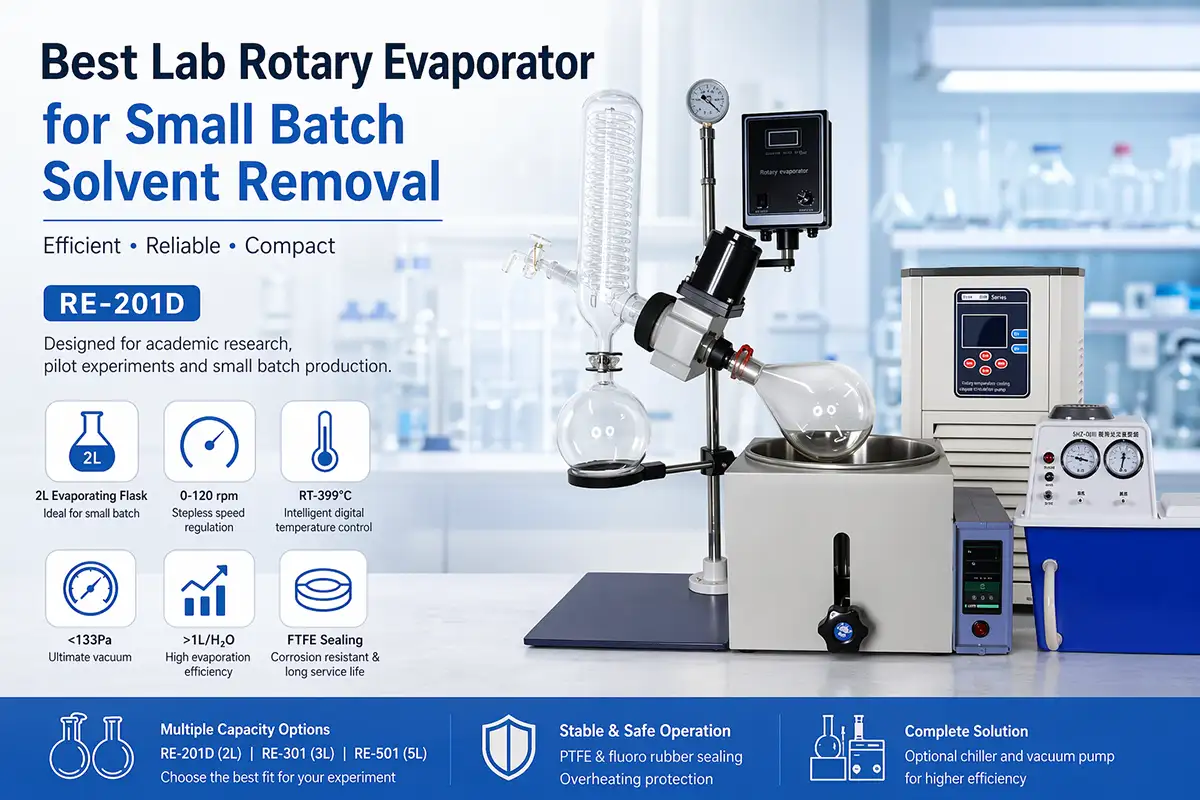
For analytical testing, the best capacity is usually chosen by sample volume, solvent volatility, required recovery rate, and available bench space. The KD small lab range includes 2L, 3L, and 5L configurations, giving labs a clear path from low volume method work to more frequent small batch evaporation.
2L rotary evaporator: best for compact benches, training labs, low volume extracts, and controlled sample concentration.
3L rotary evaporator: a balanced choice when daily testing volume is moderate and more receiving capacity is useful.
5L rotary evaporator: preferred when a lab wants stronger throughput while staying in the compact laboratory category.
Compact Mini Rotary Evaporator Model Comparison
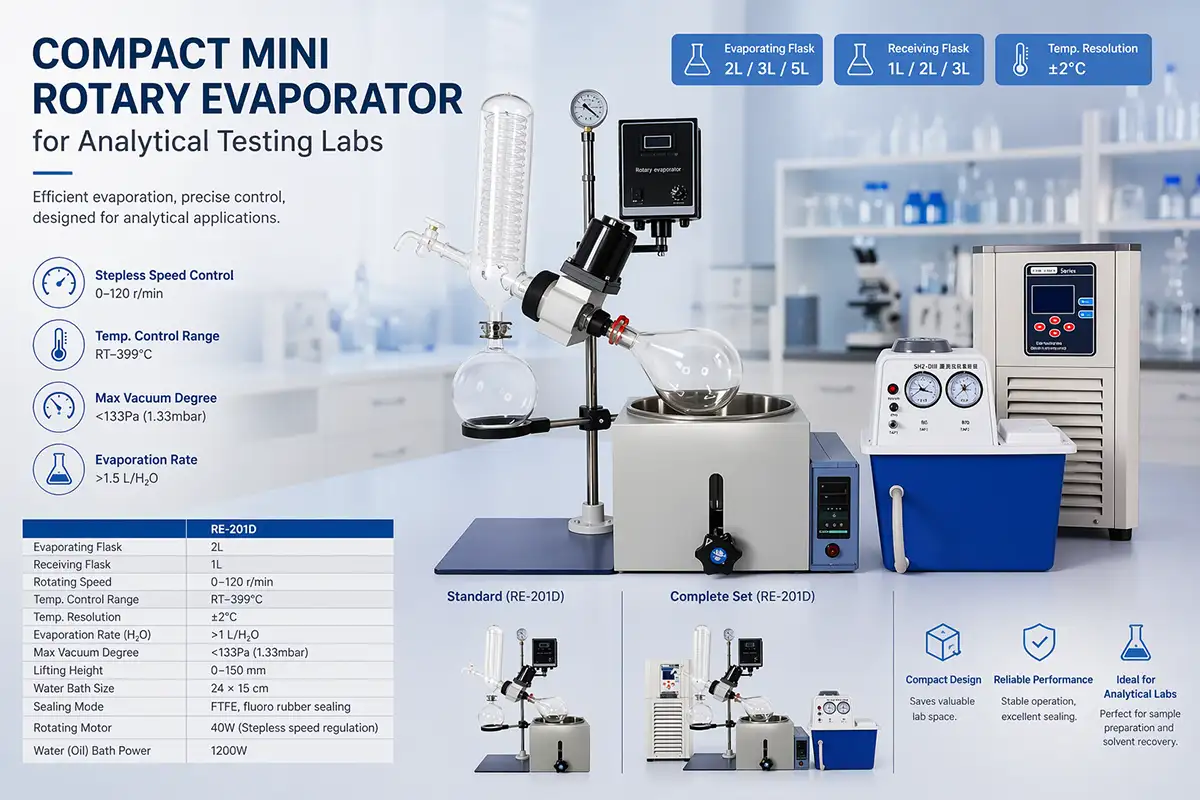
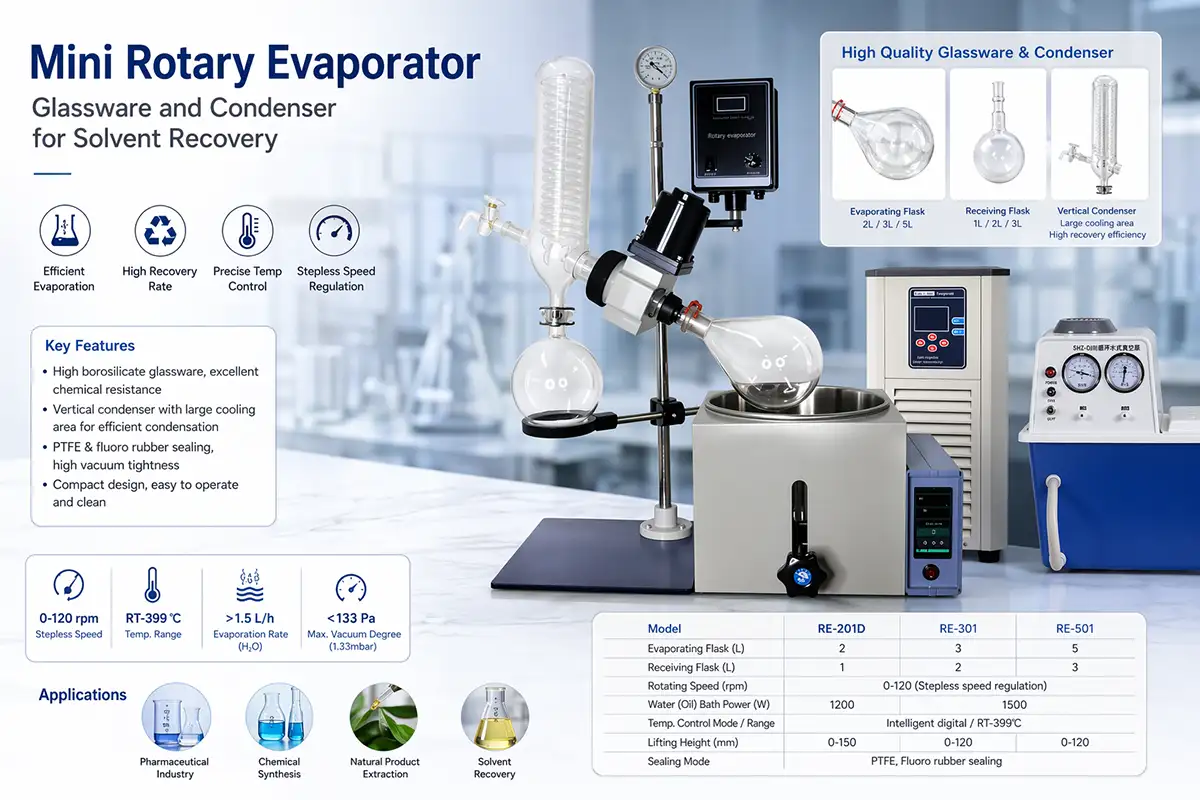
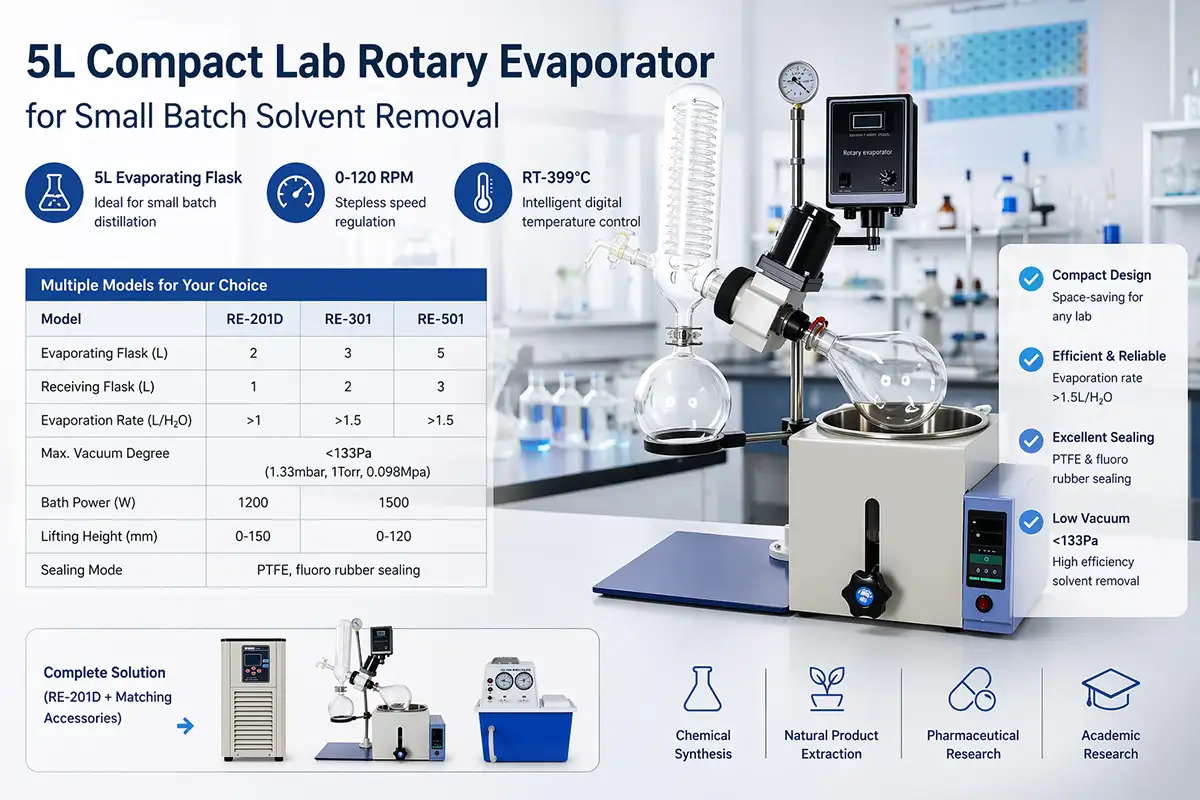
The following comparison is based on the RE-201D, RE-301, and RE-501 technical parameters. These models share the core features analytical labs need: stepless rotation, digital temperature control, vacuum operation, PTFE and fluoro rubber sealing, and water or oil bath heating up to high temperature ranges.
| Model | Evaporating Flask | Receiving Flask | Rotation | Bath Power | Temperature Control | Best Lab Fit |
|---|---|---|---|---|---|---|
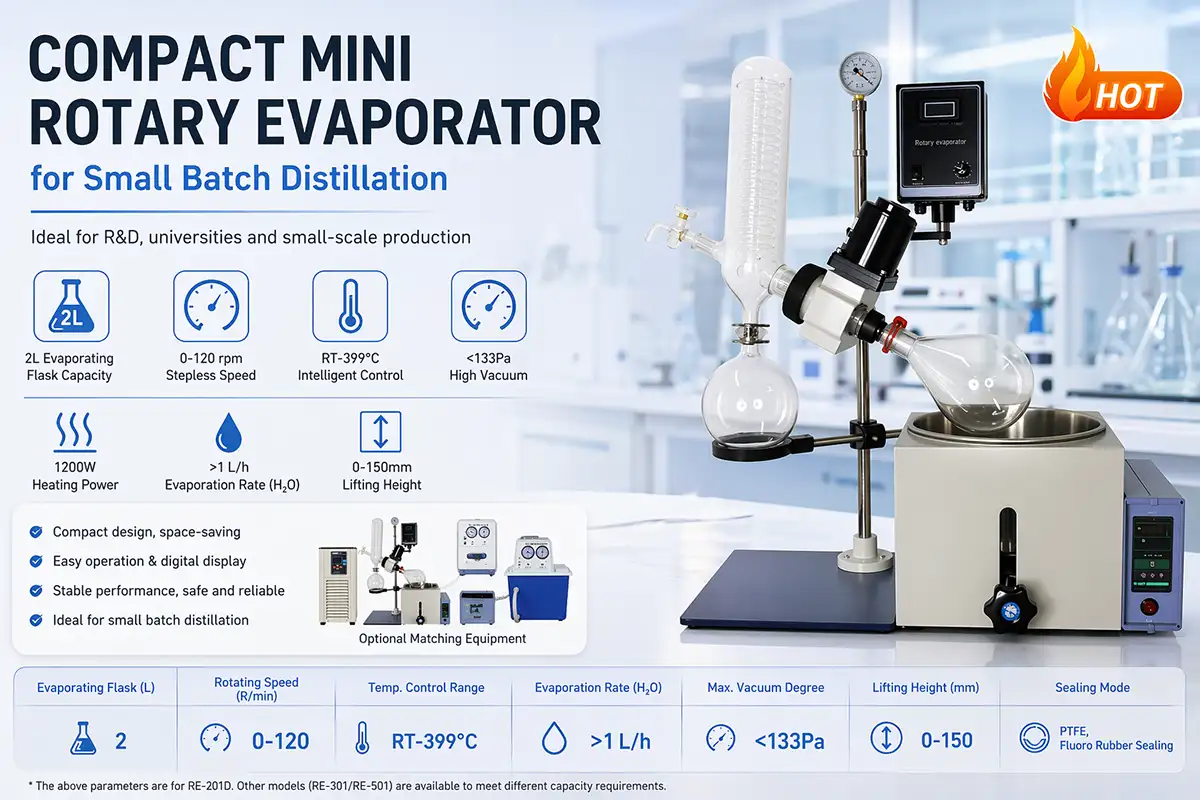
| RE-201D | 2L | 1L | 0-120 r/min, 40W stepless motor | 1200W | Intelligent digital, RT-399 deg C, +/-2 deg C | Low volume testing |
| RE-301 | 3L | 2L | 0-120 r/min, 40W stepless motor | 1500W | Intelligent digital, RT-399 deg C, +/-2 deg C | Routine sample prep |
| RE-501 | 5L | 3L | 0-120 r/min, 40W stepless motor | 1500W | Intelligent digital, RT-399 deg C, +/-2 deg C | Higher small batch throughput |
All three models list evaporation rates above 1L/H2O, with the RE-301 and RE-501 above 1.5L/H2O. The listed maximum vacuum degree is below 133 Pa, which supports efficient evaporation when paired with a suitable vacuum pump, condenser coolant, and properly chosen bath temperature.
What Makes a Mini Rotary Evaporator Efficient?
Efficiency in a compact lab rotary evaporator is not only about bath temperature. A stable vacuum, smooth rotation, condenser performance, and correct flask loading all matter. Overfilling the evaporating flask reduces surface area and increases bumping risk. Under-cooling the condenser can waste solvent vapor. Running too much heat can damage sensitive analytes.
A good analytical testing setup usually keeps the evaporating flask below half full, adjusts rotation to form a broad thin film, starts vacuum gradually, and matches the bath temperature to the solvent rather than forcing a single setting for every run. KD's practical guide on how to use a rotovap is useful for labs that want a repeatable operating routine.
Pricing Guide for Compact Lab Rotary Evaporators
For a compact analytical testing lab, the most relevant pricing band in the product list is the 5L mini and lab vacuum rotary evaporator group. Where several similar 5L listings appear, the practical mid-low reference price is $1,700. This keeps the estimate realistic while avoiding the very lowest isolated listing and the higher bundle or large capacity systems.
| Product Type | Relevant Listing Signal | Reference Price | Recommended For |
|---|---|---|---|
| 5L mini electronic rotary vacuum evaporator | 5L mini electronic rotary vacuum evaporator and 5L lab vacuum rotary evaporator set | $1,700 | Analytical testing labs needing compact daily solvent removal |
| 5L hot sale lab distiller rotating evaporator | Small laboratory distillation and sample concentration | $1,695 | Budget conscious labs comparing compact entry options |
| KD rotary evaporator bundle | Rotary evaporator with chiller and vacuum pump package | $1,900 | Labs starting a complete evaporation station |
A 5L compact system is often the best value when sample volume is changing from week to week. Smaller glassware is easier to manage, while the 5L platform leaves enough capacity for repeated testing, solvent exchange, and small production validation.
Recommended Workflow for Analytical Sample Preparation
A compact mini rotary evaporator performs best when the workflow is controlled. Analytical labs can improve repeatability by treating evaporation as a method step rather than a rough finishing task.
Prepare the sample and choose the flask
Select a flask that leaves enough headspace. For most analytical testing, the evaporating flask should not be filled beyond half capacity.
Set bath temperature according to solvent behavior
Use enough heat to support stable vapor formation, but avoid unnecessary thermal stress on target compounds.
Start rotation before applying full vacuum
Rotation spreads the sample into a thin film, improving heat transfer and reducing bumping risk.
Control condensation and recovery
Keep condenser coolant appropriate for the solvent. Better condensation protects the vacuum pump and improves solvent recovery.
When to Move from 2L to 5L
A 2L rotary evaporator is compact and precise, making it a good match for method development, teaching demonstrations, or low volume quality testing. The move to 5L becomes worthwhile when batches repeat frequently, when receiving capacity slows the workflow, or when several analysts share the same evaporation station.
For labs still comparing the basic purpose and structure of a rotovap, KD's article on what a rotovap does and how it works provides a helpful background before selecting capacity.
Selection Checklist for a Testing Lab
Before choosing a compact mini rotary evaporator, compare the equipment against the real laboratory routine. The best unit is not always the smallest one. It is the one that removes solvent cleanly, fits the bench, supports the required throughput, and leaves room for safe operation.
Capacity: choose 2L for low volume precision, 3L for routine testing, or 5L for higher small batch throughput.
Vacuum control: pair the evaporator with a pump that can reach the required vacuum range without unstable pulsing.
Condensation: match coolant temperature and condenser capacity to solvent volatility.
Temperature range: the RE small series supports intelligent digital control from room temperature to 399 deg C with +/-2 deg C resolution.
Glassware handling: receiving flask size matters when solvent recovery is frequent or batches are repeated.
Footprint and lifting: make sure the unit can be operated safely under a hood or on a dedicated bench.
Build a Compact Solvent Removal Station Around the Right Rotovap
A compact mini rotary evaporator can become one of the most useful instruments in an analytical testing lab when capacity, vacuum, condenser cooling, and workflow are matched correctly. For small batch solvent removal, KD's 2L, 3L, and 5L lab rotary evaporator options provide a practical starting point, with the 5L category offering the strongest flexibility for frequent testing.
Review Compact Models