Durable Rotary Evaporator for Large Volume Chemical Synthesis
A reliable large-volume rotary evaporator helps synthesis laboratories remove solvents, concentrate products, recover valuable media, and prepare the next process step without exposing heat-sensitive compounds to unnecessary thermal stress.
What makes a rotovap suitable for large-volume synthesis?
The practical answer is a correctly sized evaporation flask, stable rotation, adequate bath power, strong condensation, chemical-resistant sealing, controlled vacuum, and a frame that remains steady under a heavy glass load. For routine pilot or production work, 10 L, 20 L, and 50 L systems cover very different batch sizes. The best choice is not simply the largest machine; it is the model that matches the normal charge volume, solvent load, available utilities, and required turnaround time.
Why rotary evaporation works well after chemical synthesis
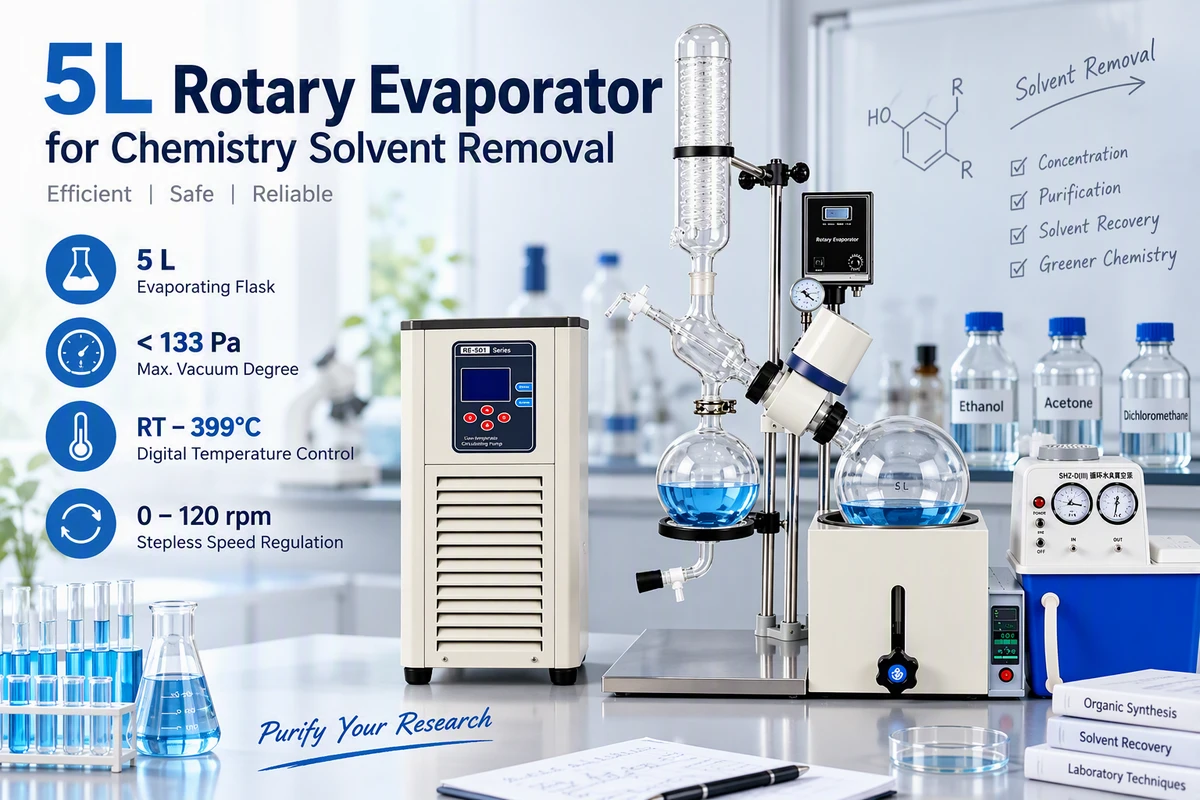
A rotary evaporator, also called a rotovap, removes volatile solvent under reduced pressure. Vacuum lowers the solvent’s boiling temperature, while flask rotation spreads the liquid into a thin film. That larger surface area supports faster heat transfer and steadier evaporation. Vapor then moves into the condenser, returns to liquid, and drains into the receiving flask.
This combination is valuable after extraction, reaction workup, crystallization preparation, intermediate concentration, and solvent exchange. It can be gentler than open boiling and makes solvent collection more practical. Readers needing a simple process explanation can review this guide to rotary evaporator chemistry.
Durability features that matter in daily production
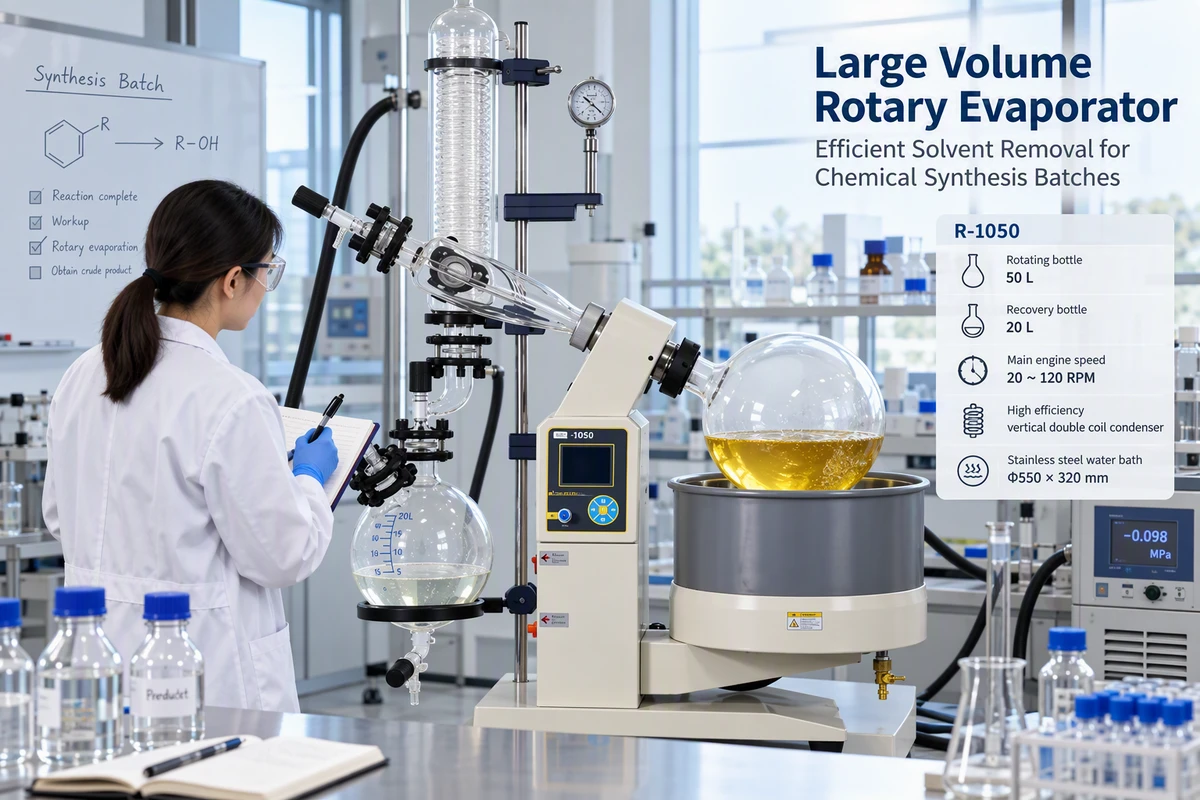
Mechanical durability also depends on details that specifications cannot fully summarize: balanced glassware, secure flask joints, corrosion-resistant bath construction, accessible clamps, guarded moving parts, and a lifting mechanism that moves predictably. A durable rotary evaporator for large volume chemical synthesis should make inspection simple because small seal, bearing, hose, or glass defects are easier to correct before they cause downtime.
Consumable availability is equally important. A strong frame offers little value if a worn seal or damaged flask cannot be replaced promptly. This overview of rotary evaporator parts explains the components most likely to require inspection or replacement.
Large-volume rotary evaporator technical specifications
The following provided parameters make the scale difference clear. Rated evaporation values use water and should not be treated as guaranteed rates for every solvent or formulation. Viscosity, vapor pressure, solids content, coolant conditions, and operating setpoints change real performance.
| Parameter | RE-1002 | RE-2002 | RE-5002 |
|---|---|---|---|
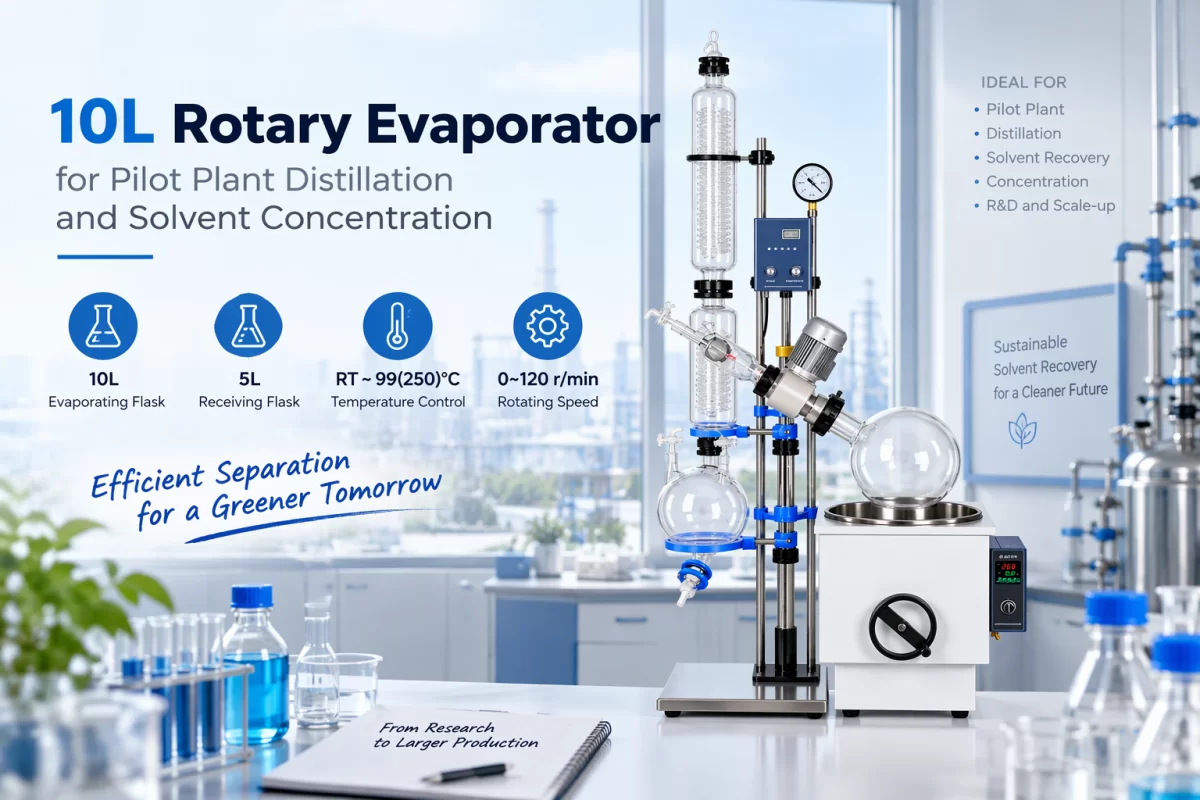
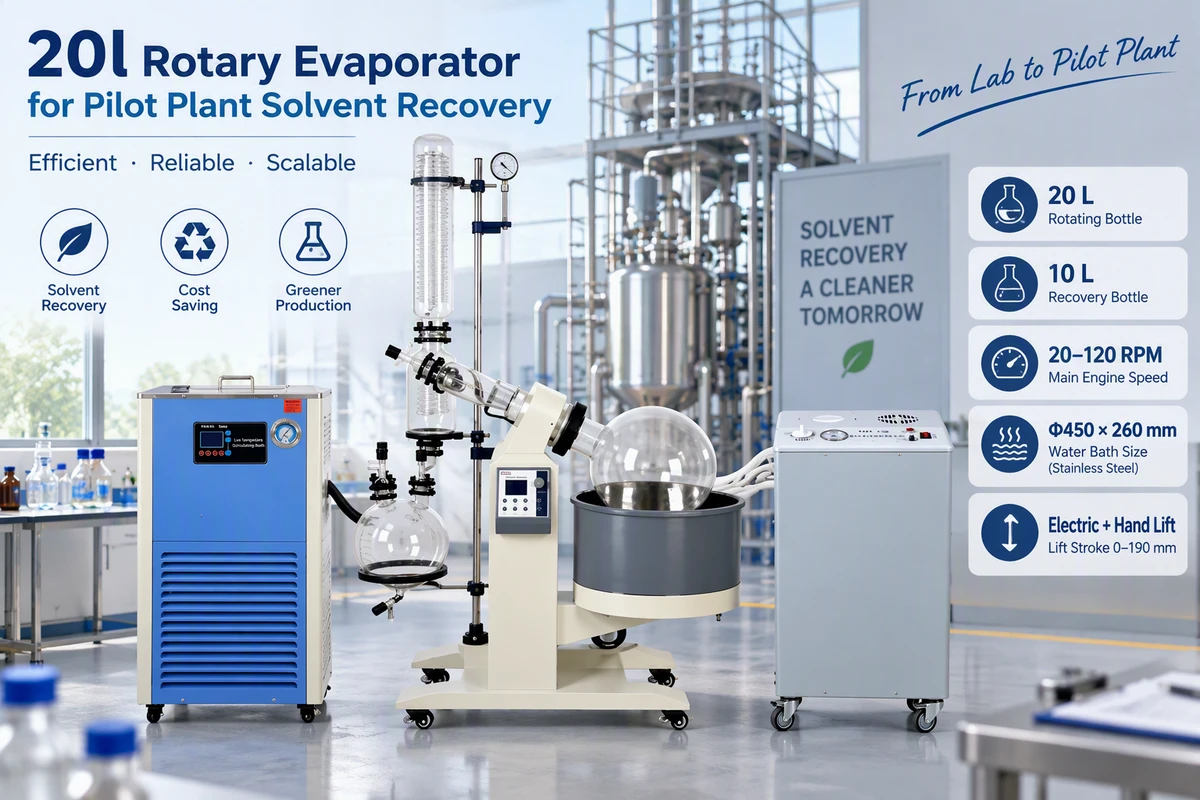
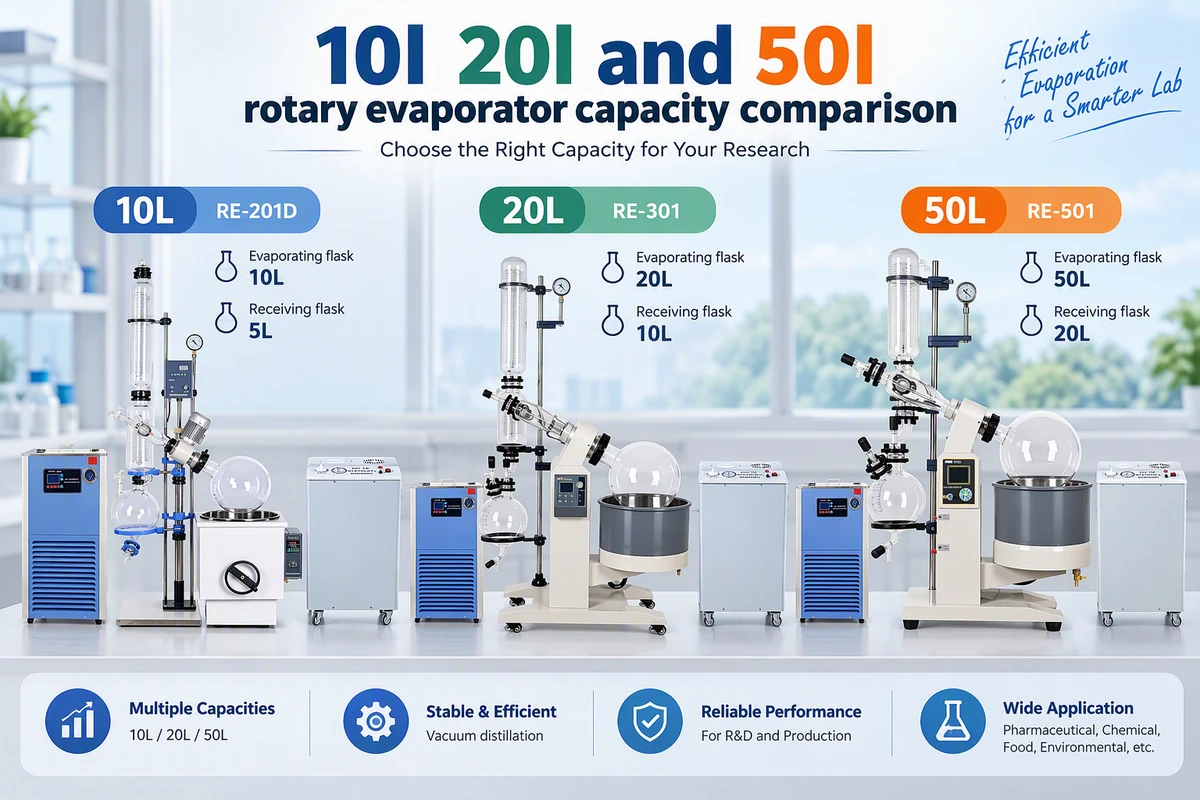
| Evaporating flask | 10 L | 20 L | 50 L |
| Receiving flask | 5 L | 10 L | 20 L |
| Rotating motor | 180 W | 250 W | 250 W |
| Rotating speed | 0–120 r/min | 0–120 r/min | 0–90 r/min |
| Bath power | 3000 W | 5000 W | 7000/9000 W |
| Temperature range | Room temperature to 99°C, with an optional/configured range to 250°C | ||
| Temperature fluctuation | ±1°C | ||
| Evaporation rate (H₂O) | >3 L/h | >5 L/h | >9 L/h |
| Condenser | Vertical double condenser | ||
| Lifting mode / height | Manual water/oil bath lifting, 0–220 mm | ||
| Voltage | 220 V / 50 Hz | 220 V / 50 Hz | 380 V / 50 Hz |
| Sealing | PTFE and fluoro-rubber sealing | ||
Electrical supply, bath medium, maximum allowable temperature, and local configuration must be confirmed before ordering or installation.
Selecting 10 L, 20 L, or 50 L for synthesis work
10 L for scale-up and moderate batches
The RE-1002 is a practical bridge between laboratory glassware and pilot processing. Its 10 L evaporating flask, 5 L receiver, 0–120 r/min range, and rated water evaporation above 3 L/h suit frequent medium batches where flexibility matters more than maximum throughput.
20 L for pilot plants and repeated processing
The RE-2002 adds a 20 L evaporation flask, 10 L receiver, 5000 W bath, and rated water evaporation above 5 L/h. It is a balanced option for synthesis teams that process larger solvent loads but do not require the footprint, three-phase service, or utility demand of a 50 L system.
50 L for bulk concentration and solvent recovery
The RE-5002 provides a 50 L evaporating flask, 20 L receiver, up to 7000/9000 W bath power, and rated water evaporation above 9 L/h. Its 380 V / 50 Hz requirement makes pre-installation electrical planning essential. More detail on large-scale use is available in the 50 L rotary evaporator guide.
A useful buying calculation begins with liters of solvent per batch, batches per shift, and acceptable processing hours. Next, check whether the condenser and chiller can remove the vapor load. Finally, confirm receiver capacity and whether safe draining or receiver exchange is possible during long runs. Buying a powerful bath without sufficient cooling merely moves the bottleneck to the condenser.
Vacuum, cooling, safety, and maintenance
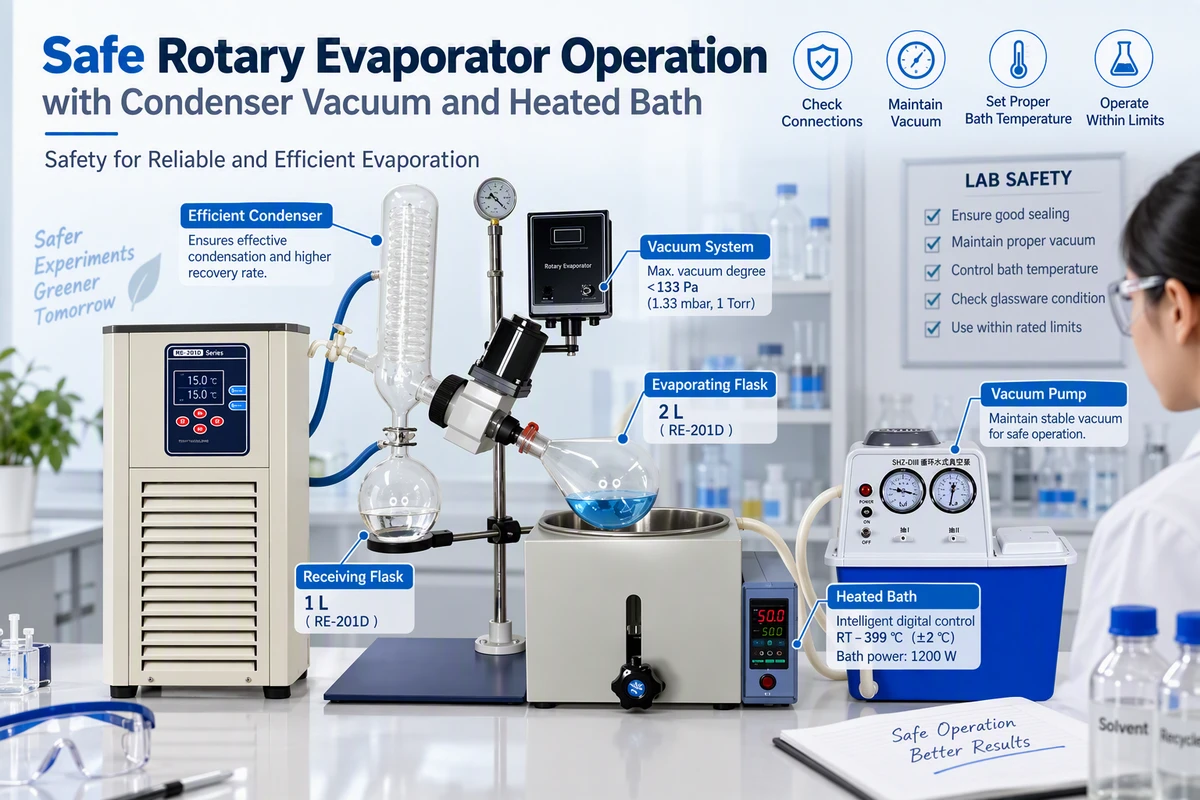
Vacuum should be lowered gradually until controlled boiling begins. Applying maximum vacuum immediately can cause bumping, foaming, product carryover, or a sudden condenser load. Rotation should create a stable film without splashing. Bath temperature should remain only as high as needed to maintain the target rate, and coolant should be cold enough to condense the incoming vapor.
Routine care protects both throughput and glassware. Use a written inspection schedule rather than waiting for vacuum loss. The most useful checks include:
Inspect evaporation and receiving flasks for chips, scratches, star cracks, or chemical attack before every run.
Clean and examine PTFE and fluoro-rubber sealing surfaces; replace components that are deformed, swollen, hardened, or leaking.
Check vacuum tubing, coolant hoses, clamps, and joints for secure connection and compatible materials.
Keep the rotating load balanced and stop the drive if vibration or unusual noise develops.
Remove bath contamination and verify temperature indication through the facility’s calibration or verification program.
Use a trap where required to protect the vacuum pump from condensed solvent or process carryover.
A practical final decision
A durable large-volume rotovap should be purchased as a complete process system, not as an isolated flask and bath. Confirm the normal and maximum batch size, solvent compatibility, target recovery rate, vacuum controller, pump resistance, condenser design, chiller capacity, electrical supply, ventilation, installation space, glassware handling method, and replacement-part availability.
For moderate scale-up, the 10 L model offers flexibility and lower utility demand. For recurring pilot batches, the 20 L model provides a strong capacity-to-infrastructure balance. For bulk chemical synthesis work and high solvent loads, the 50 L model delivers the highest listed water evaporation rate, but it also needs more power, cooling, space, and disciplined handling.
The most dependable result comes from matching every subsystem. Stable rotation creates the film; controlled vacuum lowers boiling temperature; bath power supplies energy; the condenser removes that energy; and sound seals keep the process closed. When those elements are correctly sized and maintained, a rotary evaporator can become a durable, repeatable workhorse for concentration and solvent recovery after large-volume chemical synthesis.
Plan a complete large-volume rotary evaporation system
Prepare the solvent list, batch volume, desired cycle time, utility details, and temperature limits before requesting a configuration. These details make model, chiller, vacuum pump, and accessory selection far more accurate.
Review a 10 L rotary evaporator