How to Buy Complete Rotovap Setup With All Parts?
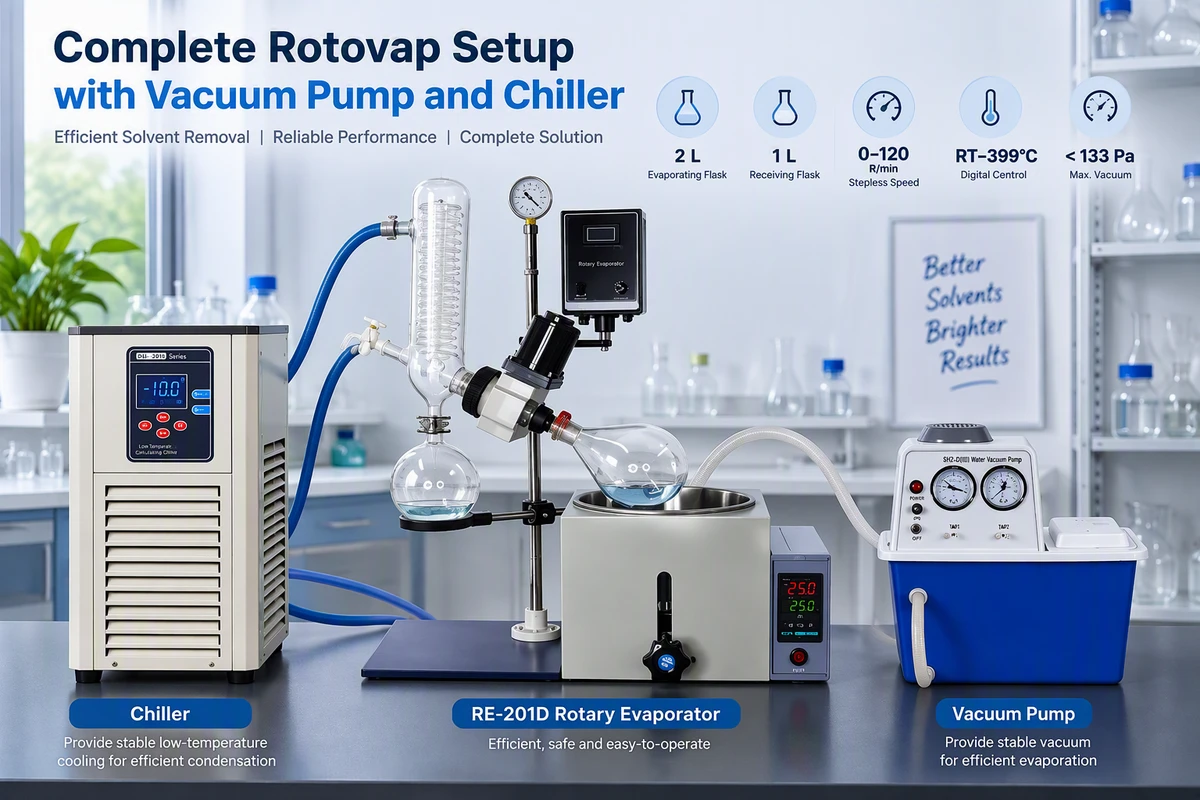
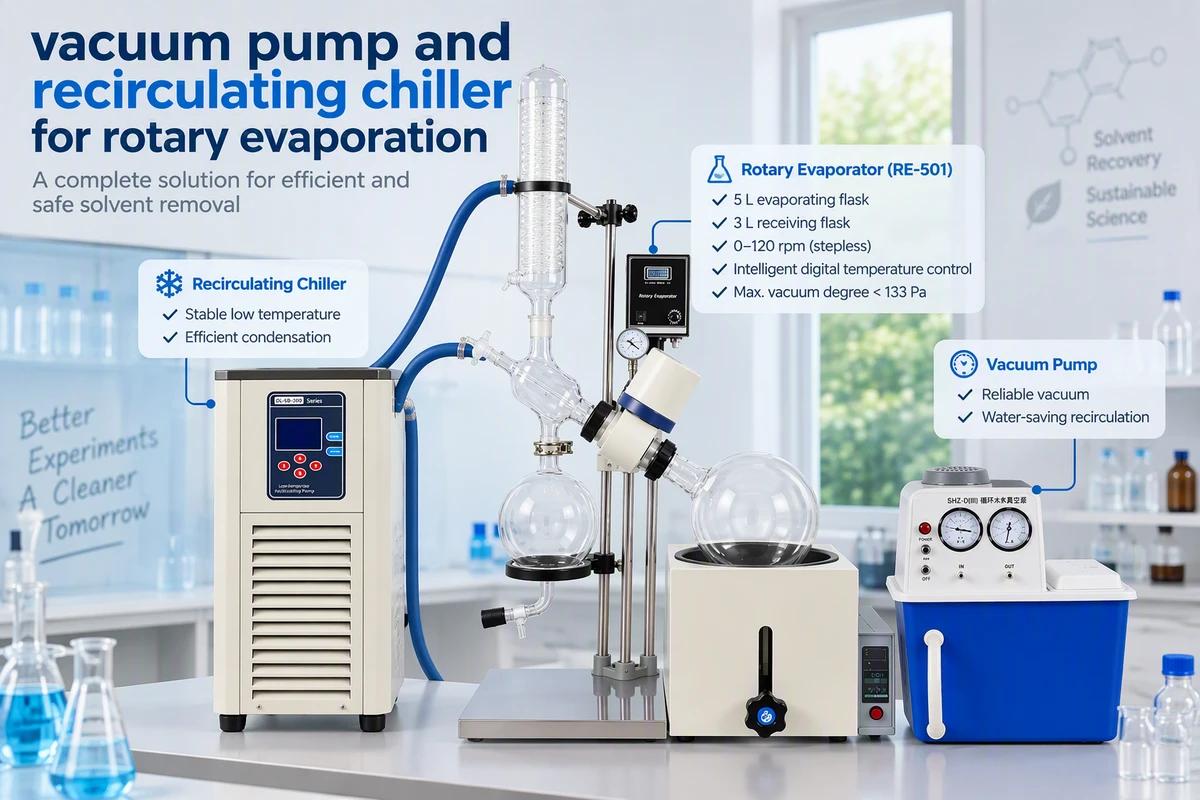
A complete rotovap setup is more than a rotating flask and water bath. It is a matched solvent-removal system that includes evaporation, vacuum, cooling, collection, connections, and safety accessories.
Buying a complete rotovap setup should begin with the process, not with the lowest equipment price. The solvent, batch volume, desired evaporation speed, available voltage, cooling-water temperature, and required final vacuum determine which parts belong together. A low-cost rotary evaporator can become expensive if a vacuum pump is chemically incompatible, the chiller is too small, or the glass joints do not match.
For a straightforward purchase, ask for one itemized system quotation and confirm every connection before shipment. The quotation should identify the rotary evaporator, vacuum pump, recirculating chiller, vacuum controller or regulator, glassware, seals, tubing, clamps, adapters, power requirements, and spare consumables. For a closer look at component names and functions, use this guide to rotary evaporator parts.
What Must a Complete Rotovap Setup Include?
Rotary evaporator body
The drive motor, vapor duct, lifting mechanism, bath, support frame, flask clamp, and condenser form the working core.
Evaporating and receiving flasks
At least one evaporation flask and one receiving flask are required. Confirm usable fill volume, joint size, glass thickness, and coating options.
Chemical-resistant vacuum pump
The pump must reach the target pressure while tolerating the solvent vapor that may pass through the condenser.
Recirculating chiller
Cooling capacity must be rated at the intended operating temperature, not only at room temperature. Include insulated supply and return hoses.
Vacuum measurement and control
A gauge shows system pressure; a controller or regulating valve stabilizes evaporation and helps prevent bumping and foaming.
Small but essential parts
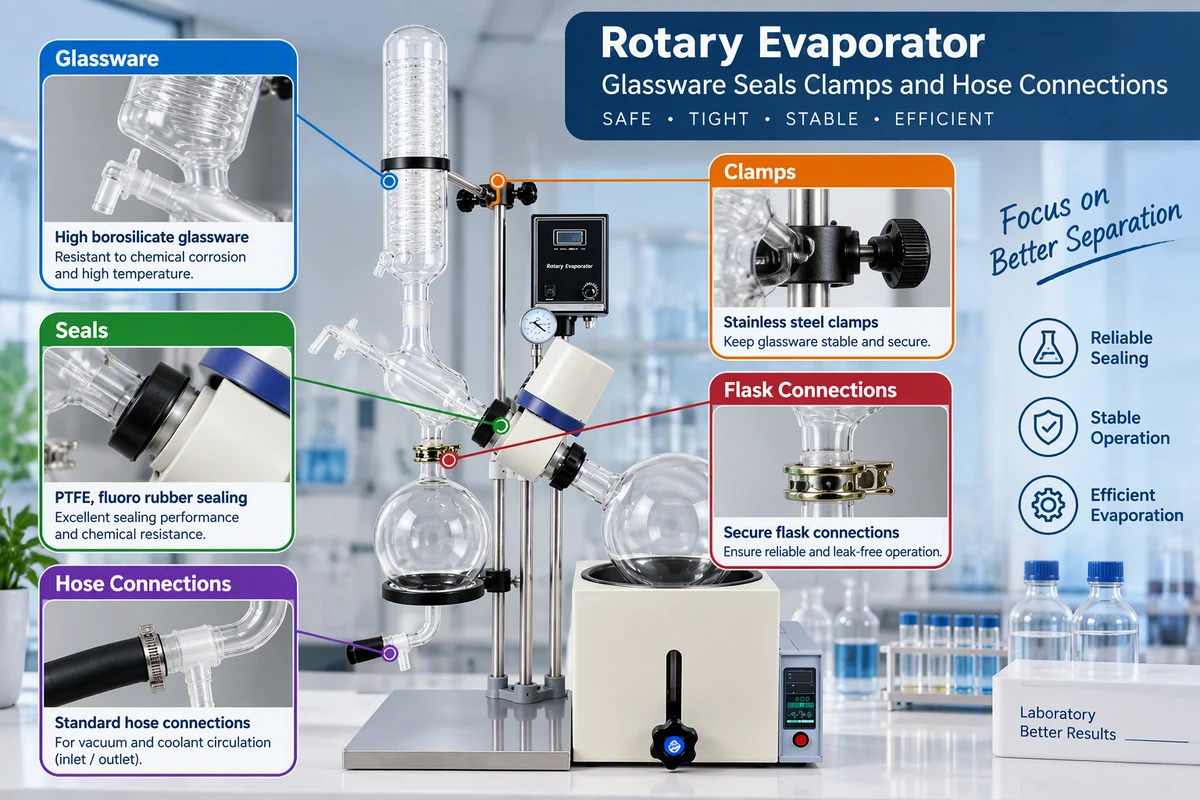
PTFE seals, fluoro-rubber seals, clips, clamps, feed tube, vacuum hose, drain hose, adapters, fuses, and spare gaskets complete the package.
My answer: no. Many listings cover only the evaporator, bath, condenser, and standard glassware. I recommend treating any offer as incomplete until the quotation names the pump model, ultimate vacuum, flow rate, wetted materials, and hose size.
Choose Flask Capacity From the Real Batch Volume
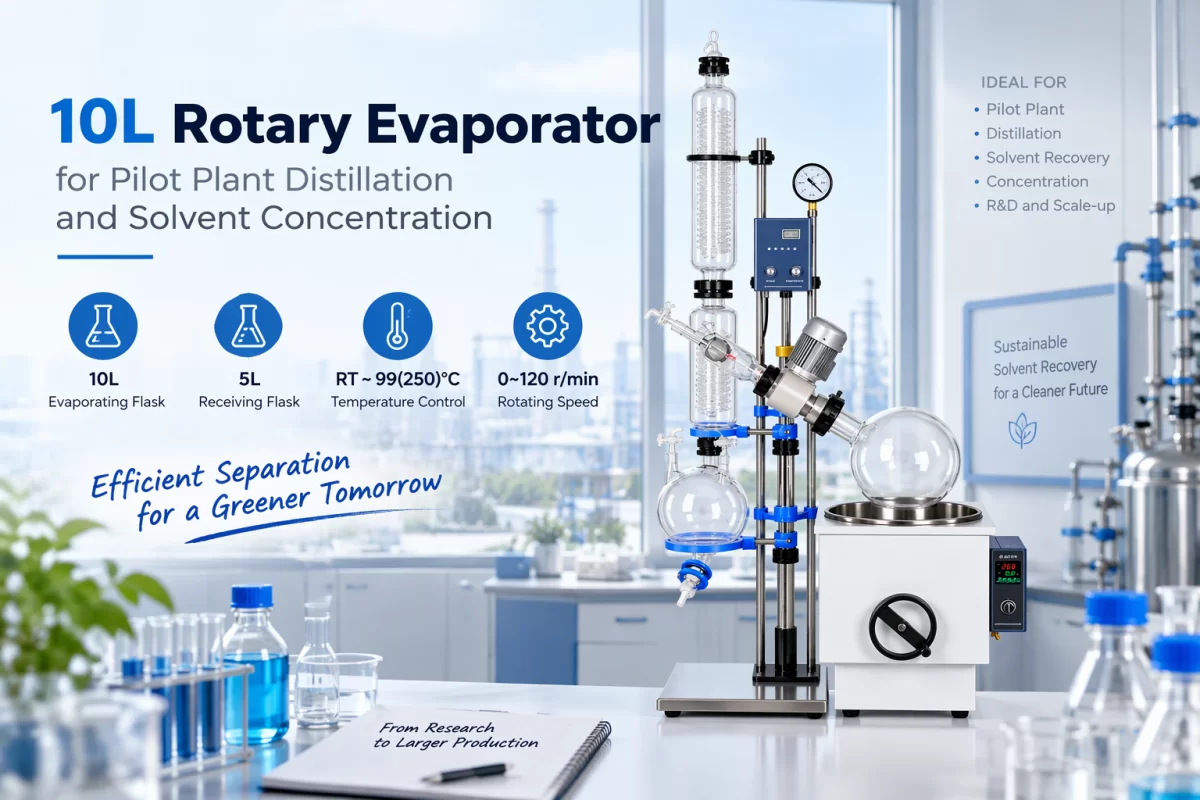
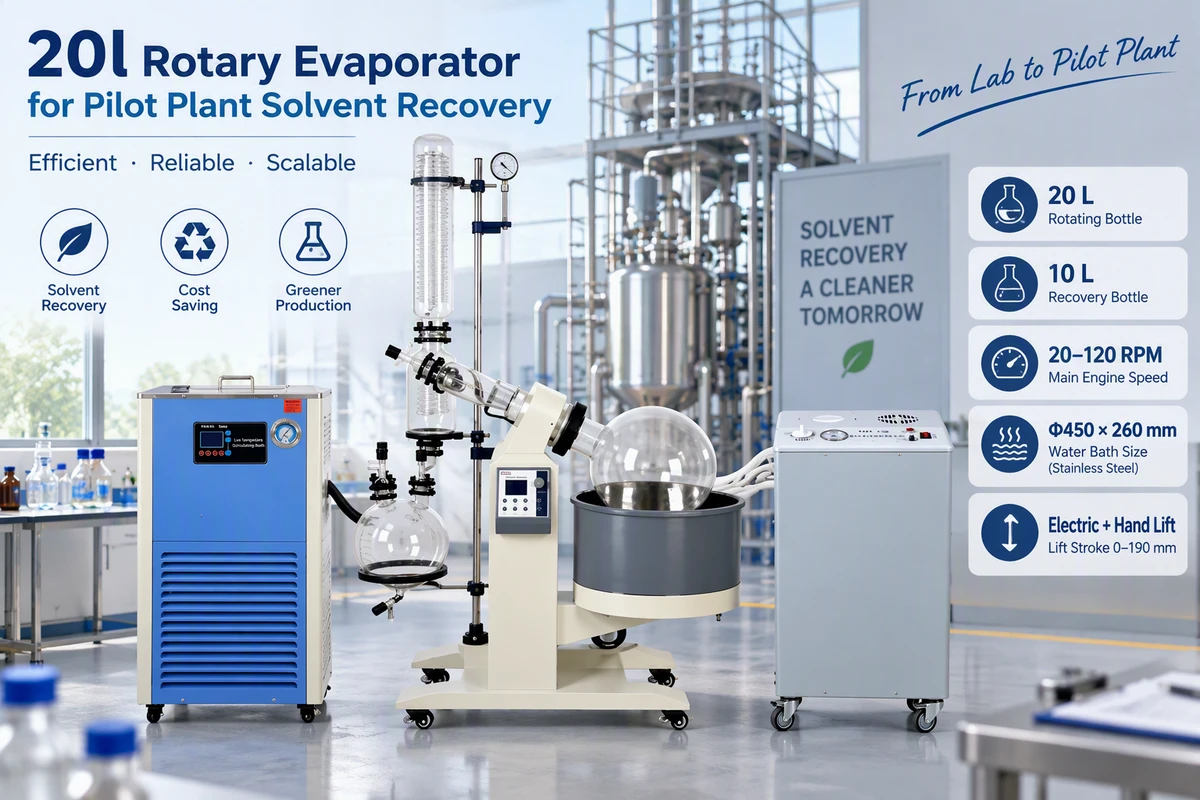
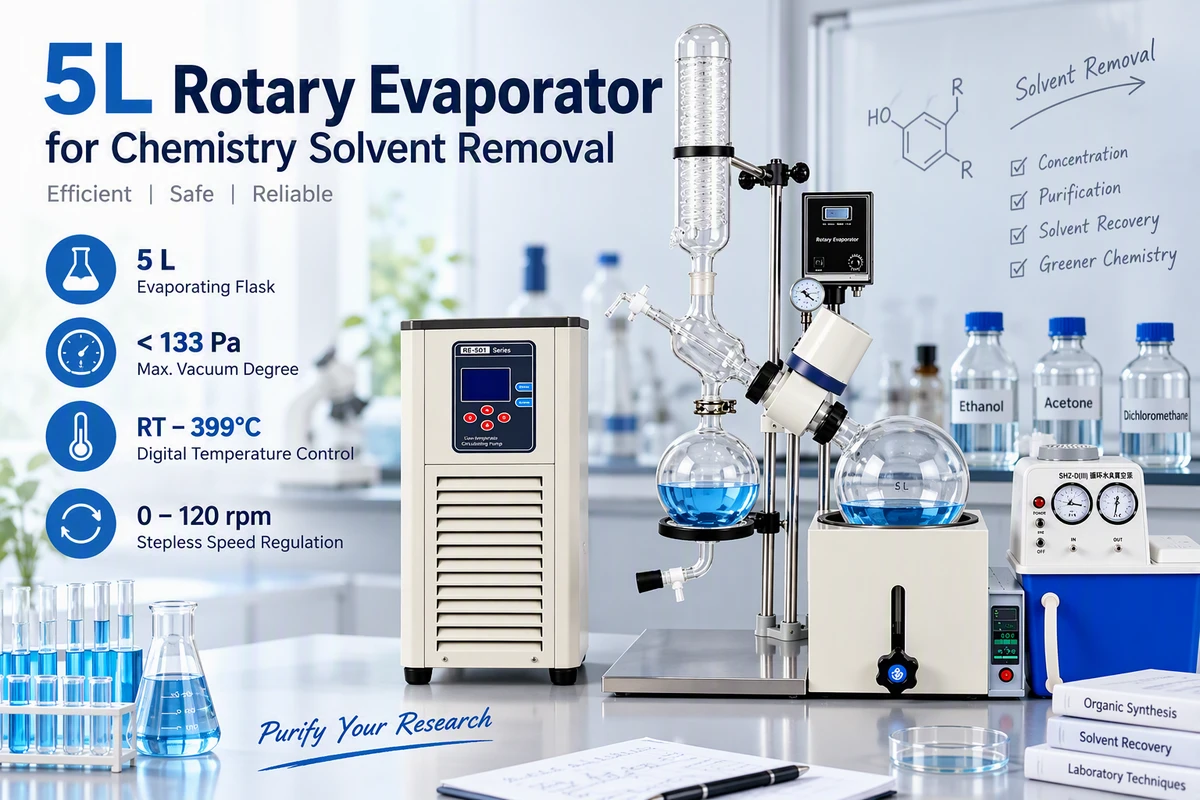
An evaporation flask needs open space for vapor formation and safe rotation. Filling a flask to its nominal capacity encourages splashing, carryover, and unstable boiling. As a practical starting point, select a flask substantially larger than the liquid charge and adjust for foaming behavior. A 2 L model is useful for small research batches, while 5 L units suit routine laboratory processing. Capacities of 10 L, 20 L, and 50 L serve pilot and production work.
The provided equipment ranges cover 2 L, 3 L, and 5 L benchtop configurations as well as 10 L, 20 L, and 50 L scale-up systems. Reported water evaporation rates rise from more than 1 L/h on the 2 L model to more than 9 L/h on a 50 L model under specified conditions. Actual solvent throughput changes with boiling point, bath temperature, vacuum stability, condenser temperature, flask loading, and heat-transfer area.
My answer: choose from the largest normal batch rather than the smallest trial. I would also check receiving-flask capacity and discharge frequency. A large evaporating flask paired with an undersized receiver interrupts work and increases handling.
How to Match the Vacuum Pump, Chiller, and Condenser
Vacuum selection: pressure should be low enough to bring the solvent to a gentle boiling point below the product’s damage temperature. Pump flow also matters because air leaks and vapor load must be removed continuously. The listed RE-201D, RE-301, and RE-501 systems specify a maximum vacuum below 133 Pa under suitable conditions, but the complete system can only approach that value when the pump, seals, glass joints, and hoses are leak-tight. A dedicated guide to choosing a vacuum pump for a rotovap explains chemical resistance and pressure control in more detail.
Cooling selection: the condenser must remove the heat carried by solvent vapor. Ask the supplier for cooling capacity in watts at the required coolant temperature and for the recommended flow rate. For volatile solvents, colder coolant may improve recovery, but extremely cold operation is not automatically better; it can add energy cost and condensation on external surfaces. A vertical double condenser is listed for the 10–50 L RE series, while R-series configurations use vertical double-coil or high-efficiency main-and-side condenser arrangements depending on size.
Temperature and pressure context: the National Institute of Standards and Technology lists ethanol’s normal boiling point at approximately 78.4°C. A rotovap lowers the boiling temperature by reducing pressure, allowing gentler solvent removal. This is why a stable vacuum controller is usually more valuable than simply choosing the pump with the deepest possible vacuum.
Useful Specifications to Compare Before Buying
The table below condenses key values from the supplied technical parameter sheets. It is a selection guide rather than a performance guarantee; final specifications should be confirmed on the commercial quotation.
| Model | Evaporating Flask | Receiving Flask | Speed | Bath Power | Water Evaporation Rate | Lift |
|---|---|---|---|---|---|---|
| RE-201D | 2 L | 1 L | 0–120 rpm | 1200 W | >1 L/h | 0–150 mm |
| RE-301 | 3 L | 2 L | 0–120 rpm | 1500 W | >1.5 L/h | 0–120 mm |
| RE-501 | 5 L | 3 L | 0–120 rpm | 1500 W | >1.5 L/h | 0–120 mm |
| RE-1002 | 10 L | 5 L | 0–120 rpm | 3000 W | >3 L/h | 0–220 mm |
| RE-2002 | 20 L | 10 L | 0–120 rpm | 5000 W | >5 L/h | 0–220 mm |
| RE-5002 | 50 L | 20 L | 0–90 rpm | 7000/9000 W | >9 L/h | 0–220 mm |
Mobile tip: swipe horizontally to view all specification columns.
Check Power, Materials, and Installation Space
Electrical compatibility must be confirmed before ordering. Small systems may use single-phase power, while large baths can require three-phase service. The supplied R-series sheet lists single-phase 220 V/60 Hz for smaller configurations and three-phase 220–240 V or 380 V/60 Hz for larger equipment. The RE-1002 and RE-2002 list 220 V/50 Hz, while the RE-5002 lists 380 V/50 Hz. Never assume that a plug adapter can solve a voltage, phase, frequency, or current mismatch.
Also measure bench width, ceiling clearance, doorway width, and service access. R-series outline dimensions increase from 660 × 400 × 1020 mm for the R1005 to 1320 × 770 × 2340 mm for the R1050. Leave room to raise the lift, remove the flask, route hoses without kinks, and safely empty the receiver.
For solvent-contact components, request borosilicate glass and verify seal chemistry. The provided models use PTFE and fluoro-rubber sealing. PTFE offers broad chemical resistance, while elastomer compatibility depends on the solvent and temperature. Ask for an exploded diagram and part numbers so replacement rotovap parts can be ordered without measuring every joint later.
My answer: not by itself. Throughput is useful only when recovery efficiency, product temperature, vacuum stability, cleaning time, and operator safety remain acceptable. I prefer a controllable system with spare-part support over an oversized system that runs poorly at the normal batch volume.
What to Put in the Request for Quotation
Solvent names, mixtures, approximate boiling range, and any corrosive components
Normal and maximum liquid volume per batch
Target processing time and expected daily batches
Maximum acceptable product temperature
Required flask capacity, receiving capacity, and condenser style
Vacuum pump model, flow, ultimate pressure, wetted materials, and noise level
Vacuum gauge/controller range and connection sizes
Chiller cooling capacity at the requested temperature, reservoir size, and pump flow
All glassware, seals, clamps, feed tubes, vacuum hoses, coolant hoses, and adapters
Local voltage, phase, frequency, plug type, and total connected power
Spare seal set, spare flask, warranty, manuals, packing method, and commissioning support
For first-time operation, request a leak-test procedure, assembly drawing, recommended starting pressure, bath-temperature limits, and shutdown sequence. Review the practical guide on how to use a rotovap before training operators. Never rotate damaged glassware, close a system without a pressure-relief path, or use unknown tubing with aggressive solvent vapor.
Final Buying Advice
The best complete rotovap setup is the smallest properly engineered system that handles the largest routine batch with safe headspace and reasonable processing time. Match the pump to solvent chemistry and pressure, match the chiller to the real heat load, confirm every glass joint and hose, and verify facility power before purchase. Ask for a line-by-line quotation instead of accepting the phrase “complete set.” That simple step exposes missing controllers, adapters, spare seals, and utility equipment before they delay installation.
A complete rotary evaporator purchase should arrive ready for planned assembly, leak testing, and commissioning. When process details are supplied clearly, the equipment provider can recommend a balanced package rather than a collection of unrelated parts.
Build a Complete Rotovap Package
Prepare the solvent list, batch size, target temperature, available power, and throughput goal. These five details make equipment sizing and quotation comparison faster and more accurate.