How to Choose a Rotary Evaporator for Chemistry?
Choosing the best rotary evaporator is easier when the decision starts with the actual chemistry: batch volume, solvent boiling point, heat sensitivity, required throughput, and available vacuum and cooling utilities.
Start With the Separation, Not the Machine
A rotary evaporator, often called a rotovap, removes volatile solvent by combining rotation, controlled heating, vacuum, condensation, and collection. Rotation forms a thin liquid film inside the evaporation flask. This creates a larger surface area and supports faster evaporation at a lower temperature than open boiling. For a clear explanation of the process, see this guide to rotary evaporator chemistry.
Before comparing equipment, write down the normal solvent, starting volume, desired final volume, acceptable product temperature, batches per day, and whether the sample foams or bumps. A heat-sensitive natural product needs stable low-pressure control and effective condensation. A robust aqueous mixture may instead need more bath power and patience because water has a high boiling point and high heat demand.
No. I select capacity around the routine batch. An oversized flask may form a poor working film with a small charge, consumes more bath energy, occupies more space, and requires larger cooling and vacuum support.
Choose a Flask Size That Leaves Working Space
The labeled evaporation-flask volume is not the recommended liquid charge. Empty space is needed for safe rotation, vapor movement, and foam expansion. For routine planning, a starting charge around 50–67% of flask capacity is a useful range. Foaming solutions should be kept nearer the lower end.
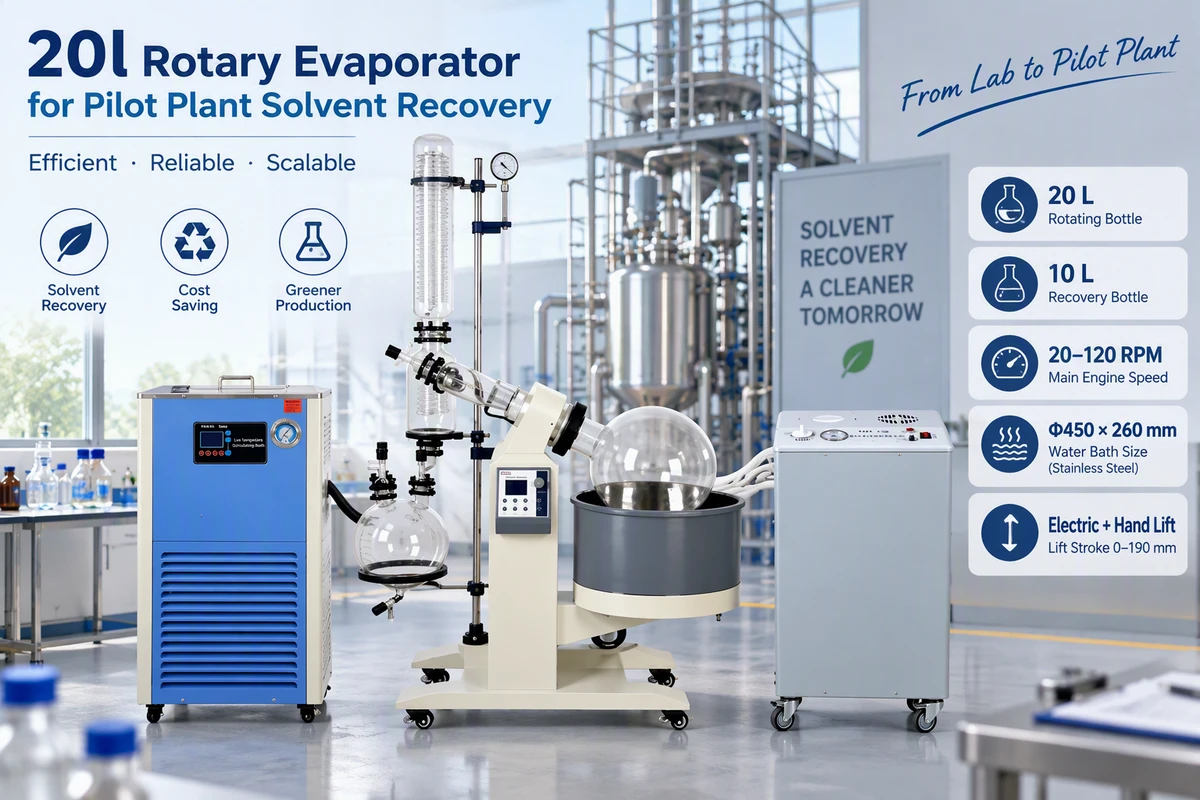
A 1 L chemistry batch normally fits a 2 L flask. A 2–3 L charge fits a 5 L unit. A 5–7 L charge points toward a 10 L rotary evaporator. The receiving flask must also hold the expected recovered solvent without interrupting the run. The available configurations pair 2, 3, 5, 10, 20, and 50 L evaporation flasks with 1, 2, 3, 5, 10, and 20 L receiving flasks respectively.
Match Vacuum, Bath, and Condenser Performance
Vacuum control
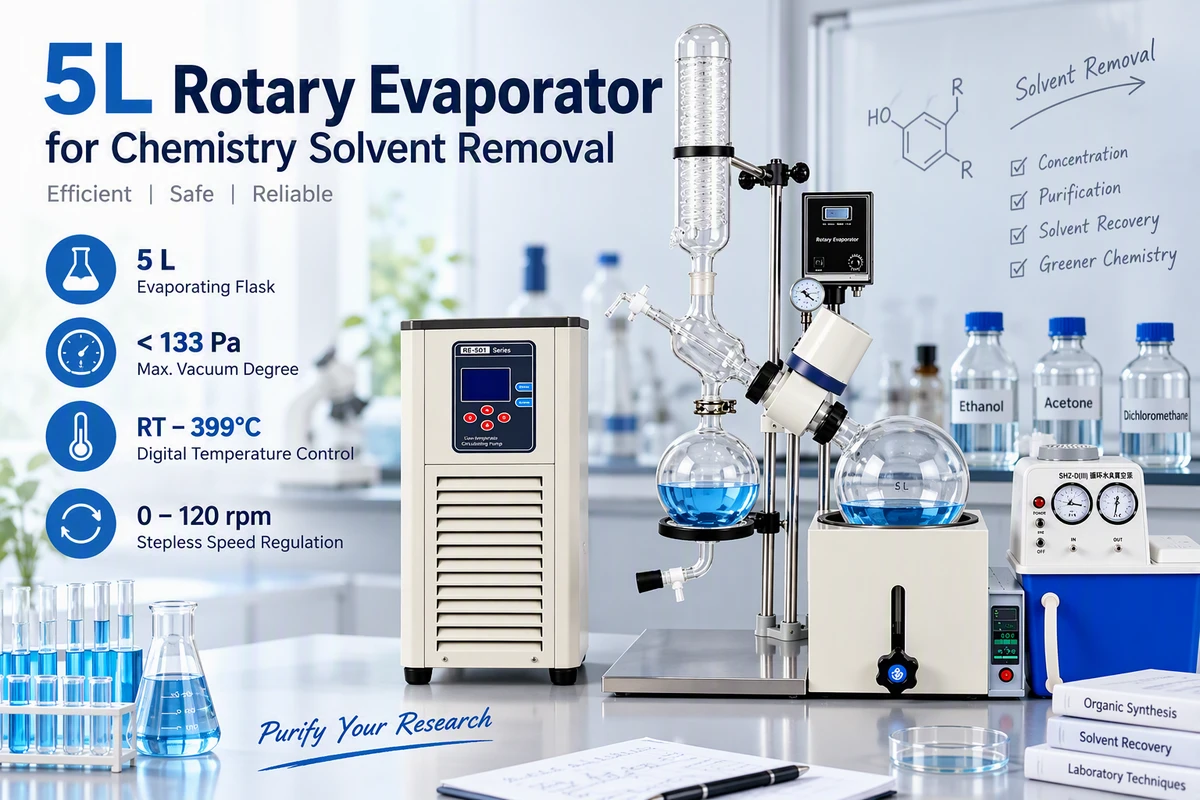
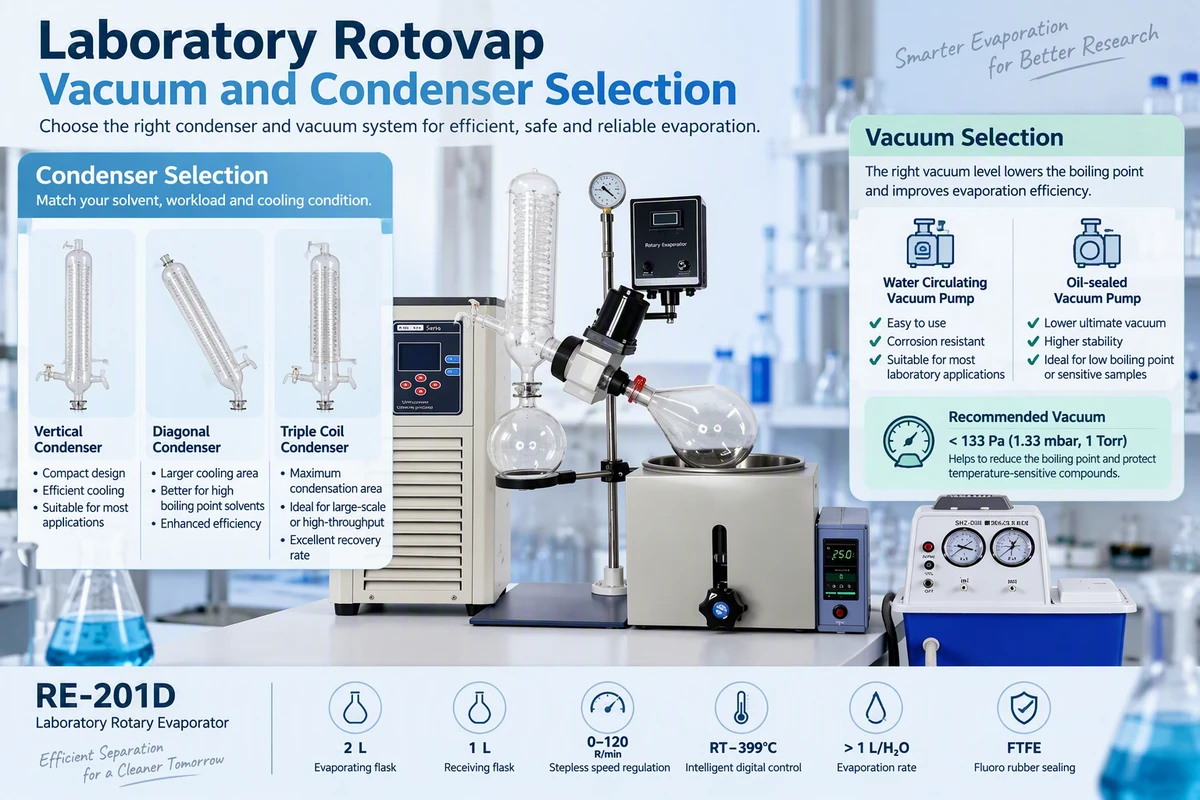
Vacuum reduces the boiling temperature, protecting sensitive compounds and accelerating solvent removal. Maximum vacuum alone does not guarantee good chemistry. Stable regulation is more useful because excessive vacuum can cause sudden boiling, bumping, solvent loss, or condenser overload. The RE-201D, RE-301, and RE-501 list a maximum vacuum below 133 Pa, equivalent to 1.33 mbar or 1 Torr, when the complete system is tight and the connected pump can achieve it. The correct pump must also tolerate the solvent vapor; this vacuum pump for rotovap guide explains the main choices.
Bath temperature and power
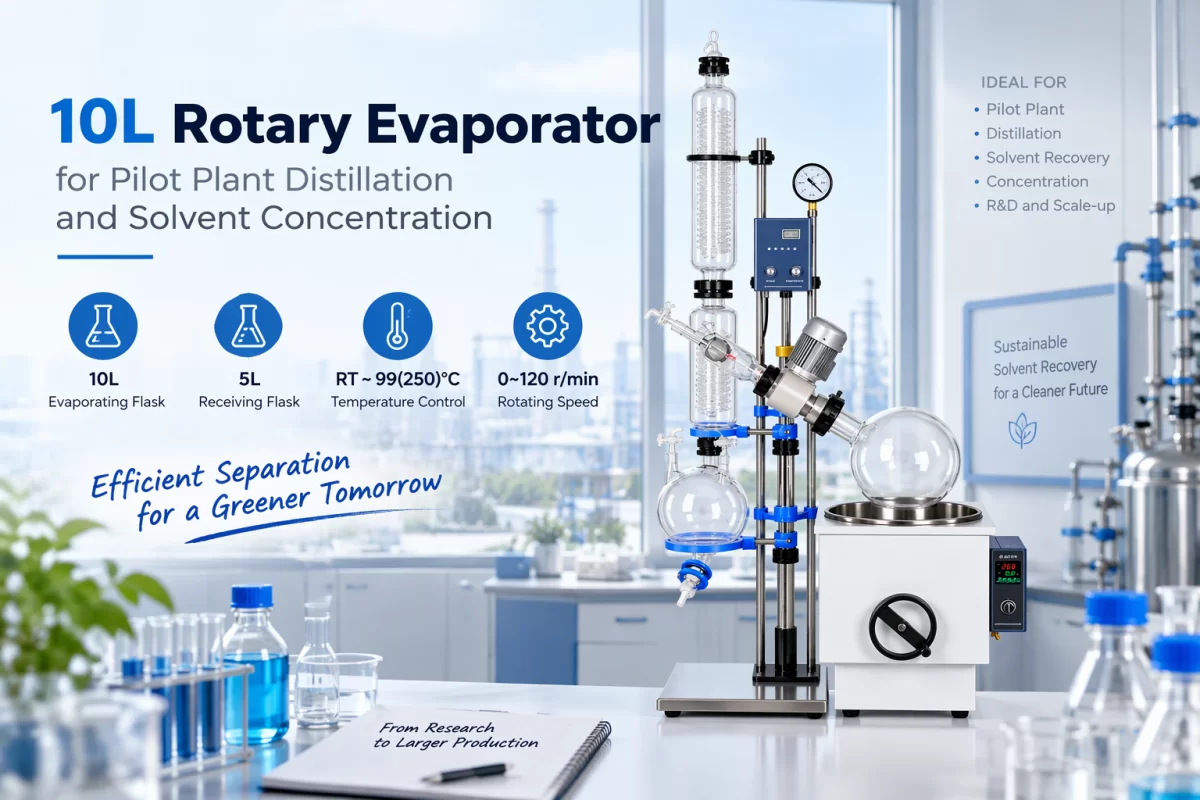
Use only enough bath heat to maintain steady evaporation. Small RE models provide 1200–1500 W bath power and an intelligent digital room-temperature-to-399°C stated control range with ±2°C resolution. The RE-1002, RE-2002, and RE-5002 provide 3000, 5000, and 7000/9000 W, with a room-temperature-to-99°C standard range or a 250°C oil-bath option and ±1°C fluctuation. Actual operating limits must follow the bath fluid, glassware, sample, and site safety procedure—not merely the controller range.
Cooling capacity
A condenser must remove heat from incoming vapor fast enough to return it to liquid. A vertical double condenser is specified on the 10–50 L RE series, while the R series uses vertical double-coil or high-efficiency main-and-side condenser arrangements. Select a recirculating chiller with adequate cooling power at the intended coolant temperature, not only a high flow-rate claim.
No. I recommend starting rotation and cooling first, then reducing pressure gradually while watching the sample. Controlled pressure reduction limits bumping and helps identify a stable evaporation point.
Compare Rotary Evaporator Specifications by Workload
The following published parameters provide a practical shortlist. Water evaporation rate is useful for comparing models under stated test conditions, but it is not a guaranteed rate for every solvent or process. Feed composition, pressure, bath temperature, rotation, condenser temperature, flask fill, fouling, and ambient conditions all affect real output.
| Model | Evap./Receive Flask | Speed | Motor | Bath Power | Water Rate | Lift | Best Fit |
|---|---|---|---|---|---|---|---|
| RE-201D | 2 L / 1 L | 0–120 rpm | 40 W | 1200 W | >1 L/h | 0–150 mm | Small research |
| RE-301 | 3 L / 2 L | 0–120 rpm | 40 W | 1500 W | >1.5 L/h | 0–120 mm | General lab |
| RE-501 | 5 L / 3 L | 0–120 rpm | 40 W | 1500 W | >1.5 L/h | 0–120 mm | Versatile bench use |
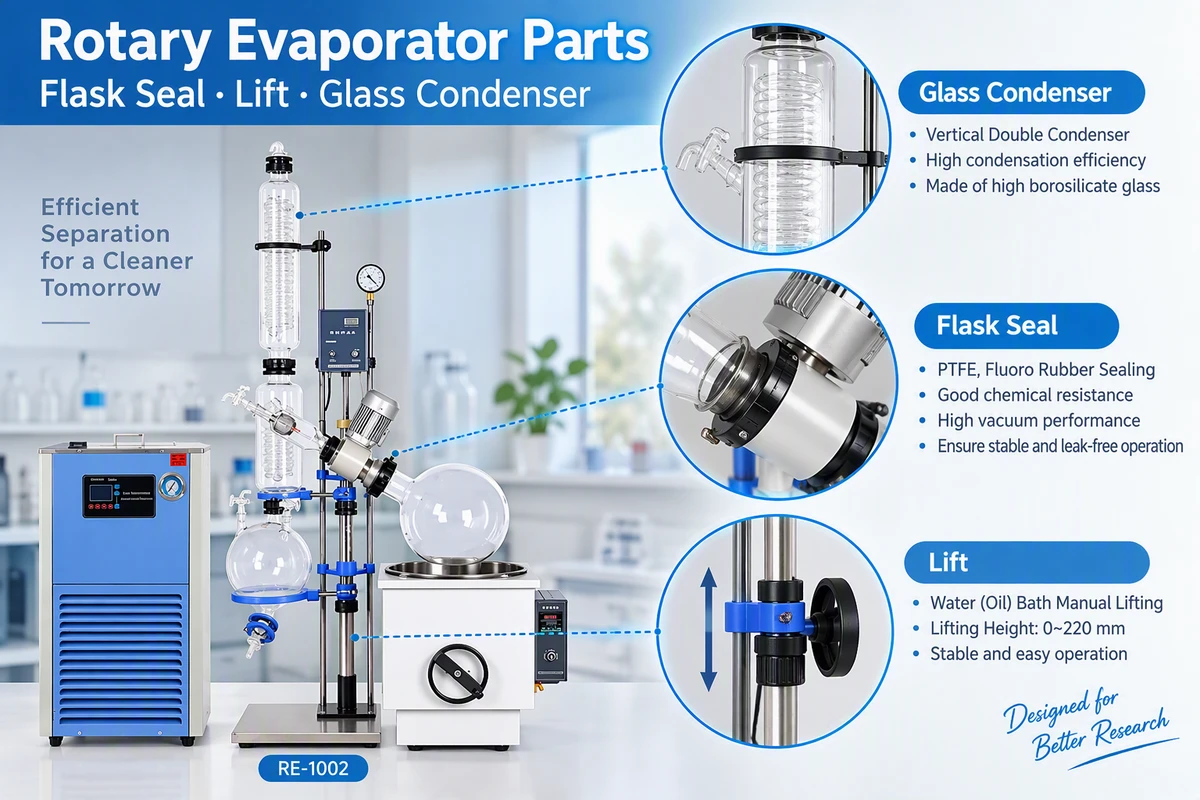
| RE-1002 | 10 L / 5 L | 0–120 rpm | 180 W | 3000 W | >3 L/h | 0–220 mm | Scale-up |
| RE-2002 | 20 L / 10 L | 0–120 rpm | 250 W | 5000 W | >5 L/h | 0–220 mm | Pilot chemistry |
| RE-5002 | 50 L / 20 L | 0–90 rpm | 250 W | 7000/9000 W | >9 L/h | 0–220 mm | Large batches |
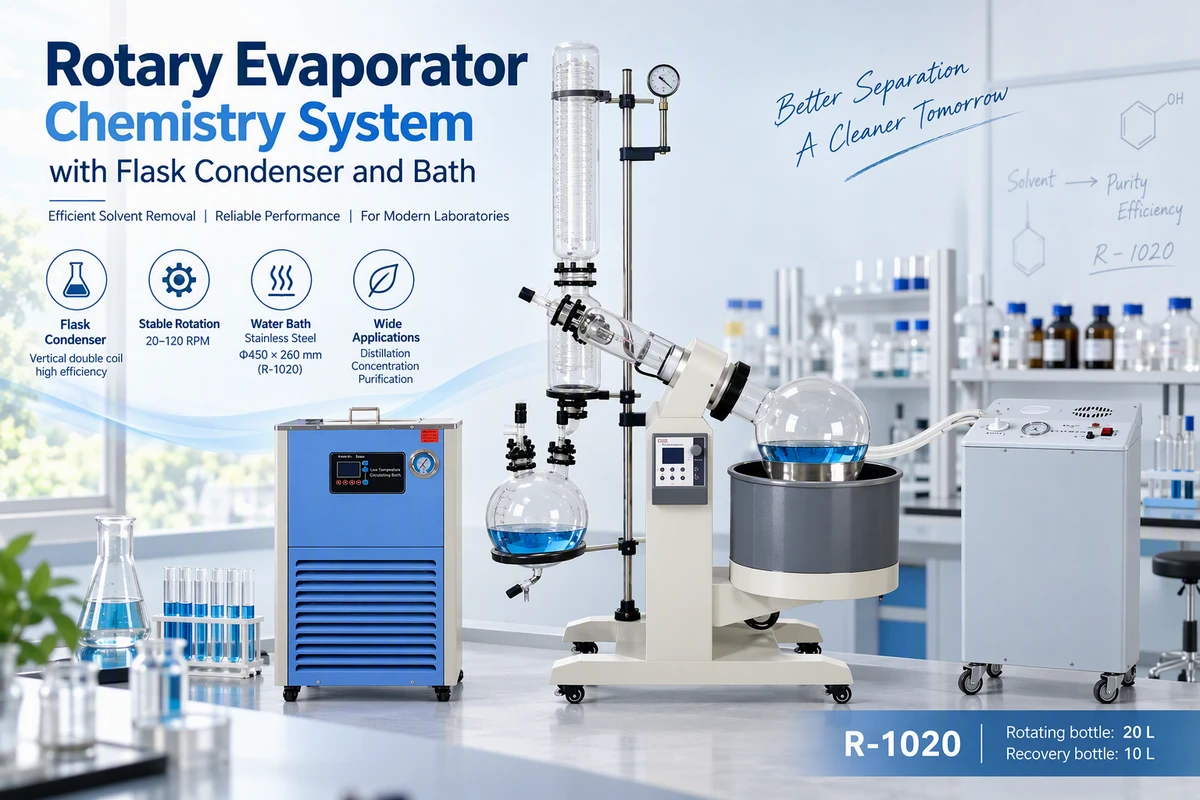
For users who prefer electric lifting, the R series offers 5, 10, 20, and 50 L rotating flasks. R1005 runs at 10–140 rpm with a 40 W motor, while R1010, R1020, and R1050 use a brushless 250 W motor and 20–120 rpm speed. Total rated power ranges from 2 to 4 kW. At the largest size, the R1050 measures approximately 1320 × 770 × 2340 mm, so doorway clearance, ceiling height, floor access, and service space must be checked before purchase.
Inspect Seals, Lift, Glassware, and Utilities
Reliable rotary evaporation depends on every connection. The listed systems use PTFE and fluoro-rubber sealing. Confirm that seals, hoses, gaskets, tubing, and pump wetted materials are compatible with the exact solvents and cleaning agents. A chemically attacked seal causes unstable pressure and contamination even when the pump is powerful.
Choose electric lift when frequent flask movement, repeatability, or emergency separation from the bath is important. Manual bath lifting can be straightforward and economical, but large glass assemblies require careful handling. Also confirm the availability and cost of rotary evaporator parts, especially evaporation flasks, receiving flasks, vapor ducts, clamps, seals, and condenser glassware.
I most often see cooling capacity and electrical service overlooked. A high-throughput rotovap cannot meet its potential if the chiller warms during the run or the laboratory cannot supply the required voltage, phase, and current.
A Simple Checklist for Choosing the Best Rotary Evaporator
Define the chemistry: list solvents, sample sensitivity, foaming risk, viscosity, and target concentration.
Size the flask: keep routine starting volume near 50–67% of nominal flask capacity.
Set the throughput: calculate liters per batch, batches per day, and acceptable run time.
Plan vacuum control: choose a compatible pump, regulator, gauge, trap, and vapor path.
Plan cooling: verify chiller capacity at the real operating temperature and expected vapor load.
Check the bath: match heating power and bath fluid to the process temperature.
Verify compatibility: review glass, PTFE, fluoro-rubber, tubing, and pump materials.
Confirm facilities: measure space and check voltage, frequency, phase, ventilation, drainage, and lifting access.
Plan safety: include shielding, inspections, pressure-release procedures, PPE, and solvent-specific risk controls.
Compare total ownership: include chiller, pump, controller, replacement glassware, seals, maintenance, and energy—not only the evaporator price.
For most chemistry laboratories processing less than about 3 L per batch, a 5 L machine offers a useful balance of flexibility and bench-scale control. A 2 L unit is more efficient for small analytical or synthesis samples. When routine charges exceed roughly 5 L, a 10 L or 20 L system reduces repeated loading. A 50 L rotary evaporator is justified by sustained large-volume demand and a facility ready to support it.
Choose a Complete Rotary Evaporation System
The right answer is not a flask size alone. Match the rotary evaporator, vacuum pump, controller, condenser, chiller, bath, seals, and receiving capacity to one defined chemistry workflow. This system-level approach improves solvent recovery, temperature control, repeatability, and long-term value.
Rotary Evaporator Solutions for Chemistry